.svg&w=384&q=75 "naujapitch logo")
Webb Defends VAR Decision on West Ham's Disallowed Equaliser Against Arsenal
Howard Webb has moved to shut down the debate over West Ham’s dramatic late “equaliser” against Arsenal, insisting VAR was right to rule it out and that David Raya had been clearly fouled.
The flashpoint came deep into stoppage time at the London Stadium. West Ham, trailing 1-0 and staring at a defeat that drags them deeper into trouble, thought they had snatched a lifeline when Callum Wilson bundled the ball home. The stadium erupted. Arsenal’s players froze. Then came the familiar pause.
VAR stepped in. And everything changed.
‘Categorically yes’: Webb backs the decision
On Match Officials Mic’d Up, Webb left no room for doubt when asked if Pablo had fouled Raya in the build-up.
“Is it a foul on the goalkeeper? Categorically yes,” he said. “We’ve said all season, including in pre-season briefings with the players, that if a goalkeeper is impeded by an opponent grabbing or holding their arms and therefore they can’t do their job, they’ll be penalised.”
That, in Webb’s eyes, is exactly what happened.
The on-field decision from referee Chris Kavanagh was to award the goal. In real time, amid the chaos of a crowded six-yard box, it looked like another messy, late equaliser that has become so common in a league obsessed with set-piece marginal gains.
But the VAR team, led by Darren England, quickly spotted a detail the naked eye can easily miss.
Inside the VAR booth
The released audio from the review room offers a rare, unvarnished look at how the call was made. England zooms in on the key contact and spells out why the goal cannot stand.
“His hand is holding his arm down. That’s impactful, for me,” England says in the transcript. “The left arm there, is holding, is across the body. He’s across the head and he’s holding the left arm of Raya, there. Which impedes his ability to get to the ball properly.”
Once framed that way, the picture changes. Raya is not simply losing a physical duel; he is being restrained. Under the guidance that referees and players were given at the start of the season, that is supposed to be a foul every time.
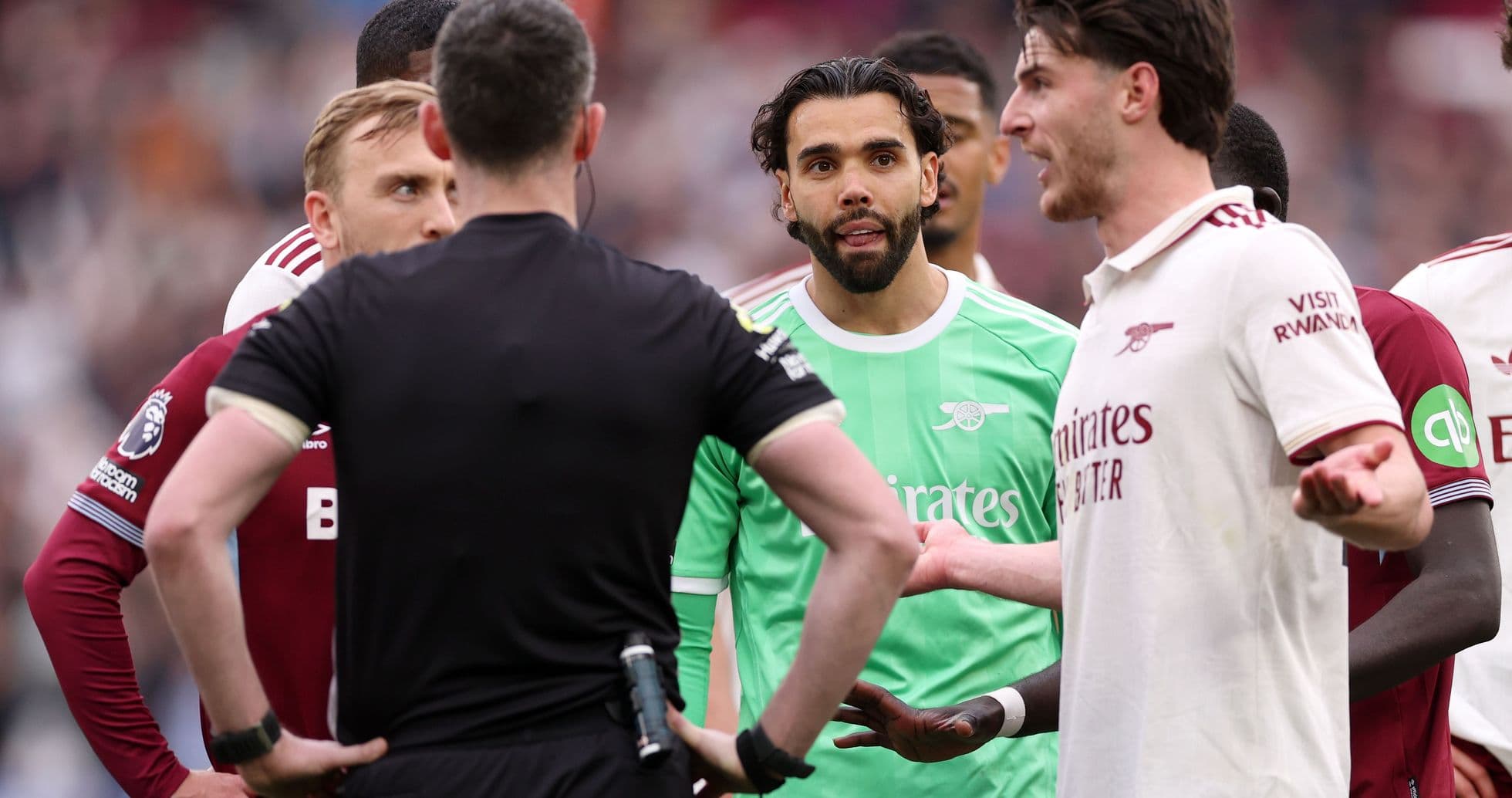
The goal is chalked off. Arsenal breathe again. West Ham’s players surround the referee in disbelief.
Two managers, two worlds
Reactions on the touchline could hardly have been more different.
Mikel Arteta, whose Arsenal side sit top of the table with 79 points from 36 games, praised the officials for sticking to the guidelines under intense pressure. He spoke of VAR showing “a lot of courage” in overturning the on-field call, a choice of words that underlined just how much this title race has turned every decision into a potential fault line.
For Arsenal, the ruling preserves a precious 1-0 victory and keeps them ahead of Manchester City, who trail by five points but hold a game in hand. Every marginal call now feels like it could tilt the trophy one way or the other.
On the other side, Nuno Espirito Santo saw only inconsistency. West Ham’s defeat leaves them marooned in 18th place on 36 points, firmly in the relegation zone, where a single point can reshape an entire season. To lose that point in stoppage time, via VAR intervention, is the sort of blow that lingers.
Nuno criticised what he described as a “lack of consistency” in how grappling and contact in the penalty area are judged. From his vantage point, similar incidents have gone unpunished. The anger is not just about one decision, but about the pattern managers believe they see over months of football.
A growing problem in the box
Webb did not shy away from the wider issue. He acknowledged that this season has thrown up an unusually high number of contentious clashes in and around the penalty area.
“This season’s been a little bit more unique than previous ones about the number of contacts in the penalty area, and it does create a challenge for the officials,” he admitted.
Clubs have invested heavily in set-piece coaches, analysts, and choreographed routines. With that has come an arms race in blocking runs, subtle holding, and the kind of dark arts that sit on the edge of the law. Attackers and defenders alike push the limits. Goalkeepers, often outnumbered and targeted, are demanding more protection.
The result? A crowded grey area where one referee’s “strong challenge” becomes another’s “clear foul”.
What comes next
Webb revealed that the PGMOL will sit down at the end of the campaign to revisit how these incidents are policed, particularly the wrestling matches that break out on corners and free-kicks. The aim is simple: clearer boundaries, more predictable outcomes, fewer flashpoints that decide seasons.
For now, the law as interpreted by officials is clear in Webb’s mind: hold a goalkeeper’s arm and prevent them from playing the ball, and you run the risk of seeing a goal wiped out.
Arsenal walk away with three points and their title dream very much alive. Manchester City, five points back with that crucial game in hand, still lurk ominously.
West Ham leave with nothing but frustration and a deepening sense of peril.
In a title race this tight and a relegation battle this brutal, how many more nights will swing on a single grip of an arm in the six-yard box?