.svg&w=384&q=75 "naujapitch logo")
USA's Tactical Mastery in 2-0 Victory Over Bosnia & Herzegovina
USA’s 2-0 win over Bosnia & Herzegovina at Levi's Stadium in this World Cup Round of 32 tie was defined less by volume of chances than by the clarity of the Americans’ game plan. With USA in a 4-3-3 against Bosnia & Herzegovina’s 5-3-2, Mauricio Pochettino’s side accepted a slight deficit in possession (48% to 52%) but controlled where the game was played, turning limited shots (8 to 10) into far better chances, reflected in a clear xG edge of 0.92 to 0.25.
Structurally, USA’s back four of Alexander Freeman, Chris Richards, Tim Ream and Antonee Robinson set a high defensive line that compressed the field and supported the front three. Tyler Adams anchored the midfield as the single pivot in front of the centre-backs, with Weston McKennie and Malik Tillman operating as advanced interiors. This triangle was crucial: Adams screened passes into Edin Džeko and Ermedin Demirović, while McKennie and Tillman stepped aggressively onto Bosnia & Herzegovina’s midfield three to prevent them from turning under pressure.
In possession, USA’s 4-3-3 morphed into a 2-3-5. Robinson and Dest pushed high and wide, pinning Bosnia & Herzegovina’s wing-backs, while Pulišić and Folarin Balogun often tucked inside to attack the half-spaces. The passing data underlines the control in these zones: USA completed 346 of 415 passes (83%), almost matching Bosnia & Herzegovina’s 364 of 446 (82%) despite playing over half an hour with ten men. The Americans did not dominate the ball, but their circulation was cleaner and more purposeful, particularly in the inside channels.
Bosnia & Herzegovina’s 5-3-2 under Sergej Barbarez was clearly designed to absorb and counter. The back five of Amar Dedić, Nikola Katić, Tarik Muharemović, Stjepan Radeljić and Sead Kolašinac sat relatively deep, aiming to deny space in behind and funnel USA into crowded central areas. However, with only 3 shots on goal from 10 total efforts and a very low xG of 0.25, their offensive transitions rarely progressed into truly dangerous positions. The front two were often isolated, with the midfield three of Armin Gigović, Ivan Šunjić and Kerim Alajbegović pinned back by USA’s counterpress.
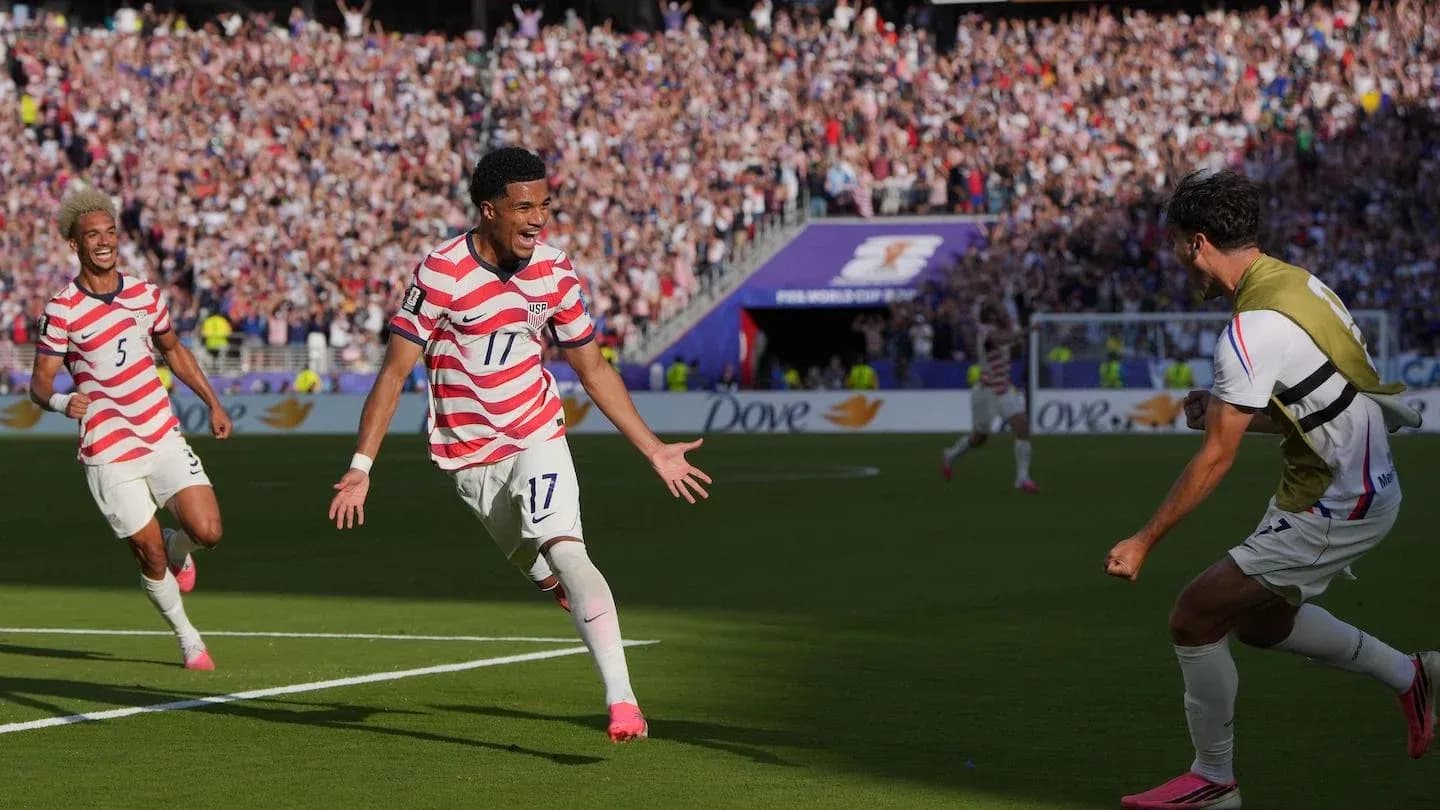
The key tactical hinge came around Balogun. His 45' opener for USA crowned a first half in which he constantly stretched the Bosnian back line with runs off the shoulder, opening pockets for Pulišić and Tillman between the lines. That goal forced Bosnia & Herzegovina to chase the game in the second half, but their response was more structural than qualitative: triple substitutions at 51' (Esmir Bajraktarević for Gigović, Benjamin Tahirović for Šunjić, Ermin Mahmić for Džeko) refreshed legs but did not fundamentally alter the 5-3-2’s conservative spacing.
The match took a dramatic turn at 64' when Balogun received a red card for “Serious foul”. Reduced to ten men and already 1-0 up, USA adjusted intelligently. The wingers dropped deeper, and the midfield line became more compact, with an emphasis on vertical efficiency rather than sustained pressure. Remarkably, even with a man disadvantage, USA still produced 6 shots inside the box out of 8 total attempts, compared to Bosnia & Herzegovina’s 5 from 10. That ratio highlights how well the Americans managed territory: fewer attacks, but almost all reaching dangerous zones.
Defensively, USA were disciplined. They committed only 7 fouls to Bosnia & Herzegovina’s 13, a figure that reflects good spacing and anticipation rather than last-ditch interventions. The back line limited clear sights of goal, helping Matthew Freese (USA) to a relatively modest workload of 3 saves. At the other end, USA’s shot selection and finishing were so efficient that Nikola Vasilj (Bosnia & Herzegovina) did not record a single save despite conceding twice. Bosnia & Herzegovina’s “goals prevented” figure of -1.73 underscores that both goals came from high-quality, well-worked situations rather than speculative efforts.
The second USA goal, scored by Tillman at 82', was the tactical confirmation of their plan. Even down to ten, they continued to exploit Bosnia & Herzegovina’s need to advance. As the visitors pushed their wing-backs higher and introduced Haris Tabaković and Amar Memić at 75' for Kolašinac and Katić, their back line lost some compactness. USA targeted those emerging gaps, and Tillman’s strike effectively punished the stretched 5-3-2, turning the game into a two-goal cushion that their defensive structure was well-equipped to protect.
Bosnia & Herzegovina’s late yellow card for Radeljić at 80' (reason: “Holding”) and the earlier bench booking for Barbarez at the same minute reflected mounting frustration as their plan of controlled resistance unraveled. Despite a slight edge in possession and an extra man for the final 25 minutes, they lacked mechanisms to break USA’s compact 4-4-1 block: there was little occupation of the half-spaces, few overloads wide, and insufficient runners from midfield to unsettle the American centre-backs.
Substitutions by Pochettino in the closing stages were clearly game-management moves. Sebastian Berhalter replaced Sergiño Dest at 87', Ricardo Pepi came in for Pulišić at 88', and Giovanni Reyna for McKennie at 90+5'. Each change added fresh legs and defensive work rate, ensuring USA could maintain their pressing triggers and compactness without physical drop-off.
Statistically, the verdict supports the eye test: USA created more and better chances with fewer resources. Their xG of 0.92 from 8 shots, with 2 on target and 2 goals scored, speaks to clinical execution and intelligent shot locations. Bosnia & Herzegovina’s 0.25 xG from 10 shots, 3 on goal, illustrates sterile possession and limited penetration. USA’s slightly lower possession but higher pass accuracy, fewer fouls, and superior chance quality all point to a side that controlled the match through structure and decision-making rather than sheer volume of play.
In tactical terms, this Round of 32 tie showed a USA side comfortable in both proactive and reactive phases, able to adapt after a red card without losing their attacking edge. Bosnia & Herzegovina, by contrast, were trapped between their initial low block and the need to chase the game, never finding a coherent attacking shape to threaten a well-organized American unit.