.svg&w=384&q=75 "naujapitch logo")
Mexico's Tactical Dominance Over Ecuador in World Cup Victory
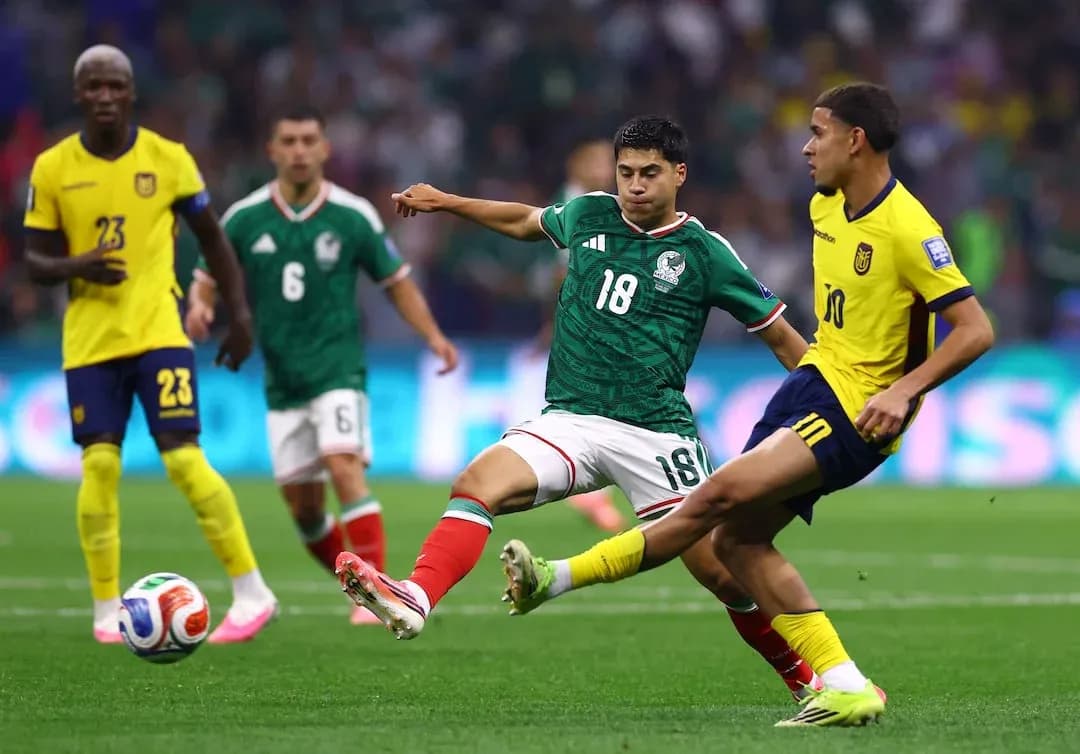
Under the Mexico City lights at Estadio Banorte, Mexico’s 2–0 victory over Ecuador in the World Cup Round of 32 felt less like a surprise and more like the logical extension of two very different tournament identities colliding.
Mexico arrived as a machine of momentum. Heading into this game, they sat 1st in Group A with 9 points from 3 matches, a perfect record built on 6 goals scored and none conceded. Overall this campaign, they had played 4 matches, winning all 4, with 8 goals for and 0 against. That total goal difference of +8 was not just a number; it was a statement of control. At home in this World Cup, they had played 3 times, won all 3, scored 5 goals and still not allowed a single one, averaging 1.7 goals for and 0.0 against per match in front of their own crowd.
Ecuador’s path was far more precarious. They reached the knockout phase from Group E with 4 points, ranked 3rd in their group with a total goal difference of 0, built from 2 goals scored and 2 conceded across 3 group games. Overall this campaign, they had played 4 matches, winning 1, drawing 1 and losing 2. They had scored just 2 goals in total and conceded 4, for a total goal difference of −2. On their travels, they had struggled badly: 2 away fixtures, 2 defeats, 0 goals scored and 3 conceded, averaging 0.0 goals for and 1.5 against away from home. Mexico’s fortress met Ecuador’s fragility.
I. The Big Picture: Shapes and Intent
On the tactical board, the contrast was clear. Javier Aguirre kept faith with Mexico’s now-familiar 4‑3‑3. R. Rangel in goal sat behind a back four of J. Gallardo, J. Vasquez, C. Montes and J. Sanchez. Ahead of them, a midfield trio of L. Romo, E. Lira and G. Mora offered balance: Romo as the shuttling connector, Lira as the anchor, Mora as the more advanced link. Up front, the line of R. Alvarado, R. Jimenez and J. Quinones gave Mexico width, a central reference point, and a direct dribbling threat from the left.
Sebastian Beccacece answered with a 4‑4‑2 that tried to compress space and spring forward in bursts. H. Galindez started in goal, shielded by a back line of P. Hincapie, W. Pacho, J. Ordonez and A. Franco. The midfield band of four—N. Angulo, P. Vite, M. Caicedo and J. Yeboah—was built to slide laterally and deny central progression, while G. Plata and E. Valencia formed a front two meant to threaten in transition.
From the opening whistle, Mexico’s shape looked like the logical evolution of their group-stage dominance. Overall this campaign they had averaged 2.0 goals per match while conceding 0.0, and the structure on the pitch reflected that statistical authority: full-backs high, a single pivot in Lira dropping between the centre-backs when needed, and both wingers tucking inside to overload Ecuador’s double pivot.
II. Tactical Voids and Disciplinary Shadows
There were no official absentees listed, so both coaches had the luxury of full squads. Yet the story of who was on the pitch came filtered through disciplinary histories that hovered over key duels.
For Mexico, C. Montes carried the quiet menace of a defender who had already walked the red line in this tournament. He had been sent off once in his 3 appearances, a reminder that his aggressive front-foot defending can occasionally boil over. Ecuador’s back line had its own disciplinary scars. P. Hincapie arrived as both one of the World Cup’s most carded defenders and a red-card recipient himself: 1 yellow and 1 red across 4 appearances, alongside 12 tackles, 2 blocked shots and 4 interceptions. A. Franco, meanwhile, led the yellow-card charts with 2 bookings and 7 fouls committed, yet also boasted 96% passing accuracy and 8 tackles with 1 blocked shot and 4 interceptions. This was a back four that defended on the edge.
Those histories mattered because both teams have shown a tendency for late-game discipline swings. For Mexico, half of their yellow cards in this World Cup had come between 16–30 minutes and the other half between 61–75, while their only red card had arrived deep into added time between 91–105 minutes. Ecuador’s yellows were more spread: 25.00% between 31–45, another 25.00% between 46–60, with 12.50% in both the 61–75 and 76–90 windows, and a red card also appearing between 91–105. This was always likely to be a match where the intensity would spike as legs tired and space opened.
III. Key Matchups: Hunter vs Shield, Engine Room vs Enforcer
The headline duel was always going to be Mexico’s left side against Ecuador’s right. J. Quinones came into the night as one of the World Cup’s most dangerous attacking outlets. Overall this campaign he had scored 3 goals and provided 1 assist in 4 appearances, taking 9 shots with 5 on target. He had completed 6 of 8 dribbles, drawn 7 fouls and posted a 7.73 average rating. Though listed as a midfielder in his season profile, Aguirre used him as an inverted forward from the left, constantly driving at A. Franco.
Franco, for his part, embodied Ecuador’s “shield” on that flank: 8 tackles, 1 blocked shot, 4 interceptions and 22 duels contested, winning 10. His 2 yellow cards and 7 fouls committed told of a defender who would not hesitate to step in aggressively. Mexico repeatedly isolated this matchup, rotating Romo and Mora to drag Ecuador’s wide midfielders inside and leave Quinones one-on-one. Each time Quinones received on the half-turn, the tension between Franco’s discipline and his need to engage was palpable.
On the opposite flank, R. Alvarado provided the cerebral counterpoint. Overall this campaign he had become one of the tournament’s premier creators: 3 assists, 10 key passes and 140 total passes at 82% accuracy, with 4 successful dribbles from 4 attempts and 7 tackles. His duel with P. Hincapie and N. Angulo was less about raw pace and more about timing. Alvarado drifted inside to form a box midfield with Romo and Mora, forcing Ecuador’s central pair—M. Caicedo and P. Vite—to make constant choices about who to track.
In the engine room, E. Lira’s role was quietly decisive. Mexico’s entire defensive record—4 clean sheets in 4 matches overall, 3 at home—owed as much to their collective structure as to any single defender. Lira’s job was to screen E. Valencia’s dropping movements and cut off the passing lanes into G. Plata’s feet. Ecuador, who had failed to score in 3 of their 4 matches this campaign, needed those central connections to come alive. Instead, Lira and Romo formed a moving wall that forced Ecuador wide, where their crosses rarely troubled C. Montes and J. Vasquez.
IV. Statistical Prognosis and the Shape of the Result
If this had been a pre-match tactical preview, the numbers would have pointed clearly in Mexico’s direction. Overall this campaign, Mexico’s attack averaged 2.0 goals per match, while their defence had yet to concede. At home, they were even more suffocating: 3 wins from 3, 5 goals scored, 0 conceded, 3 clean sheets. Ecuador, by contrast, had averaged just 0.5 goals per match overall, with 1.0 conceded. On their travels, they had failed to score in either away game and conceded 3 goals, with 0 clean sheets away from home and 2 matches where they failed to score.
Layer that onto the tactical patterns on display. Mexico’s most-used formation this World Cup has been the 4‑3‑3, deployed 3 times, and it once again gave them width, pressing angles and a stable rest-defence. Ecuador’s preferred 4‑4‑2—used in 3 matches—struggled to generate central overloads against a Mexican side comfortable defending in a 4‑1‑4‑1 without the ball.
Neither side had taken a penalty in the tournament so far; both had 0 penalties awarded, 0 scored and 0 missed. That meant the margins were always going to be found in open play and set pieces rather than from the spot. Mexico’s clean-sheet streak (4 in total, 3 at home, 1 away) and the fact they had never failed to score this campaign made them statistically primed to control the tempo once they went ahead. Ecuador, who had failed to score in 3 of their 4 matches overall and had only 1 clean sheet, were always likely to be chasing a game that their structure was not built to chase.
Following this result, the narrative tightens rather than changes. Mexico’s identity as the tournament’s most balanced side—4 wins from 4, 8 goals for, 0 against overall—hardens into something approaching inevitability. Ecuador exit having embodied their numbers: resilient in phases, capable of spells of pressure, but too blunt in front of goal and too stretched when forced to open up.
On the night, the 2–0 scoreline felt less like a twist and more like the script the data had been writing all along: Mexico’s hunters—Quinones, Alvarado, Jimenez—finding just enough incision, their shield unbreached yet again, and Ecuador’s brave but brittle resistance finally broken under the weight of structure, form and probability.