.svg&w=384&q=75 "naujapitch logo")
Spain vs Argentina: World Cup Final Breakdown
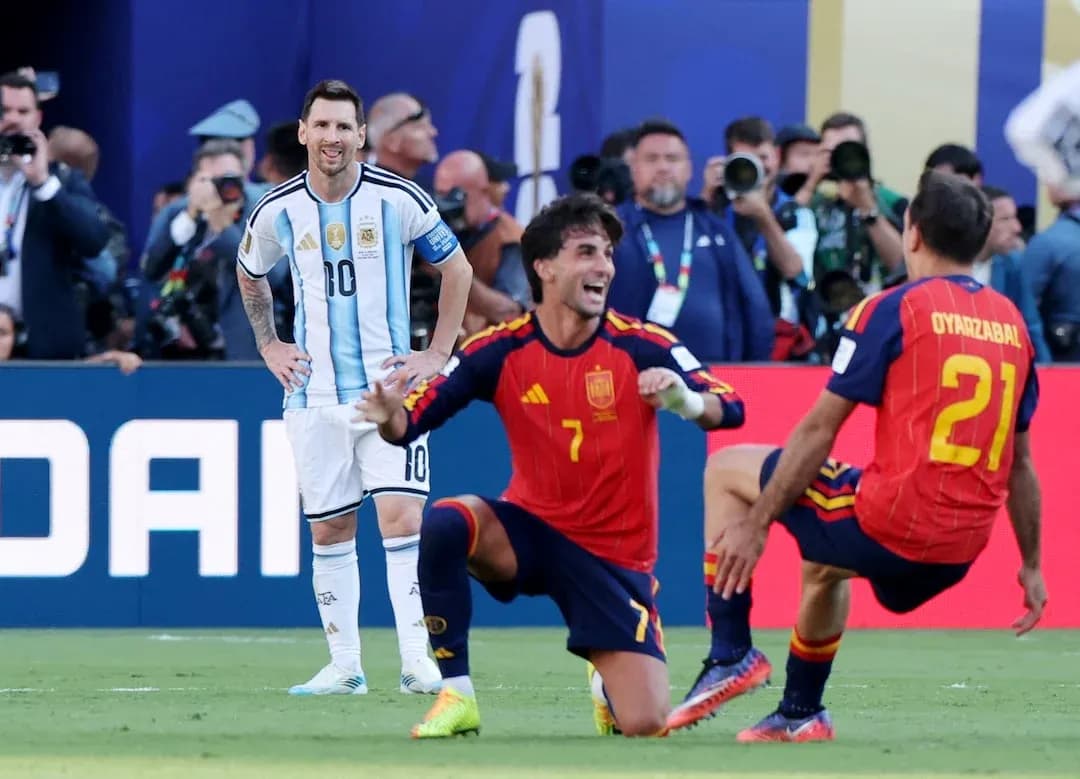
MetLife Stadium, East Rutherford. A World Cup Final stretched to 120 minutes, decided not by penalties but by a single extra‑time strike: Spain 1–0 Argentina. Around that narrow scoreline sits a clash of two fully formed footballing identities, each arriving at this stage with a clear statistical fingerprint and a defined tactical script.
I. The Big Picture – Two Perfect Beasts, One Narrow Gap
Heading into this game, Spain and Argentina had carved near‑perfect paths through the tournament. Spain’s group campaign in Group H ended with 7 points from 3 matches, a goal difference of +5 built on 5 goals scored and none conceded. Across the whole World Cup run, Spain played 8 fixtures in total, winning 7 and drawing 1, with no defeats. Their overall attacking output was 14 goals, split between 10 at home and 4 on their travels, for an overall average of 1.8 goals per match. Defensively, they were even more ruthless: just 1 goal conceded in total, 1 at home and 0 away, an overall average of 0.1.
Argentina arrived from Group J as an even more ruthless front‑foot machine. They topped their group with 9 points from 3 matches, a goal difference of +7 from 8 goals scored and 1 conceded. Across the full campaign, Argentina also played 8 matches in total, winning 7 and losing only 1, scoring 19 goals overall (14 at home, 5 away) at an average of 2.4 per match. The price of that attacking ambition was a more open back line: 8 goals conceded in total, split evenly between home and away, for an overall average of 1.0.
The final, then, was framed as Spain’s control and defensive perfection against Argentina’s firepower and emotional surge, with the World Cup on the line.
II. Tactical Voids and Discipline – Where the Edges Might Fray
There were no listed absences for either side, so both Luis de la Fuente and Lionel Scaloni approached this final at full strength. That makes the tactical selection even more revealing: Spain locked into their preferred 4‑2‑3‑1, a shape they had used in 6 of their 8 tournament line‑ups, while Argentina went with the 4‑4‑2 that had underpinned 5 of their matches.
Spain’s season‑long disciplinary pattern hinted at a team that tends to stay composed but can become stretched late in games. Their yellow cards clustered notably in two windows: 31–45 minutes (33.33% of their bookings) and 91–105 minutes (50%). That spike in extra time suggests that as matches lengthen, Spain’s intense pressing and positional play can edge into fouls as legs tire.
Argentina, by contrast, carried a more combustible profile. Their yellow cards were spread across regulation time but flared dramatically in extra time: 33.33% of their yellows came between 91–105 minutes, and 20.00% between 106–120 minutes, with an additional late‑game booking outside the standard ranges. More tellingly, Argentina’s only red card in the tournament arrived between 91–105 minutes. Enzo Fernández, a central pillar in midfield, had already walked the disciplinary tightrope with 1 yellow and a yellow‑red combination across the tournament. This pattern pointed to a side whose emotional intensity, so vital to their momentum, risked boiling over precisely when control is most needed.
III. Key Matchups – Hunter vs Shield, Engine vs Engine
The headline duel was always going to be Lionel Messi against Spain’s defensive shield. Messi arrived as one of the tournament’s top scorers and creators: 8 goals and 4 assists in 8 appearances, with 28 shots in total and 18 on target, plus 26 key passes and 27 successful dribbles from 38 attempts. He had drawn 20 fouls and won most of his duels, embodying Argentina’s creative and psychological centre.
But even Messi’s numbers carried a crack in the armour: from the penalty spot he had scored 0 and missed 2 during this World Cup. In a final where fine margins and set‑piece pressure often decide the outcome, that record loomed large. If this match had been dragged to penalties, Spain might have felt a subtle psychological edge.
Spain’s shield was collective rather than individual. Unai Simón anchored a back four of Pedro Porro, Pau Cubarsí, Aymeric Laporte and Marc Cucurella, screened by Rodri and Fabián Ruiz. The structure was designed to compress the spaces Messi loves to occupy between the lines, while the double pivot could tilt toward whichever Argentine forward dropped off. Across the campaign, Spain’s defensive numbers were almost surreal: 7 clean sheets in total, 4 at home and 3 away, and only 1 match in which they failed to score. This was a side that controlled risk as a principle.
Further up, the “Hunter vs Shield” narrative flipped direction. Mikel Oyarzabal entered the final with 5 goals and 1 assist in 8 appearances, with 21 shots in total and 12 on target. His movement from the left, combined with the creativity of Dani Olmo and the teenage unpredictability of Lamine Yamal, asked constant questions of an Argentina back line that had conceded 8 goals in total and kept only 2 clean sheets overall.
Cristian Romero and Lisandro Martínez, both among the tournament’s most carded defenders with 2 yellows each, were simultaneously Argentina’s last line and a disciplinary risk. Romero had 15 tackles, 3 successful blocks and 10 interceptions; Lisandro Martínez had 12 tackles, 1 block and 6 interceptions. Their aggression is what makes Argentina hard to break, but against Spain’s fluid front four, any mistimed challenge risked tilting the final.
In midfield, the engine‑room battle was delicately balanced. Rodri and Fabián Ruiz offered Spain circulation and control, while Argentina’s quartet of Rodrigo de Paul, Enzo Fernández, Alexis Mac Allister and Nicolás González brought intensity and verticality. Enzo’s passing numbers across the tournament – 512 completed passes at 93% accuracy – underlined his role as Argentina’s deep connector, but his 12 fouls committed and yellow‑red card hinted at a potential fault line under Spain’s positional pressure.
IV. Statistical Prognosis – Why the Margins Favoured Spain
On paper, Argentina’s attack was the more explosive, with 19 goals overall at 2.4 per match, compared to Spain’s 14 at 1.8. But finals are rarely decided by volume alone. Spain’s defensive record – 1 goal conceded in total, an average of 0.1 per match – was the single most dominant metric in the entire match‑up. Argentina’s own defensive average of 1.0 goals conceded per game suggested that, over 90 or 120 minutes, Spain were more likely to find a way through than Argentina were to crack a near‑perfect back line.
Discipline and late‑game patterns tilted the balance further. Spain’s yellow‑card spikes in extra time reflected fatigue but not chaos; Argentina’s extra‑time bookings and that solitary red card signposted a greater risk of losing control just when Spain’s methodical approach tends to grind opponents down. Add in Argentina’s penalty record – 3 penalties in total, only 1 scored and 2 missed – and the statistical story of fine‑margin moments leaned subtly toward Spain.
In the end, the final followed the logic of those numbers. A match that remained goalless through 90 minutes was decided in the 120‑minute window where Spain’s structure and Argentina’s volatility were always most likely to collide. The 1–0 after extra time was not just a dramatic scoreline; it was the distilled expression of a campaign in which Spain built an almost unbreakable shield, and Argentina lived – and finally fell – by the sword.