.svg&w=384&q=75 "naujapitch logo")
Southampton's Play-off Victory Clouded by Controversy
The final whistle went at St Mary’s and two very different pictures formed.
On one side, Southampton’s players sank to their knees, then rose to salute a home crowd that had just witnessed a 2-1 extra-time win and what should be a ticket to Wembley. On the other, Middlesbrough’s squad stood almost motionless, staring up at their travelling support with the hollow look of a group who had given everything and lost.
And yet, as the stands emptied, one question lingered over the south coast: is this play-off tie actually over?
Saints win the tie – but not the argument
On the pitch, the story felt gloriously simple. Riley McGree struck early to put Middlesbrough ahead on the night and in the tie, breaking open a contest that had been locked at 0-0 from the first leg.
Southampton wobbled. For much of the first half, Kim Hellberg’s side looked sharper, cleaner in possession, more assured in their structure. They had done their homework and it showed.
Then, right on the cusp of half-time, Ross Stewart pounced. The equaliser changed everything. The mood, the noise, the belief inside St Mary’s. From that moment, Boro’s legs began to fade and Saints gradually tightened their grip.
Extra-time arrived with the visitors hanging on, and it took a slice of fortune to finally break them. Shea Charles swung in a cross from the right that became something else entirely – a cross-shot that arced its way through bodies and beyond the goalkeeper. St Mary’s erupted. A scruffy, decisive moment, but in play-off football, no one cares how it looks.
On the basis of 210 minutes, Southampton earned their place in the Championship play-off final on 23 May, where Hull City await. That should be the end of it.
It isn’t.
A tie that could be settled in the courtroom
This is the 40th season of the English play-offs. They were designed as a brutal, thrilling, unforgiving sporting decider. Players, managers, supporters – all living on a knife-edge.
This one may yet be decided in a very different arena.
Events at Middlesbrough’s Rockliffe Park training ground last Thursday now cast a long shadow. Southampton have been charged by the EFL with spying on a Boro training session – an allegation they have not denied. The case has been passed to an independent disciplinary commission, and the range of potential sanctions is stark.
- A fine.
- A points deduction.
- Even expulsion from the play-offs.
Saints have requested more time to complete an internal review of what happened, stretching the usual 14-day window to respond. The EFL, though, has pushed for a hearing “at the earliest opportunity”. Late on Tuesday, a spokesperson for the commission made it clear that the legal process is under way, but no timetable has been set.
So while Southampton’s players should be preparing for what is routinely called the richest game in English football, there is a nagging doubt in the background. Their Wembley dream is on the boardroom table now, not just the tactics board.
Hellberg’s anger and heartbreak
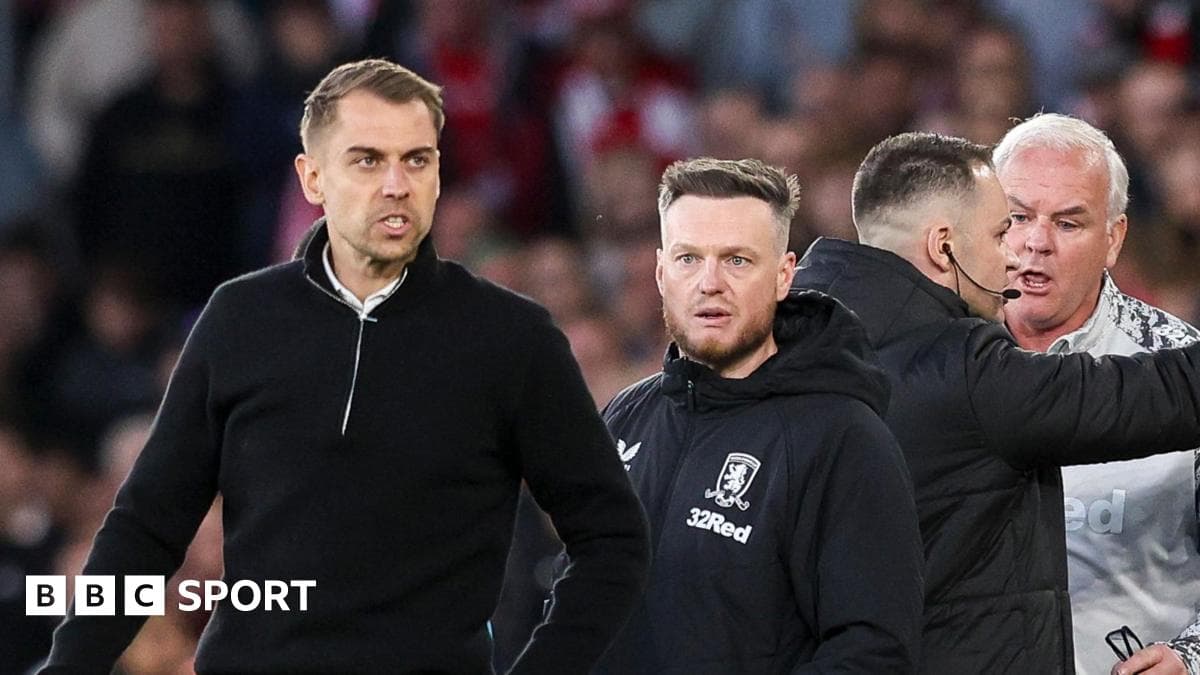
No one has felt the weight of that off-field controversy more than Kim Hellberg.
The Swede, in his first job in English football, had already made his feelings clear after the goalless first leg. He spoke then of “someone who makes decisions to go and try to cheat”. After losing in such agonising fashion at St Mary’s, the emotion ran even deeper.
Hellberg talked about the 15-year journey that had brought him to this point, the dream of working in the Premier League, and the hours he had poured into studying Southampton in the build-up to this tie. Hours that kept him away from his young family.
“If we hadn’t caught that man that they sent up five hours to drive, you would sit there and say well done in the tactical aspect of the game and I would go home and feel like I’ve failed,” he said.
Those words cut to the heart of the issue for him. For a coach operating without the financial muscle of parachute payments, the edge lies in detail, in preparation, in the tactical craft that might tilt a tight tie.
“When that is taken away from you – we’re not going to watch every game, we’re going to send someone instead and film the sessions and hope they don’t get caught – it breaks my heart in terms of all the things I believe in.”
His team had led, had executed the plan, had pushed Southampton to the brink. Then fatigue, fortune and one mis-hit cross undid them. After a season in which Boro missed out on automatic promotion on the final day and then stumbled into a bad run at the worst possible moment, this was a brutal way for the campaign to fracture.
“When I took the Middlesbrough job, I know there are clubs with bigger resources, parachute teams that can spend more money, that are teams with bigger squads than us,” he said. “What you have as a coach is the tactical element of the game and where we can beat the opponent. You have to find a way of getting an advantage. That’s what you always try to do as we can be better in that element. And when that is taken away from you…”
He didn’t need to finish the sentence. The look on his face did it for him.
Wembley on hold
Middlesbrough will fly back to Teesside on Wednesday with the table saying their season is over. Beaten on the field, beaten by a late, looping strike that will live long in Southampton memories.
Yet even their summer plans are on pause. Players who would normally scatter for holidays and international duty must now wait to see if an independent panel reopens the door.
Back on the south coast, there was no wild pitch invasion at full-time, no prolonged party. The celebrations were real, but restrained. Everyone inside St Mary’s understood that this story still has another chapter to be written.
Southampton have done enough with the ball to book a place at Wembley. Whether that stands will depend on what three people in a hearing room decide about what happened at Rockliffe Park.
In the 40th year of the play-offs, English football may be about to discover what it looks like when the season’s most dramatic fixture is settled not by a goal like Shea Charles’, but by a judgement on how far a club is willing to go to gain an edge.