.svg&w=384&q=75 "naujapitch logo")
Real Sociedad vs Valencia: Tactical Analysis of a Volatile Match
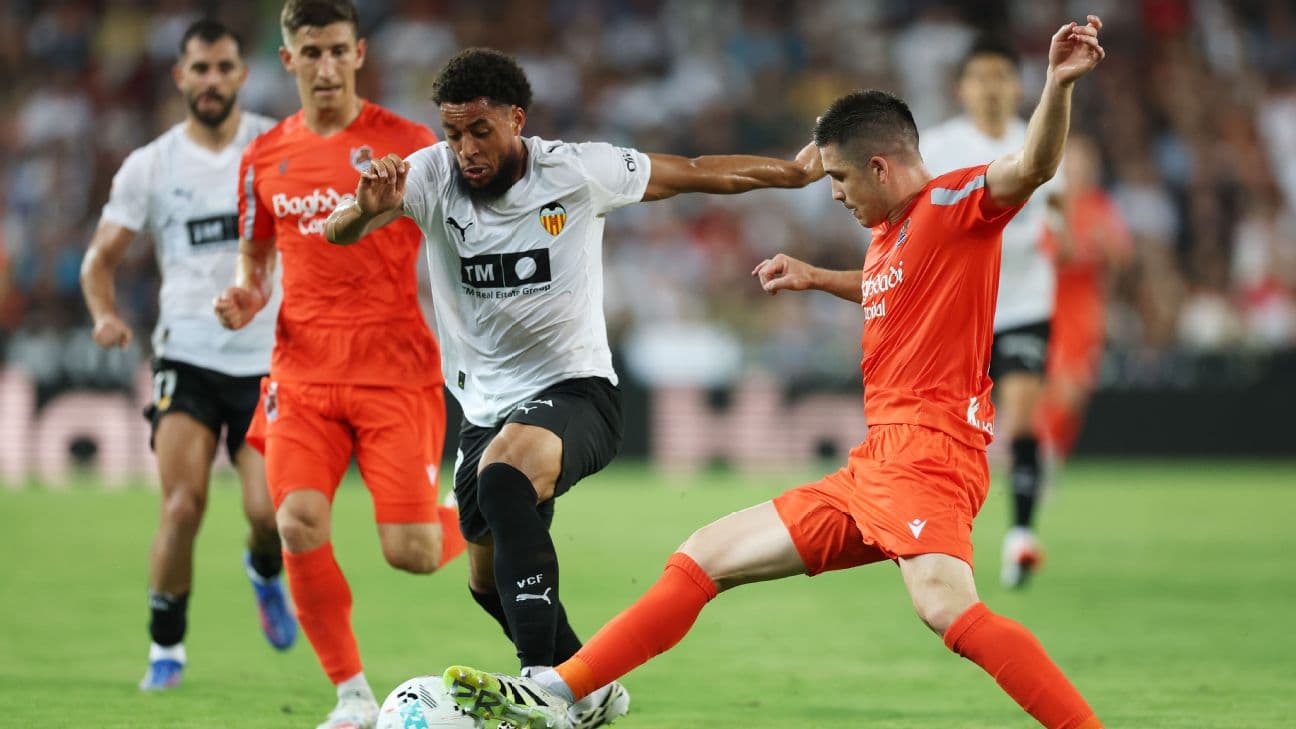
Real Sociedad’s 3-4 home defeat to Valencia at Reale Arena unfolded as a tactically volatile contest where structural ideas were clear, but execution and game management diverged sharply between the sides. The hosts imposed a territorial and possession-based plan, yet Valencia’s vertical punch, efficiency in advanced areas and late-game adaptation with ten men ultimately defined the result.
Real Sociedad set up in a 4-2-3-1 under Pellegrino Matarazzo, using the double pivot of Beñat Turrientes and Carlos Soler as the platform for sustained pressure. Their 55% possession and 491 passes, with 410 accurate (84%), show a side committed to controlled buildup. The back four of A. Elustondo, Jon Martin, Igor Zubeldia and A. Munoz stepped high, compressing the pitch and allowing the attacking midfield trio of P. Marin, B. Mendez and A. Zakharyan to operate between the lines behind O. Oskarsson.
That early structure paid off immediately: at 3', A. Munoz attacked from deep, finishing a move assisted by A. Elustondo. It was emblematic of Real Sociedad’s intent to use full-backs as additional attackers, overloading wide zones and arriving late into the box. However, this same aggressive posture exposed them in defensive transition. With only 3 shots on goal from 8 total, Real Sociedad’s shot volume remained modest relative to their territorial dominance, and their xG of 1.14 underlines that much of their possession did not translate into consistently high-quality chances.
Valencia, in a 4-4-2 under Carlos Corberan, accepted a more reactive role. Their 45% possession and 412 passes, 321 accurate (78%), reflect a team comfortable without the ball but extremely purposeful when they had it. The double striker pairing of J. Guerra and H. Duro was central to this plan. Guerra, nominally a forward, frequently dropped into the right half-space to receive and turn, while D. Lopez and G. Rodriguez from midfield provided direct running and support.
The first equaliser at 8' – J. Guerra scoring from a D. Lopez assist – highlighted Valencia’s verticality. Breaking through Real Sociedad’s advanced line, they exploited the space behind the full-backs and the slight disconnect between the centre-backs and the double pivot. The 22' goal, H. Duro finishing from an E. Comert assist, again came from efficient, direct play: a quick progression that Real Sociedad’s high line and rest defence failed to manage. Across the match, Valencia produced 13 total shots, 6 on goal, and an xG of 1.61, illustrating a more dangerous shot profile despite less possession.
Matarazzo’s in-game adjustments at 57' were clearly designed to sharpen the attacking structure and add fresh energy: L. Sucic (IN) came on for B. Mendez (OUT), M. Oyarzabal (IN) came on for A. Zakharyan (OUT), and S. Gomez (IN) came on for A. Munoz (OUT). These moves shifted Real Sociedad’s attacking dynamics. M. Oyarzabal’s introduction in particular added more gravity between the lines and improved link play with O. Oskarsson.
The 60' own goal by C. Tarrega, under pressure inside his own box, was a direct consequence of Real Sociedad’s renewed territorial squeeze and more aggressive occupation of central spaces. Just three minutes later, at 63', the tactical bet was fully rewarded: O. Oskarsson scored, assisted by M. Oyarzabal, a sequence that encapsulated the intended 4-2-3-1 mechanisms – a creative ten feeding the lone striker after sustained pressure.
Defensively, though, Real Sociedad never fully stabilised. Their 13 fouls and four late yellow cards (Arsen Zakharyan at 25' for Foul, Beñat Turrientes at 86' for Foul, Jon Martin at 88' for Foul, and Igor Zubeldia at 88' for Foul) point to a side increasingly stretched and resorting to corrective actions rather than proactive control. The high line and aggressive full-back play left the centre-backs frequently exposed to Valencia’s direct runners, particularly once fatigue set in.
Valencia’s defensive plan hinged on a compact 4-4-2 block, with wide midfielders L. Rioja and D. Lopez tracking Real Sociedad’s full-backs and central midfielders screening passing lanes into the number ten zone. When E. Comert was sent off at 70' for a “Professional foul last man”, Corberan’s side faced a critical tactical test. Up to that point, Comert had been key in managing depth behind the midfield line. His dismissal forced a structural reorganisation.
The response was a series of substitutions aimed at refreshing legs and rebalancing the block: U. Sadiq (IN) for H. Duro (OUT) and T. Rendall (IN) for F. Ugrinic (OUT) at 73', followed by Pepelu (IN) for D. Lopez (OUT) and L. Ramazani (IN) for L. Rioja (OUT) at 74', and later A. Almeida (IN) for U. Nunez (OUT) at 83'. The pattern suggests a shift towards a deeper, more compact shape, with Pepelu and A. Almeida adding control and ball retention in central areas, while Ramazani offered counter-attacking threat from wide.
Despite being down to ten men and making those defensive-minded adjustments, Valencia remained incisive late on. Their 2 corner kicks and 3 offsides, versus Real Sociedad’s 3 corners and 5 offsides, reinforce the picture of a team choosing selective, high-risk runs rather than constant occupation of the last line. The late goals at 89' (G. Rodriguez, assisted by A. Almeida) and 90' (J. Guerra, assisted by T. Rendall) were the product of this calculated approach: quick, direct attacks into spaces left as Real Sociedad overcommitted in search of a winner.
In goal, A. Remiro for Real Sociedad made 2 saves but, with a goals prevented figure of -1.37, the data points to underperformance relative to the quality of shots faced. Some of Valencia’s efforts were well-constructed but still within a range where higher shot-stopping could have altered the outcome. At the other end, S. Dimitrievski for Valencia faced only 3 shots on goal and made 1 save, also with goals prevented at -1.37, indicating that when Real Sociedad did create clear chances, they were largely converted.
Statistically, the match underlines a key tactical contrast. Real Sociedad’s higher possession, pass volume and accuracy show a side structurally committed to control, but their xG of 1.14 and limited shots on goal reveal an inability to consistently break down a compact, well-organised block, especially once Valencia adjusted after the red card. Their defensive index on the day was undermined by poor transition control and late-game discipline issues.
Valencia, conversely, aligned their tactical plan tightly with their statistical output. With fewer passes and less possession, they still generated more shots, higher xG and ultimately four goals, including two in the final minutes with ten men. Their overall form in this match was defined by vertical efficiency, intelligent use of the front two, and adaptive in-game management from Carlos Corberan, who successfully reshaped his side’s structure after going a man down without sacrificing their counter-attacking edge.