.svg&w=384&q=75 "naujapitch logo")
Real Sociedad vs Valencia: A Seven-Goal Thriller
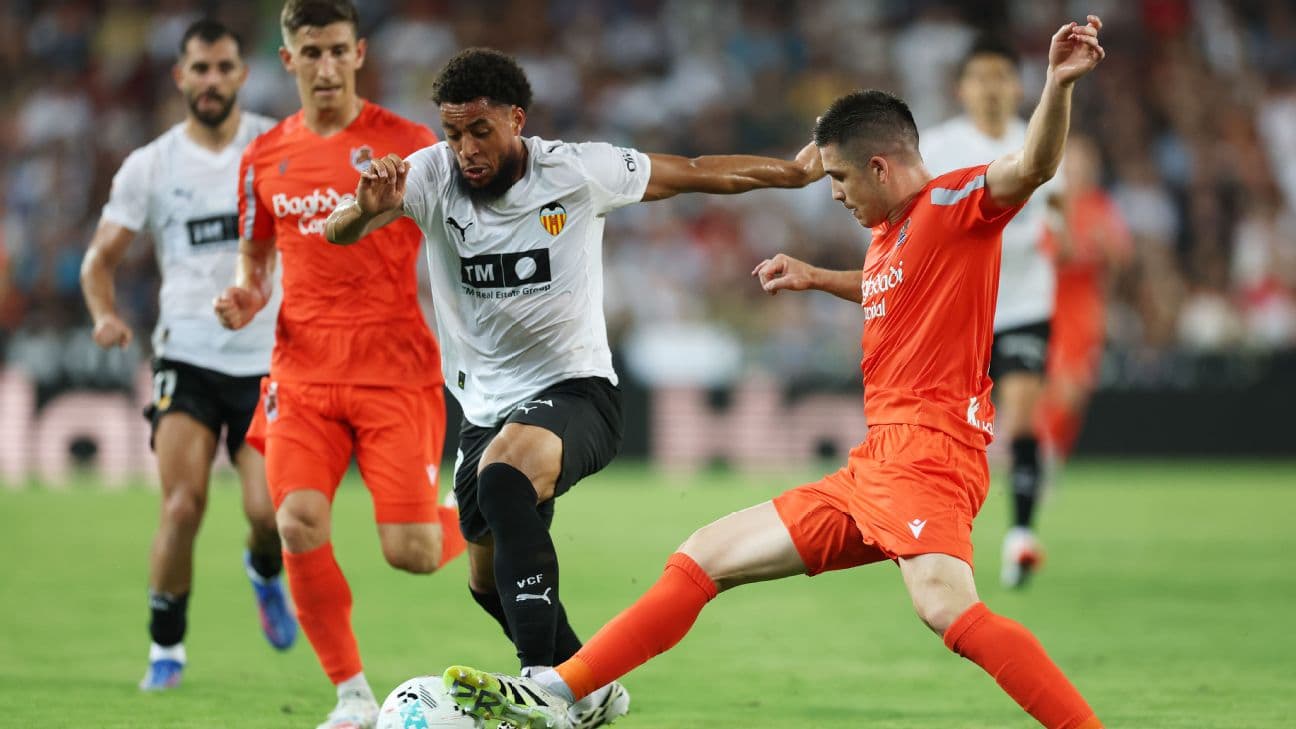
The Reale Arena had the feel of a season’s reckoning rather than a dead‑rubber. Real Sociedad and Valencia arrived separated by a single point in La Liga, 10th against 9th, both with flawed but unmistakable attacking identities. Over 90 frantic minutes, that shared volatility produced a 4-3 away win, a scoreline that felt like the logical extreme of what these two sides have been hinting at all year.
Heading into this game, the numbers already sketched the outline. Overall, Real Sociedad had scored 58 and conceded 60, a goal difference of -2 that perfectly captured a campaign of balance tipped by chaos. At home they had been more expansive: 37 goals for and 31 against across 19 matches, averages of 1.9 scored and 1.6 conceded. Valencia, by contrast, travelled with a more conservative attacking profile but a brittle rearguard: on their travels they had scored 19 and conceded 32, averaging 1.0 for and 1.7 against. Put simply, this was a fixture primed for chances, and it delivered.
I. The Big Picture – Structures that invite drama
Pellegrino Matarazzo doubled down on Real Sociedad’s season-long tactical DNA, returning to the 4-2-3-1 that has been his most-used shape (13 league starts in that formation). A. Remiro sat behind a back four of A. Munoz, I. Zubeldia, J. Martin and A. Elustondo. In front, the double pivot of B. Turrientes and C. Soler was tasked with doing two things at once: protect a defence that concedes 1.6 goals per game at home and feed a fluid line of three – P. Marin, B. Mendez, A. Zakharyan – behind lone striker O. Oskarsson.
Valencia’s Carlos Corberan answered with his own default setting: a 4-4-2, the shape he has used in 23 league matches. S. Dimitrievski anchored a back line of J. Vazquez, E. Comert, C. Tarrega and U. Nunez, with a flat but hard-running midfield band of Luis Rioja, F. Ugrinic, G. Rodriguez and D. Lopez. Up front, Javi Guerra played off H. Duro, a pairing that blended Guerra’s creative instincts with Duro’s penalty-box aggression.
The half-time scoreline – 2-1 to Valencia – reflected the season-long pattern: Real Sociedad’s front four found spaces between the lines, but Valencia’s directness and set-piece threat repeatedly exposed a home defence that has kept only 2 clean sheets at Reale Arena all season. The full-time 4-3 only confirmed how thin Real Sociedad’s margin for error has become.
II. Tactical Voids – Suspensions and injuries shape the chessboard
Both coaches had to negotiate significant absences. Real Sociedad were without A. Barrenetxea and D. Caleta-Car through yellow-card suspensions, and A. Odriozola plus J. Gorrotxategi through injury. The loss of Caleta-Car, one of La Liga’s most card-prone defenders with 6 yellows and 1 red, forced Matarazzo to reconfigure his central defence. His profile – 26 successful blocks and 27 interceptions overall – usually anchors the back line; without him, J. Martin and Zubeldia had to assume greater responsibility in the air and in covering wide spaces behind the full-backs.
On the flanks, the absence of Barrenetxea stripped Real Sociedad of a natural wide runner, pushing more creative burden onto A. Zakharyan and P. Marin to attack the half-spaces rather than the touchline.
Valencia’s injury list was even more structural. José Gayà, one of the league’s leading red-card recipients but also a primary outlet on the left, was sidelined with a muscle injury. Without his overlapping threat and 25 key passes this season, Corberan leaned heavily on J. Vazquez at left-back and Luis Rioja ahead of him to carry progression and width. Central defensive depth was thinned by the injuries to M. Diakhaby and J. Copete, plus D. Foulquier and Renzo Saravia missing on the right side of defence. That context made the selection of C. Tarrega and E. Comert as the central pairing a necessity rather than a luxury.
Disciplinary trends also hung over the contest. Real Sociedad’s season-long yellow-card pattern shows a pronounced late-game spike: 22.35% of their yellows arrive between 76-90 minutes, with another 21.18% between 46-60. Valencia mirror that volatility, with 22.86% of their yellows also in the final quarter-hour. In a match that was still alive deep into the second half, both sides were always likely to flirt with chaos rather than control.
III. Key Matchups – Hunter vs Shield, Engine vs Enforcer
The headline duel came in theory rather than pure selection: Mikel Oyarzabal, Real Sociedad’s 15-goal talisman, began on the bench. His season profile – 62 shots, 36 on target, 42 key passes and 7 penalties scored from 7 taken – has been the sharpest weapon in a side that averages 1.6 goals overall. His introduction later in games has often tilted the xG balance, and here he loomed as a potential late-game closer against a Valencia defence conceding 1.7 away goals on average.
On the other side, Hugo Duro arrived as Valencia’s leading scorer with 10 league goals but also a blemish from the spot: 1 penalty scored and 1 missed. That detail matters in a fixture between two teams that invite pressure in their own third. For Real Sociedad, who have faced 8 penalties and seen all 8 converted, any foul in the box against Duro risked being punished – unless his earlier miss weighed on his decision-making.
Behind them, the “Engine Room” duel pitted Real Sociedad’s B. Turrientes and C. Soler against the Valencia axis of G. Rodriguez, F. Ugrinic and Javi Guerra. Guerra, with 6 assists and 30 key passes, is Valencia’s creative metronome, but his 28 fouls committed and willingness to engage duels (213 contested) also make him a disruptive presser. Turrientes and Soler had to play through that pressure while shielding a centre-back pairing already weakened by Caleta-Car’s suspension.
IV. Statistical Prognosis – A match that always leaned toward goals
Heading into this game, both teams’ season-long Expected Goals profiles (by proxy of their scoring and conceding averages) pointed in the same direction: high event, low control. Real Sociedad’s home attack at 1.9 goals per game against Valencia’s away defence conceding 1.7 created a projected band where 2-3 home goals was entirely plausible. Conversely, Valencia’s 1.0 away goals average, facing a Real Sociedad side that concedes 1.6 at home and has only 3 clean sheets overall, hinted that the visitors would not leave scoreless.
Layer in the disciplinary curves – both teams peaking for yellows in the final quarter-hour – and the late stages were always likely to be stretched, error-prone and fertile for chances. The final 4-3 away win did not so much defy the data as exaggerate it. Real Sociedad’s defensive fragility, amplified by the absence of Caleta-Car, met a Valencia side whose best weapons (Guerra’s passing, Duro’s movement, Rioja’s wide threat) thrive in broken-field transitions.
Following this result, the table tightens but the tactical verdict is clear. Real Sociedad remain a side whose attacking structure can trouble anyone, especially once Oyarzabal steps onto the pitch, but whose defensive platform and disciplinary profile undermine their ceiling. Valencia, meanwhile, continue to live on the edge: away from home they concede too much to control games, yet possess just enough individual quality in Guerra, Duro and Rioja to turn open contests into victories.
In San Sebastian, those season-long truths collided and produced a seven-goal thriller that felt less like an anomaly and more like the inevitable conclusion of two chaotic campaigns.