.svg&w=384&q=75 "naujapitch logo")
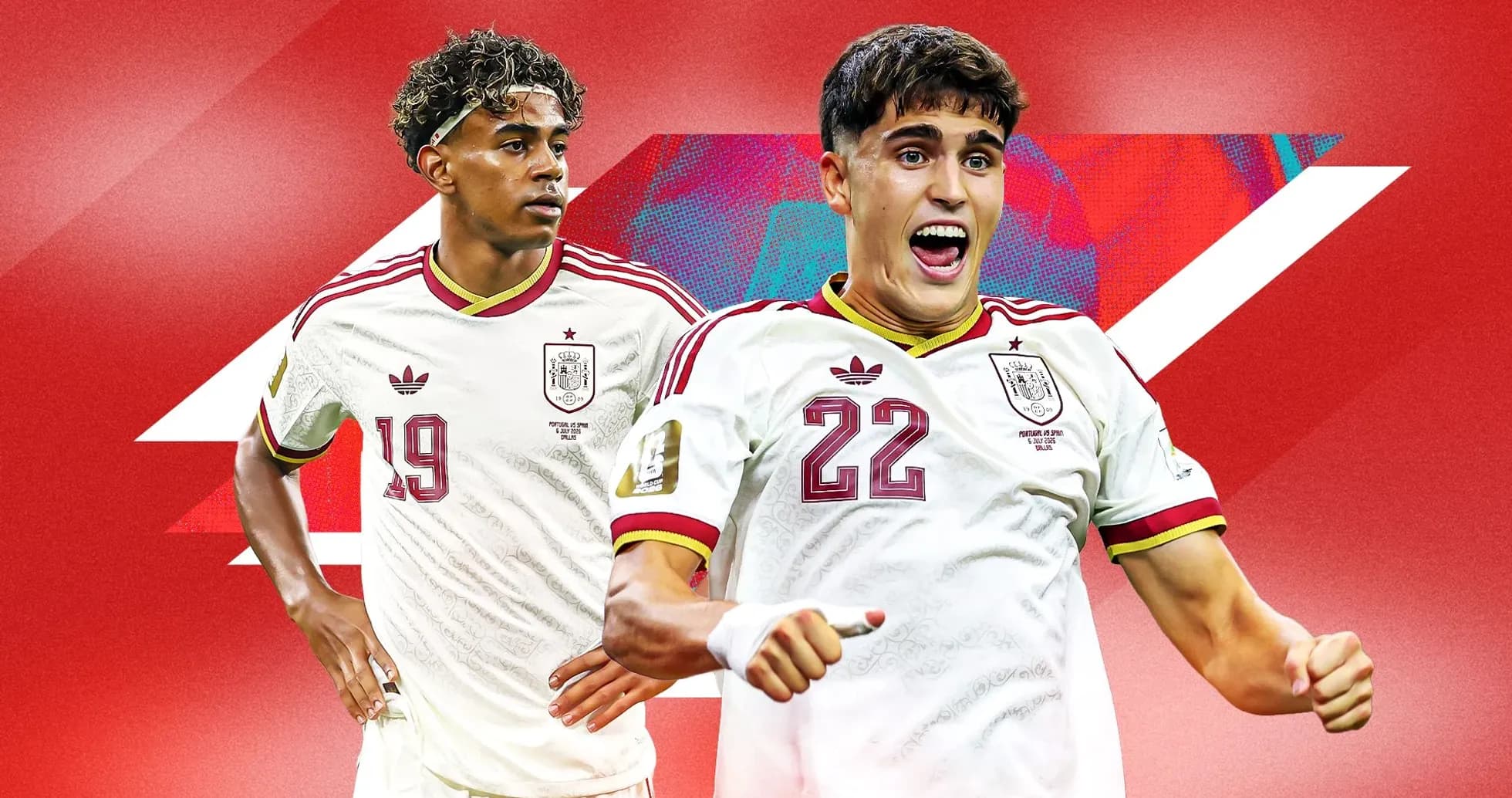
Pau Cubarsí and Lamine Yamal: Spain's Future Stars Shine at World Cup
Luis de la Fuente insisted last summer that Pau Cubarsí’s omission from Spain’s Euro 2024 squad had nothing to do with age. He simply felt he had four centre-backs operating at a “higher level”.
That line already feels dated.
Right now, in North America, there are not many defenders at this World Cup playing at a higher level than the 19-year-old from La Masia.
A defence that doesn’t blink
Spain have reached the quarter-finals without conceding a single goal. That kind of record never belongs to one man.
Mikel Oyarzabal harries relentlessly from the front. Rodri patrols in front of the back four like a one-man security system. Behind them, every piece of the defensive unit has snapped into place.
Marc Cucurella is justifying why Real Madrid wired €60 million to Chelsea. Unai Simón has shut down any debate with David Raya and Joan García by stacking up five clean sheets in a row. At 32, Aymeric Laporte looks as assured as at any point in his career. Pedro Porro, so often erratic for Tottenham, suddenly looks like a model of reliability in red.
Yet Cubarsí’s performances demand their own spotlight.
The teenager has not flinched once. Not in his positioning. Not in his decision-making. Not in his use of the ball. For a player still in his teens, this is not normal.
La Masia’s calm at the eye of the storm
Perhaps we should have seen this coming. Barcelona certainly did.
Cubarsí has been a regular at Barça since 17. Xavi called him “an era-defining player”. Carles Puyol went further, predicting he would be the club’s first-choice centre-back for at least 15 years. Those are not throwaway compliments in that part of Catalonia.
Cubarsí himself insists he feels no pressure on the pitch. Whether or not you believe that, what he is doing at a World Cup at 19 remains extraordinary.
Defensively, he has barely put a foot wrong. His reading of danger is sharp, his timing in the tackle precise, his duels measured rather than frantic. Next to him, Laporte has been the perfect foil, the veteran voice in his ear.
“At crucial moments, a player like Laporte brings that experience Cuba needs [alongside him], and they complement each other fantastically,” De la Fuente said. “We’ve achieved a phenomenal balance in the centre of defence.”
The balance is only half the story. With Cubarsí, Spain effectively add another playmaker.
Schooled in the art of building from the back, he steps into midfield lines, splits pressure with angled passes and rarely looks rushed. At the time of writing, only Rodri has completed more passes than Cubarsí at this World Cup. That is not a quirk of one lopsided match; it is the spine of Spain’s game plan.
No wonder he is one of just four players in De la Fuente’s squad to have played every minute so far.
Yamal, waiting for the spark
At the other end of the pitch, the narrative is different, but no less intriguing.
Lamine Yamal arrived in North America under a cloud of doubt. A hamstring injury had cut short his 2025-26 season with Barcelona and threatened his World Cup. He missed both of Spain’s warm-up games and only managed 19 minutes in the shock 0-0 draw with Cape Verde.
When he finally started, in the 4-0 dismantling of Saudi Arabia in Atlanta, Spain looked transformed. Yamal opened the scoring and stretched the game in a way nobody else in this squad can. Every time he received the ball wide, the pitch seemed to tilt.
Since then, the story has been more complicated.
His dribbling lit up the round-of-32 thrashing of Austria, a match that made Spain the first side since Brazil in 1958 to start two teenagers in a World Cup knockout game. Yet against Portugal, the old duel returned. Nuno Mendes, his nemesis, once again shackled him in a tight 1-0 win.
So, heading into Friday’s quarter-final with Belgium, the most feared winger in football is still without an assist at this World Cup and has created just five chances in total. On paper, those numbers look underwhelming.
Yamal doesn’t need telling.
“I’m very demanding of myself,” he told Mundo Deportivo. “I’m never satisfied with what I’m doing. Besides that, I just need to keep playing. I was out for almost two months, and it’s not the same as when you’ve already played seven games in a row.
“Keep touching the ball, keep playing, keep adding minutes and, obviously, that [big] match will come. In the end, people remember these moments, from the round of 16 and the quarter-finals onwards. That’s when I’m most motivated.
“I’ve taken this whole process calmly so I can arrive at this point in good shape. I feel great, eager to show what we are as Spain and what I am.
“I’ve never been the best player in the group stage. The closer the important matches get, the semi-finals or the final, the better I play.”
Those are not the words of a teenager intimidated by the stage. They sound like a player waiting for the knockout rounds to bend to his will.
Two era-defining pillars?
The idea that Yamal tends to save his best for the decisive games should chill Belgium and everyone else left in the draw. He did exactly that at Euro 2024, rising when the pressure peaked and helping drive Spain to the title.
Now imagine that same late-tournament surge, but with an “era-defining” defender anchoring the other end of the pitch.
Spain already know what it looks like when a generation is built around a once-in-a-lifetime talent. This time, they might have two – one orchestrating from the right wing, the other dictating from the heart of defence.
If the knockout rounds really do bring out the best in Yamal, and Cubarsí keeps playing like a veteran trapped in a teenager’s body, the question for this World Cup may not be whether Spain are ready.
It may be whether anyone else is ready for them.