.svg&w=384&q=75 "naujapitch logo")
Osasuna vs Espanyol: Tactical Analysis of a Narrow Defeat
The evening at Estadio El Sadar closed on a familiar knife-edge for Osasuna. Following this result, a 2–1 home defeat to Espanyol in La Liga’s Regular Season - 37, the table tells a stark story: Osasuna sit 16th on 42 points with a goal difference of -5 (44 scored, 49 conceded overall), while Espanyol, now on 45 points and 11th with a goal difference of -12 (42 for, 54 against overall), look like a side that has learned to suffer and strike at the right moments.
This was not a cup tie, not a 1/8 final, but it carried that kind of emotional weight. For Osasuna, strong at home with 9 wins from 19 and 31 goals scored at El Sadar, the script was supposed to be different. Instead, they ran into an Espanyol side that has grown comfortable on their travels: 5 away wins from 19, 22 away goals, and a pragmatic 4-4-2 that felt tailor-made to exploit Osasuna’s structural flaws.
I. The Big Picture: Structures and Season DNA
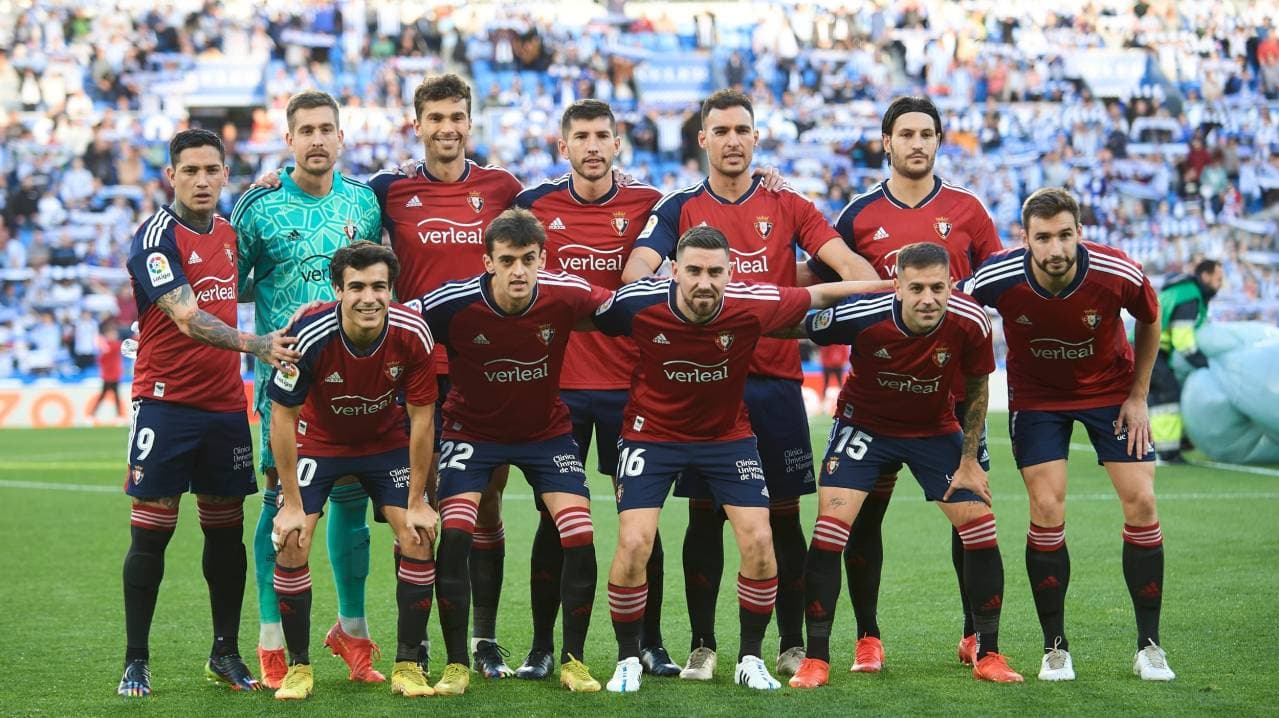
Alessio Lisci stayed loyal to Osasuna’s season-long backbone, rolling out the 4-2-3-1 that has been his most-used shape (22 league games in this formation). S. Herrera anchored the side in goal, shielded by a back four of V. Rosier, A. Catena, F. Boyomo, and A. Bretones. Ahead of them, L. Torro and J. Moncayola formed the double pivot, with R. Garcia, A. Oroz, and V. Munoz supporting lone striker A. Budimir.
The structure reflected Osasuna’s identity this season: at home they average 1.6 goals for and 1.3 against, a team that leans into El Sadar’s intensity, pressing high and accepting risk. Their overall 7 clean sheets, with 5 of those at home, come not from passive defending but from controlled aggression.
Espanyol, under Manolo Gonzalez, answered with a textbook 4-4-2 – one of the club’s core systems this campaign (12 league games in this shape, alongside a heavier use of 4-2-3-1). M. Dmitrovic started in goal, behind a defence of O. El Hilali, C. Riedel, L. Cabrera, and C. Romero. The midfield four – T. Dolan, U. Gonzalez, Pol Lozano, and P. Milla – provided both legs and guile, while Exposito and K. Garcia led the line.
Their season numbers are clear: on their travels Espanyol score 1.2 goals per game and concede 1.6, a negative balance but one that has been enough to deliver 5 away wins and 5 away clean sheets. This is a team that often lives on the edge but is comfortable in transition.
II. Tactical Voids: Absences and Discipline
Both sides entered this fixture with key absentees that subtly rewrote the tactical script.
Osasuna were without R. Moro, ruled out through injury. While not a headline name, his absence reduced Lisci’s options for wide rotation and late-game verticality from the bench – a small but real limitation in a side that has failed to score in 11 matches overall, all of those blanks coming largely away but still indicative of a fragile attacking ecosystem.
Espanyol’s voids were heavier in profile: C. Ngonge and J. Puado both missed out with knee injuries. Without them, Gonzalez had fewer direct runners and penalty-box threats to rotate into the front line, increasing the creative burden on Exposito and the timing of third-man runs from midfield.
From a disciplinary standpoint, this was always likely to be a spiky contest. Heading into this game, Osasuna’s yellow-card profile showed a late-game surge: 21.35% of their yellows came between 76-90', with another 14.61% in the 91-105' window. Espanyol’s own late-game edge was even sharper, with 30.00% of their yellows arriving between 76-90' and 16.67% between 91-105'. Both teams are conditioned to fight – and foul – in the closing stretch.
Red-card history added another layer. Osasuna’s season red distribution includes 28.57% of reds in 31-45', 28.57% in 76-90', and 28.57% in 91-105', while Espanyol’s reds spike in 46-60' (40.00%) and 76-90' (40.00%). This is not a fixture for the faint-hearted; it is one where the final quarter of the match is as much about emotional control as tactical detail.
III. Key Matchups: Hunter vs Shield, Engine Room Battles
The headline duel was always going to be A. Budimir against Espanyol’s back line. Budimir, with 17 goals in La Liga and a rating of 6.84, has been one of the league’s most reliable finishers. He thrives on early crosses, second balls, and penalty-box chaos. He has taken 88 shots with 41 on target and even from the spot he is high-volume and high-risk: 6 penalties scored but 2 missed. Osasuna as a team have a perfect season record from the spot in the league data (6 scored from 6, 100.00%), but Budimir’s individual tally reveals the fine margins he lives on.
His direct opponent in the heart of Osasuna’s own defence, A. Catena, told the story of the “shield” from the other side. For Osasuna this season, Catena has been immense: 32 blocked shots, 33 interceptions, and 1673 passes at 85% accuracy. He is also one of the league’s most card-prone defenders, with 11 yellows and 1 red. In this match he again stood as the organiser and last-ditch barrier, but the structural vulnerability around him – especially when full-backs pushed high – left spaces for Espanyol’s forwards to exploit.
On the Espanyol side, the “Hunter vs Shield” narrative flipped: Exposito, listed as a forward here, and K. Garcia tested Osasuna’s defensive line with movement and link play. Exposito’s season as a creator has been outstanding: 6 assists, 80 key passes, and 965 total passes at 76% accuracy. He is not just a playmaker; he is a territorial weapon, progressing the ball and drawing 42 fouls. His presence between the lines forced L. Torro and J. Moncayola to constantly choose between stepping out and protecting the back four.
The “Engine Room” duel pitted Moncayola against Pol Lozano. Moncayola has been Osasuna’s metronome and enforcer: 1369 passes at 80% accuracy, 52 tackles, and 38 key passes. He carries 9 yellow cards but no reds, a player who walks the disciplinary tightrope without falling. Lozano, for Espanyol, is more combustible: 945 passes at 87% accuracy, 38 tackles, 22 interceptions, but 11 yellow cards and 1 yellow-red. His 64 fouls committed underline his role as the disruptor. Their clash in central spaces defined the rhythm – Moncayola trying to build and switch, Lozano intent on breaking play and setting the tone physically.
Out wide, O. El Hilali’s duel with V. Munoz and A. Bretones was another key axis. El Hilali has been a defensive workhorse: 72 tackles, 15 blocked shots, 40 interceptions, and 9 yellows. His capacity to win 130 duels out of 237 allowed Espanyol to be braver with their right flank, knowing he could absorb one-versus-one situations.
IV. Statistical Prognosis: What the Numbers Say About the Story
Following this result, the numbers sketch a clear tactical logic. Osasuna, with 44 goals for and 49 against overall, are a side whose attacking production is respectable but not explosive, and whose defensive record is slightly worse than mid-table. Their home strength – 31 goals for and 24 against at El Sadar – remains their lifeline, but a run of “LLLLW” in the form column before this match underlined a team flirting with danger.
Espanyol, by contrast, carry a more volatile profile: 42 goals for and 54 against overall, conceding 1.5 per game on average. Yet their ability to collect 12 wins and 10 clean sheets, split evenly between home and away (5 clean sheets on their travels), shows a team that can oscillate between chaos and control. Their away record of 22 goals scored and 31 conceded suggests that when the game becomes stretched, they have enough structure and individual quality – especially through Exposito, P. Milla, and the work of U. Gonzalez and Lozano – to punish lapses.
From an Expected Goals perspective, even without explicit xG numbers in the data, the profiles are telling. Osasuna’s reliance on Budimir, their zero misses from 6 team penalties, and a home average of 1.6 goals for point toward a side that generally creates decent-quality chances but lacks a diversified threat map. Espanyol’s broader spread of creators and scorers – with P. Milla’s 7 goals, Exposito’s 6 assists, and contributions from deeper runners – hints at a more varied xG distribution, even if their finishing and defensive lapses have dragged their goal difference down to -12.
Defensively, Osasuna’s 7 clean sheets overall and Espanyol’s 10 suggest that, on their best days, both can lock games down. But the card distributions – especially the late surges in yellows and significant red-card clusters between 46-60' and 76-90' for Espanyol, and 31-45', 76-90', and 91-105' for Osasuna – indicate that control often frays exactly when game states become most volatile.
In that context, a narrow 2–1 away win for Espanyol feels like the statistical midpoint between their attacking opportunism and defensive fragility, and Osasuna’s home courage and systemic cracks. The Hunter in Budimir found resistance in a compact Espanyol back line; the Shield in Catena was breached just enough by Exposito, K. Garcia, and the supporting runs from midfield.
Following this result, the prognosis is clear. Osasuna remain a dangerous, emotionally charged home side whose season has been defined by fine margins and disciplinary tightropes. Espanyol leave Pamplona looking like a mid-table team with the tools – and the temperament – to turn unstable matches into decisive, if narrow, victories.