.svg&w=384&q=75 "naujapitch logo")
Morocco Stuns Netherlands in World Cup Penalty Shootout
The moment Ismael Saibari broke free, half of Morocco’s bench took off after him. By the time they caught up, nobody could tell who was who, swallowed in a tangle of limbs, shirts and disbelief. Somewhere in that pile lay the man who had just dragged Morocco into the last 16 of the World Cup and sent one of Europe’s traditional powers out into the night.
Across the pitch, Cody Gakpo stood alone with a different kind of weight on his shoulders.
Gakpo’s goal, and a grief that wouldn’t shift
When Gakpo slammed the Netherlands into the lead on 72 minutes, the celebration told its own story. Orange shirts flooded the pitch from everywhere – substitutes, staff, starters – not just because this felt like a pivotal World Cup goal, but because of who had scored it and what he was carrying.
Gakpo had chosen to play despite the announcement that he and his partner had lost their unborn son. After the ball crashed into the net, he barely seemed to register the chaos around him. On the way back to halfway he pointed to the sky, tears welling, as Denzel Dumfries wrapped an arm around him and tried, in vain, to offer some comfort.
In another version of this night, that goal wins it. The narrative writes itself: football as redemption, the healing power of sport, the cathartic release of a man in mourning. But the game does not deal in sentiment. It rarely does. It reserves the right to be cruel, and in Doha it exercised that right with a vengeance.
Koeman’s gamble: safety first, joy last
Ronald Koeman will wake up with questions ringing in his ears. He may well insist he got it right. Many will disagree.
The Netherlands arrived at this tie as one of the tournament’s most free-scoring sides. Seven goals against Sweden and Japan, three more in a dead rubber with Tunisia. Nobody had scored more in the group phase. Yet when faced with Morocco, Koeman’s instinct was not to lean into that attacking power, but to retreat from it.
Out went the familiar 4-3-3. Out went Tijjani Reijnders. In came a five-man back line and a plan built on restraint. The idea was clear: keep it tight, blunt Morocco, nick it when the moment comes.
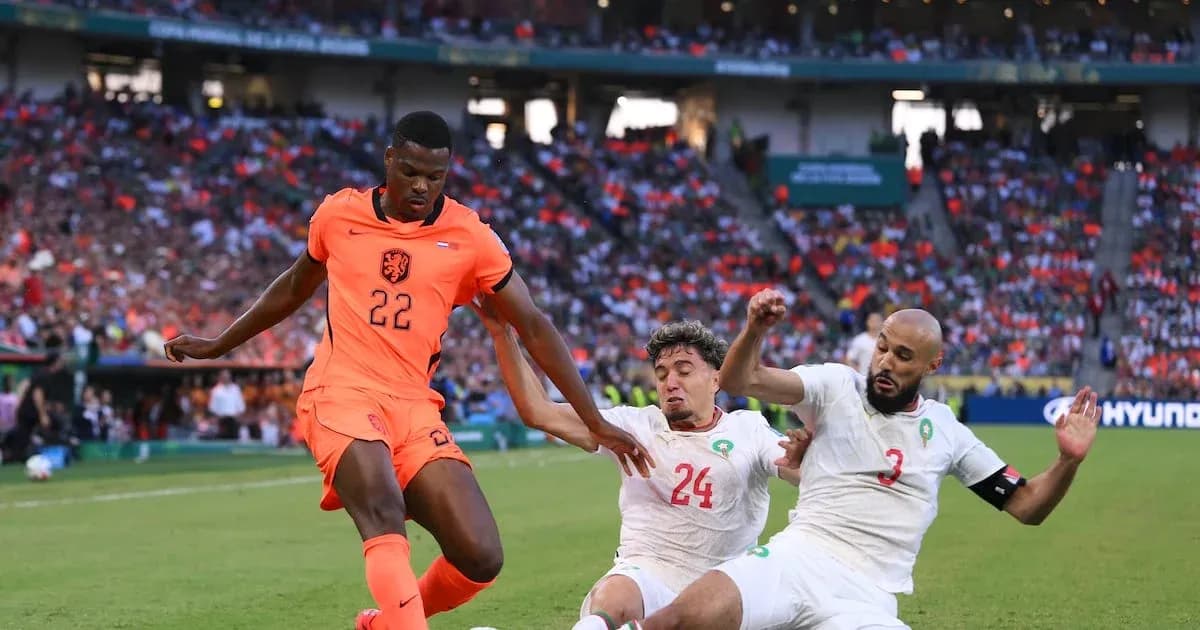
What followed was a scratchy, cautious performance that ceded 70% of the ball and almost all of the initiative. For long stretches, the Netherlands barely laid a glove. Micky van de Ven’s thumping drive just before half-time, tipped over by Yassine Bounou, was the only real note of threat. At the other end, Bart Verbruggen had already been forced into action, springing to deny Neil El Aynaoui and Achraf Hakimi.
Koeman, unrepentant later, pointed to the quality of the opposition. Morocco, he argued, were a different level to those the Dutch had already dismantled. On the scoreboard, for a few precious minutes, he looked vindicated.
A match thick with history and needle
From the opening whistle this was not just a football match. It was loaded.
The countries’ deep ties hummed in the background, a shared history adding another layer to the usual tension of a World Cup knockout. On the pitch, it showed in the challenges: sharp, late, insistent. Jan Paul van Hecke seemed to collect every bruise going, clattered three times in the first half, his head finally left bleeding.
In the stands, the theatre took on a life of its own. Local fans gleefully revived an old grievance, reminding the Netherlands that this date marked 12 years since Arjen Robben’s infamous tumble against Mexico, which led to a late penalty and a last-16 escape. Every Dutch touch early on was greeted with a chorus of boos, Moroccan supporters only too happy to join in.
Hakimi, quiet by his standards before the interval, began to find angles and gaps after it. His underlapping runs sliced at Koeman’s defensive wall. On one of them Van de Ven had to throw himself into a crunching last-ditch tackle, the sort that rattles the bones and the stadium alike.
Still, Morocco were not fully fluent. The Dutch block did its job for long enough. And then, bizarrely, a drinks break seemed to change everything.
Hydration break, hammer blow
Midway through the second half, with Morocco firmly in control and the Dutch struggling to breathe, play stopped for one of Fifa’s now-routine hydration pauses. It felt innocuous. It wasn’t.
The break allowed Koeman to reach for his old emergency plan. On came Wout Weghorst for the ineffective Brian Brobbey, the battering ram wheeled out for one more mission.
Within seconds, the script flipped. Verbruggen launched long, Weghorst flicked on, Crysencio Summerville burst through and, under pressure, hooked the ball across to Gakpo. One touch, one ruthless finish, and suddenly the Netherlands were ahead, celebrating wildly, their rope-a-dope approach looking suspiciously like a masterstroke.
For a while, it looked as if they would ride that wave all the way through, just as they had in 2010 on their way to the final. Morocco pushed, probed, angled crosses in from both flanks. The Dutch sat deeper, and deeper still. Time ticked away.
Then the game turned on a single, glorious delivery.
Diop’s late leveller and a twist of the knife
The board went up. Added time. The Dutch bench edged closer to the touchline, sensing the finish line.
And then Chemsdine Talbi, a Morocco substitute, took charge on the right. He checked onto his stronger foot and sent in a cross so inviting it almost demanded a scorer. Issa Diop obliged, thundering in at the back post and rising above his marker to head home in the first minute of stoppage time.
The Moroccan end erupted. The Netherlands’ desolation was instant, and visible. They had been a couple of minutes from a controlled, if joyless, passage into the last 16. Instead, they were dragged into extra time by a side that refused to accept the script.
Extra time itself never quite caught fire. Legs went, space opened but rarely with conviction. Verbruggen, outstanding throughout, produced one more big moment, flinging himself to deny Soufiane Rahimi in the clearest chance of the additional 30 minutes. Bounou, at the other end, watched mostly in relative calm.
So it came down to penalties. A test of nerve from 12 yards, with an entire tournament hanging in the balance.
The shootout, and a sliding-doors moment
Both sides blinked early. One miss each, tension ratcheting up with every step from the centre circle.
Then came the moment Koeman would later call a sliding door. Rahimi strode up for Morocco and struck low. Verbruggen guessed right, got down, and appeared to have saved it. For a heartbeat, the Dutch roared. The ball, cruelly, spun off his trailing heel and trickled over the line.
Fine margins. Brutal ones.
Quinten Timber then dragged his kick horribly wide, the kind of miss that sticks in a player’s mind for years. Hakimi, usually ice-cold, smacked the post and briefly reopened the door. But Bounou held firm, and when Saibari converted, the Moroccan goalkeeper and his team-mates sprinted towards the corner, swallowed by that now-familiar avalanche of bodies.
Morocco had won 3–2 on penalties. The Netherlands were out.
Canada await Morocco next. On a day when Europe’s powers stumbled, Africa’s standard-bearers kicked that door open again and walked straight through.