.svg&w=384&q=75 "naujapitch logo")
Michael Carrick Takes Charge as Manchester United Head Coach
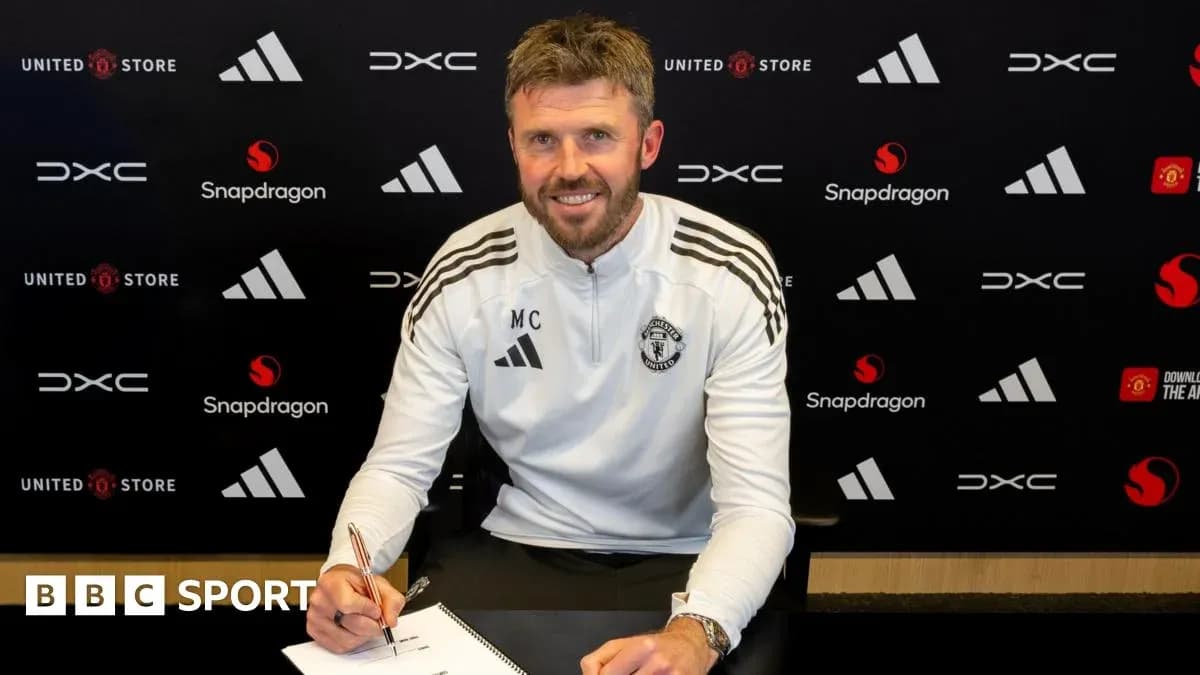
Manchester United have removed the word “interim” from Michael Carrick’s title and handed him the keys to Old Trafford for good, appointing the 44-year-old as permanent head coach on a two-year deal.
It is a reward for a surge that has dragged United out of the drift that followed Ruben Amorim’s sacking in January and pushed them, against most expectations, back into the Champions League.
From caretaker to standard-bearer
Carrick stepped in as a stop-gap. He has ended the season as the man United believe can lead a full-scale rebuild.
Since taking charge on 13 January, he has overseen 16 league games. United have won 11 of them. No Premier League club has collected more points in that period than the 36 gathered under his watch. The club are guaranteed third place after Sunday’s frantic, nerve-jangling win over Nottingham Forest, a result that sealed their return to Europe’s top table.
Those numbers have not gone unnoticed. Carrick’s name sits on a six-man shortlist for the Premier League manager of the season award, a marker of how sharply the narrative has turned.
For Carrick, who arrived as a player two decades ago and quietly became one of the most influential midfielders of his generation, the promotion carries a deep personal weight.
“From the moment that I arrived here 20 years ago, I felt the magic of Manchester United. Carrying the responsibility of leading our special football club fills me with immense pride,” he said, speaking like a man who understands exactly what he is walking into rather than someone dazzled by the office door plate.
He has leaned heavily on the collective, too.
“Throughout the past five months, this group of players have shown they can reach the standards of resilience, togetherness and determination that we demand here. Now it's time to move forward together again, with ambition and a clear sense of purpose. Manchester United and our incredible supporters deserve to be challenging for the biggest honours again.”
The words fit the club’s mythology. The task is far more brutal.
Calm amid the noise
Over recent weeks, Carrick has been asked the same question over and over: what happens next? When will there be clarity? At times he could have pointed reporters back to their own transcripts.
The clarity has now arrived. So has the hard part.
Third place in a stripped-back 40-game campaign – no European football, early exits in both domestic cups – is one thing. Navigating a season that could stretch to 60 matches, across four fronts, is another entirely.
Carrick has brought something United have craved for years: calm. The mood at Carrington has softened, the dressing room feels more stable, and he has refused to flap in moments that would once have sent the club spiralling. Statistical breakdowns have surfaced suggesting United’s performances have not always matched their results since Amorim’s departure. That criticism misses the shift in mentality and organisation that has underpinned this run.
Yet even calm managers need help.
A squad that must be rebuilt, not just tweaked
The coming window will define whether this appointment becomes a platform or a false dawn. United’s recruitment has to be sharp, and it has to be brave.
Central midfield is the glaring fault line. Casemiro is leaving. Manuel Ugarte has not convinced at the level United require. Kobbie Mainoo, for all his promise and poise, cannot be flogged through every fixture of a 60-game slog.
Carrick needs legs, control and depth in that area, not just another name on the squad list.
Other gaps are opening. If Patrick Dorgu continues to be pushed into more advanced roles, Luke Shaw cannot be left as the only serious option at left-back. The position demands genuine competition, not a stop-gap.
The same tension exists in goal. Senne Lammens needs a challenger, yet Radek Vitek, outstanding on loan at Bristol City, wants to keep playing every week. That is unlikely to happen if he returns to sit on the bench at Old Trafford. United must decide whether to bring him back as an understudy, sign another goalkeeper, or cash in on his form and look elsewhere.
These are not theoretical debates. They are structural decisions that will shape Carrick’s first full season.
Academy promise, senior responsibility
United’s academy, as ever, offers hope.
Eighteen-year-old midfielder Jacob Devaney has impressed in the Scottish Premiership with St Mirren, showing the composure and range of passing that tends to catch the eye at Old Trafford. Shea Lacey, a bright England Under-20 international, looks set for more chances next season and has the kind of directness that can jolt a game awake.
Those names matter. They fit the club’s identity. But they cannot be asked to carry the project.
The academy can supplement; it cannot do the heavy lifting. Carrick needs a recruitment department that matches his clarity with its own.
From revival to expectation
What began as a salvage mission has turned into something more ambitious. United are back in the Champions League. The table says they are the third-best side in the country over the course of this league campaign. The form table since January paints an even more flattering picture.
Strip away the emotion, though, and the scale of the next step becomes obvious.
With extra games, more travel and higher stakes, simply holding onto third place next season would represent a major leap. The margins at the top are thin, the schedule unforgiving, and the patience of a fanbase conditioned to demand titles is not infinite.
Carrick has earned his chance. He has restored a measure of authority to the dugout and given United something they have lacked for too long: a sense of direction.
Now comes the question that will define his tenure: will the club give him the players – and the structure – to turn this resurgence into a genuine return to the elite, or will another promising chapter be left unfinished?