.svg&w=384&q=75 "naujapitch logo")
Manchester City Dominates Brentford 3-0 in Premier League Showdown
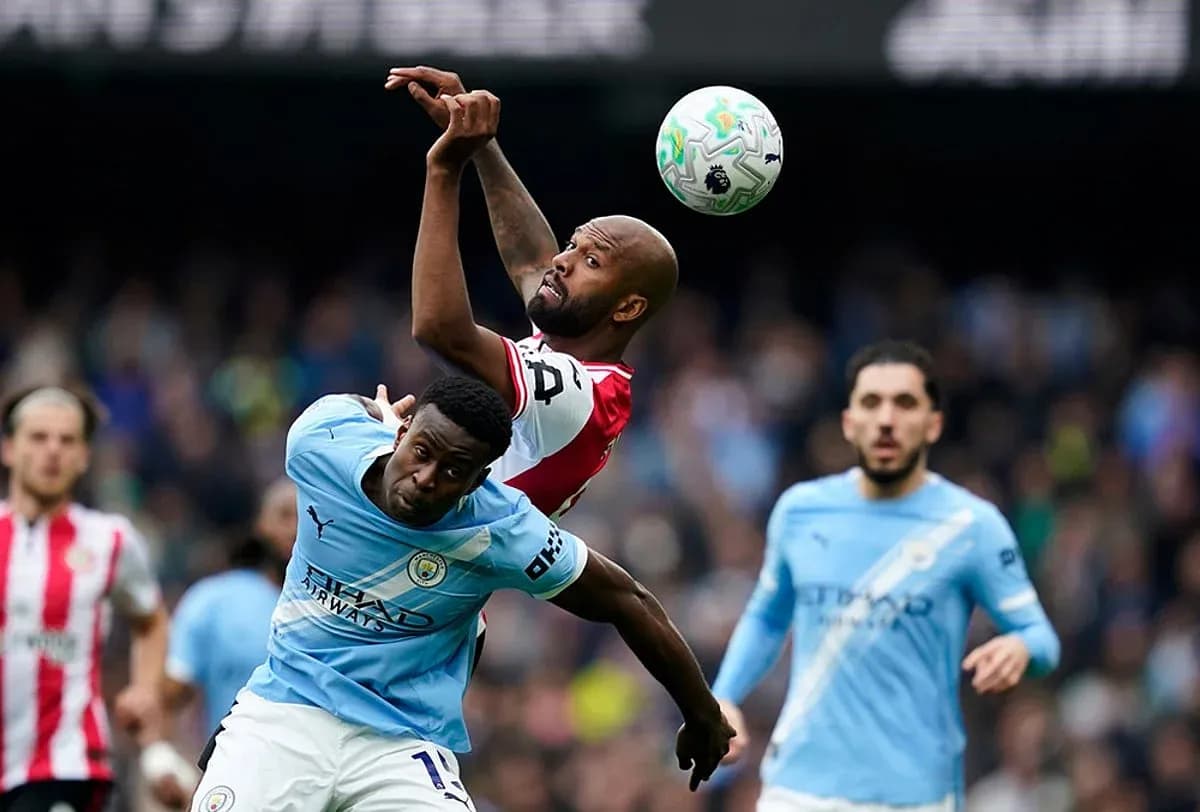
Manchester City’s 3–0 win over Brentford at the Etihad Stadium in Premier League Round 36 was a controlled, data-backed domination built on territorial pressure and a decisive second-half gear change. With 59% possession, 25 shots and an xG of 2.98, Pep Guardiola’s side eventually converted statistical superiority into scoreboard clarity, while Brentford’s limited 0.24 xG underlined how effectively City suppressed threat. The game was goalless at half-time, but Jérémy Doku’s opener on 60', Erling Haaland’s strike on 75' and Omar Marmoush’s stoppage-time finish reflected a tactical arc: patient first-half probing, then vertical acceleration and fresh legs overwhelming a tiring Brentford block.
Executive Summary
Scoring Sequence & Disciplinary Log
The first half’s key inflection was disciplinary rather than attacking. On 36', Bernardo Silva (Manchester City) received a yellow card — Argument — signalling rising emotional temperature despite City’s control of the ball.
The breakthrough came on 60', when Jérémy Doku scored a Normal Goal for Manchester City, capitalising on sustained pressure that had already produced a heavy shot volume. Immediately after, Guardiola reshaped his attacking structure: Rayan Cherki (OUT) was replaced as Omar Marmoush (IN) came on for him at 60', and Tijjani Reijnders (OUT) was withdrawn with Phil Foden (IN) coming on for him, also at 60'. These twin substitutions injected more direct running and final-third craft.
Brentford responded with structural changes of their own. At 61', Aaron Hickey (OUT) made way as Vitaly Janelt (IN) came on, a move towards shoring up central zones and second balls. On 68', Mikkel Damsgaard (OUT) was replaced when Dango Ouattara (IN) came on, adding pace to Brentford’s transition threat.
City’s sustained pressure told again on 75', when Erling Haaland scored a Normal Goal, doubling the lead and effectively breaking Brentford’s resistance. Keith Andrews then turned to experience and control: at 79', Yehor Yarmoliuk (OUT) was replaced as Jordan Henderson (IN) came on, an attempt to stabilise possession and game management.
The second wave of discipline followed Brentford’s attempts to compete more aggressively. On 80', Kristoffer Ajer (Brentford) was shown a yellow card — Foul — reflecting the strain of defending repeated City incursions. Late-game frustration and contesting of decisions then surfaced: at 88', Matheus Nunes (Manchester City) was booked — Argument — and, in the same minute, Jordan Henderson (Brentford) also received a yellow card — Argument.
City’s third goal arrived in added time and showcased the impact of Guardiola’s bench. At 90+2', Omar Marmoush scored a Normal Goal for Manchester City, assisted by Erling Haaland, sealing the 3–0. Shortly after, game management tipped into caution: at 90+5', Omar Marmoush (Manchester City) was shown a yellow card — Time wasting — as City ran down the clock. The final substitution came in regulation time: Jérémy Doku (OUT) left the pitch with Savinho (IN) coming on for him at 90', a like-for-like wide replacement to maintain vertical threat while protecting a key performer.
Disciplinary totals are therefore: Manchester City 4 yellow cards (Bernardo Silva, Nico O’Reilly, Matheus Nunes, Omar Marmoush); Brentford 2 yellow cards (Kristoffer Ajer, Jordan Henderson). Total cards: 6.
Tactical Breakdown & Personnel
Guardiola’s starting XI was built around technical security and wide dynamism. Gianluigi Donnarumma in goal, with a back line of Matheus Nunes, Marc Guéhi, Nathan Aké and Nico O’Reilly, formed a possession-heavy defensive unit. Even with Nunes and O’Reilly listed as defenders, their profiles suggest an asymmetrical build-up: Nunes stepping into midfield lanes, O’Reilly offering underlapping progression. The double pivot and advanced midfielders — Tijjani Reijnders, Bernardo Silva, Antoine Semenyo and Rayan Cherki — gave City multiple central overload options, while Jérémy Doku and Erling Haaland provided the depth and penalty-box threat.
The numbers support this territorial model: 463 total passes at 86% accuracy versus Brentford’s 320 at 76% show City’s dominance in circulation. Fifteen shots inside the box and ten outside underline a balanced shot profile: they were able to access the area regularly while also taking selective efforts from range to stretch Brentford’s block.
Defensively, City’s “Defensive Index” in this match can be read through volume and quality suppression. Brentford were held to just 4 total shots, 2 on target, and an xG of 0.24. Donnarumma needed only 2 goalkeeper saves, indicating that most Brentford efforts were either blocked (1 blocked shot) or forced into low-probability positions. City’s 8 fouls and 4 yellow cards reflect active counter-pressing and some emotional spikes rather than systemic defensive instability.
Brentford’s structure under Keith Andrews was more reactive. With Caoimhin Kelleher in goal and a back line of Michael Kayode, Kristoffer Ajer, Nathan Collins and Keane Lewis-Potter, they looked to compress central channels and rely on wing-backs and midfielders — Yehor Yarmoliuk, Mathias Jensen, Aaron Hickey, Mikkel Damsgaard — to shuttle and counter. Kevin Schade and Igor Thiago up front were tasked with stretching City on transition, but the data shows how little they could generate: only 2 shots inside the box and 2 outside, with just 2 corners and 2 offsides, indicating infrequent deep incursions and limited attempts to play in behind.
Kelleher’s 7 saves against City’s 10 shots on target, combined with a goals-prevented figure of 1.5 (matching Donnarumma’s 1.5 at the other end), highlight both goalkeepers’ effectiveness relative to shot quality. However, the volume disparity — City’s 25 shots to Brentford’s 4 — meant that Brentford’s resistance was always likely to crack as fatigue set in.
Substitutions were tactically decisive. For City, Phil Foden and Omar Marmoush added fresh movement between the lines and in behind, making it harder for Brentford to hold a compact shape. Marmoush’s goal and subsequent yellow card for Time wasting encapsulate his impact: decisive in transition, then central to closing the game. Savinho’s late introduction for Doku preserved City’s capacity to threaten on the break, discouraging Brentford from overcommitting.
For Brentford, Vitaly Janelt and Dango Ouattara were attempts to recalibrate the midfield and add pace, while Jordan Henderson’s arrival aimed to stabilise possession and leadership. Yet, with City’s xG almost 3 and Brentford pinned back, these changes could not reverse the territorial tide.
The Statistical Verdict
From a statistical standpoint, this match was a textbook case of dominance translating to the expected outcome. City’s xG of 2.98 versus Brentford’s 0.24 aligns almost perfectly with the 3–0 scoreline, suggesting finishing and chance quality broadly matched the underlying metrics. City’s 59% possession, 463 passes at 86% accuracy, and 10 corners underscore sustained pressure and territorial control. Brentford’s 41% possession, 320 passes at 76%, and just 2 corners reflect a side largely confined to their own half and reliant on sporadic breaks.
Defensively, City’s low shots conceded and Donnarumma’s modest 2 saves, combined with a goals-prevented figure of 1.5, indicate a high “Defensive Index” performance: they not only limited volume but also suppressed shot quality. Brentford’s higher foul count (14 to City’s 8) and 2 yellow cards show the strain of repeated defensive actions.
Overall form-wise, this fixture projects Manchester City as a side whose statistical profile — high xG, high possession, strong suppression of opponent xG — is fully aligned with elite performance levels. Brentford’s figures, by contrast, depict a team that defended bravely through Kelleher’s 7 saves and 1.5 goals prevented, but could not generate enough attacking volume or quality to challenge the outcome.