.svg&w=384&q=75 "naujapitch logo")
Liverpool and Chelsea Share Tactical Draw in Premier League
Liverpool and Chelsea shared a 1–1 draw at Anfield in Premier League Round 36, a match that was tactically tight and statistically even. Arne Slot’s Liverpool struck early through Ryan Gravenberch, but Calum McFarlane’s Chelsea responded via Enzo Fernández before half-time. From there, the contest became a battle of structures and control rather than volume of chances, with both sides finishing on very low expected goals (0.56 vs 0.5) and identical goalkeeper save counts. Chelsea edged possession and passing accuracy, Liverpool created slightly more shots, and a late flurry of cards reflected the intensity of a match where neither side ever fully imposed itself.
Goals
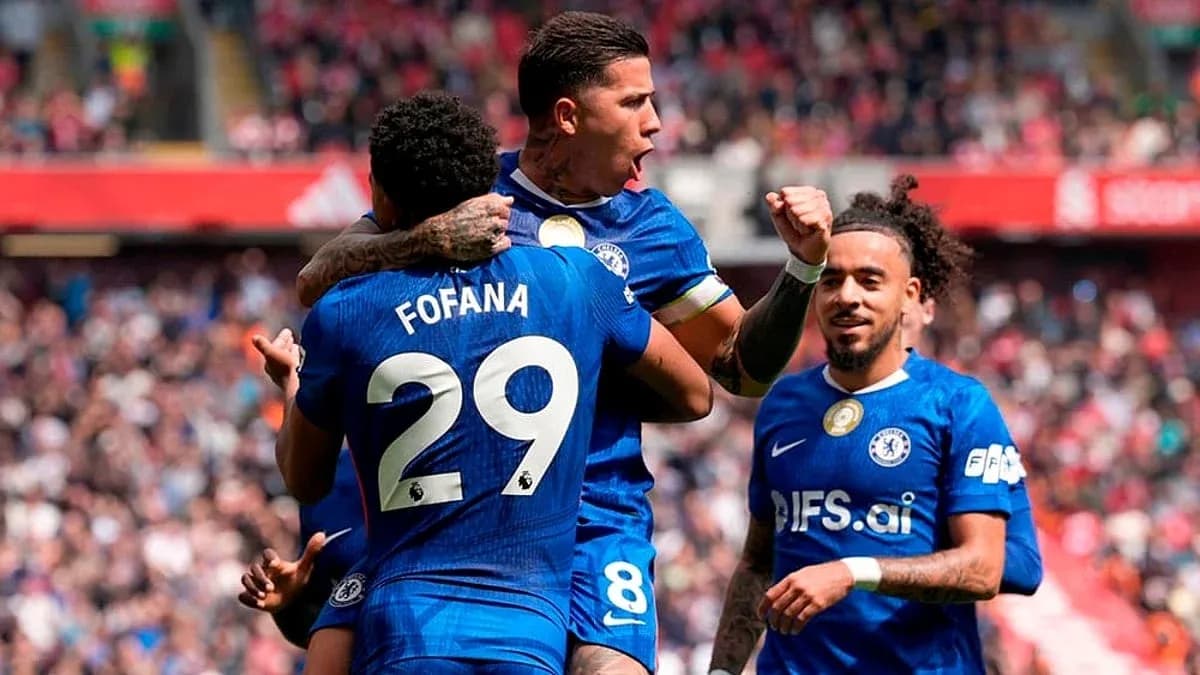
The scoring opened at 6' when Ryan Gravenberch (Liverpool) finished a move assisted by Rio Ngumoha, rewarding Liverpool’s aggressive early pressing and vertical midfield running. Chelsea equalised at 35' through Enzo Fernández, who struck without an assist, indicative of Chelsea’s ability to exploit second balls and central spaces once they settled into the game. At 50', Cole Palmer briefly thought he had turned the match, but his goal was cancelled following a VAR intervention, a pivotal moment that kept the tactical balance intact and denied Chelsea the platform to drop deeper and counter.
Substitutions
From there, the game became more attritional and substitution-driven. At 63', Reece James (IN) came on for Andrey Santos (OUT), allowing Chelsea to reshape their right side and gain more width and ball progression from deep. At 67', Alexander Isak (IN) replaced Rio Ngumoha (OUT), a clear shift from a midfield runner to a more fixed reference in the front line for Liverpool. Later, at 77', Federico Chiesa (IN) came on for Cody Gakpo (OUT), and Joe Gomez (IN) replaced Ibrahima Konaté (OUT), giving Liverpool fresh legs in attack and defence simultaneously.
Discipline
Discipline escalated in the final 25 minutes. The full card log, in chronological order, is:
- 67' Jorrel Hato (Chelsea) — Foul
- 73' Enzo Fernández (Chelsea) — Foul
- 83' Marc Cucurella (Chelsea) — Foul
- 88' Joe Gomez (Liverpool) — Argument
- 89' Moisés Caicedo (Chelsea) — Handball
- 90+4' Alexis Mac Allister (Liverpool) — Persistent fouling
Totals: Liverpool: 2 yellow cards, Chelsea: 4 yellow cards, Total: 6.
These bookings underline Chelsea’s repeated tactical fouling to break Liverpool’s rhythm, and Liverpool’s own late-game frustration and accumulation in midfield.
Tactical Analysis
Tactically, Liverpool’s structure leaned on a high technical back line with Virgil van Dijk and Ibrahima Konaté, plus Curtis Jones and Miloš Kerkez as full-backs, all comfortable advancing into midfield. With Jeremie Frimpong and Dominik Szoboszlai as advanced midfielders and Alexis Mac Allister orchestrating centrally, Slot aimed for a fluid, possession-aggressive shape that could overload Chelsea between the lines. Rio Ngumoha’s inclusion as a midfielder behind Cody Gakpo added verticality and dribbling threat, reflected in his early assist.
However, Liverpool’s attacking output was modest: 8 total shots, 3 on target, and xG of 0.56. The structure produced territory and some box entries (5 shots inside the box) but not sustained high-quality chances. Their 48% possession and 473 passes at 84% accuracy show a side willing to cede slight control to Chelsea in exchange for more direct forward play. The substitution of Ngumoha for Alexander Isak shifted Liverpool towards a more classic focal point, but without a surge in shot volume, suggesting Chelsea’s back line, led by Wesley Fofana and Levi Colwill, adapted well.
Chelsea’s approach was more control-oriented. With Moisés Caicedo and Andrey Santos initially anchoring midfield, and Enzo Fernández and Cole Palmer higher, McFarlane built a central box that aimed to outnumber Liverpool’s pivots. Marc Cucurella and Malo Gusto provided width from deeper starting positions, which helped Chelsea to a 52% possession share and 515 passes at 87% accuracy. Yet their chance creation mirrored Liverpool’s in moderation: 6 total shots, 3 on target, and xG of 0.5. Four shots inside the box suggest some penetration but not sustained dominance.
The key tactical moment was the disallowed Palmer goal at 50'. That sequence underlined Chelsea’s capacity to exploit transitional spaces and Palmer’s positioning between the lines. Once VAR cancelled it, Liverpool could maintain their higher defensive line without being forced into a deeper, more reactive block. The subsequent introduction of Reece James at 63' for Andrey Santos rebalanced Chelsea’s shape, giving them a stronger right-sided outlet and slightly more defensive security against Liverpool’s right-sided rotations with Frimpong and Szoboszlai.
Defensive Performance
Defensively, both sides were compact and relatively disciplined in open play. Liverpool committed 17 fouls and Chelsea matched that with 17, but Chelsea’s four yellow cards—three for “Foul” (Hato, Fernández, Cucurella) and one for “Handball” (Caicedo)—show a more repeated reliance on tactical infractions to slow Liverpool’s transitions. Liverpool’s two bookings were qualitatively different: Joe Gomez for “Argument” at 88', reflecting emotional tension, and Alexis Mac Allister at 90+4' for “Persistent fouling”, a sign of accumulated midfield infringements as Liverpool tried to disrupt Chelsea’s late possession phases.
In goal, Giorgi Mamardashvili for Liverpool and Filip Jørgensen for Chelsea each recorded 2 saves. With both teams’ “goals prevented” at -0.49, the data suggests each keeper conceded slightly more than the underlying shot quality might predict, aligning with the fact that both goals came from relatively low overall xG environments. Neither goalkeeper was overworked; instead, the match was decided by structural balance and midfield control rather than shot-stopping heroics.
Statistical Overview
Statistically, the verdict is of near-parity with nuanced differences. Liverpool: 8 shots to Chelsea’s 6, more corners (5 vs 2), and equal offsides (2–2), pointing to slightly more territorial pressure and set-piece presence. Chelsea: marginally higher possession (52%), better passing volume (515 vs 473) and accuracy (87% vs 84%), indicating superior circulation and ball retention. Both teams’ xG figures (0.56 vs 0.5) underline how few clear chances were carved out despite the technical quality on the pitch.
From a broader lens, Liverpool’s Overall Form in this match reflects a side capable of fast starts and structured pressing but still translating possession into only moderate chance quality. Their Defensive Index is solid: limiting Chelsea to 6 shots and 0.5 xG while maintaining an aggressive line and high full-backs. Chelsea’s Overall Form shows composure in possession and flexible in-game adjustment (notably the James substitution), but their attacking edge remains dependent on moments from Enzo Fernández and Cole Palmer rather than a consistent chance machine.
In sum, 1–1 at Anfield accurately mirrors the tactical equilibrium: Liverpool marginally more dangerous in shot volume and set-pieces, Chelsea slightly superior in control and passing, both defences largely on top, and a cancelled Palmer goal via VAR at 50' preventing either side from turning a tight tactical contest into a statement win.