.svg&w=384&q=75 "naujapitch logo")
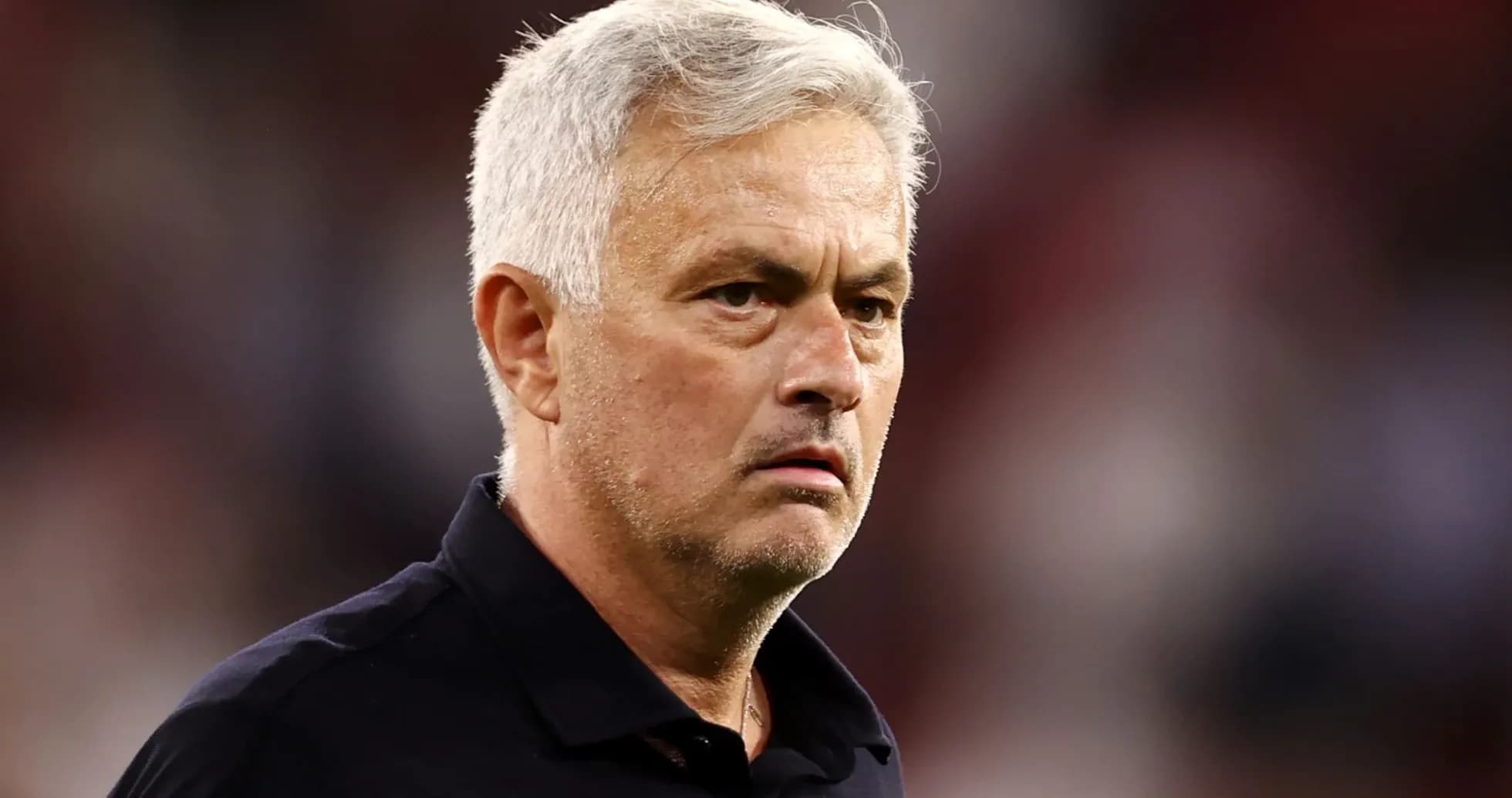
José Mourinho Reflects on Roma's Europa League Final Heartbreak
José Mourinho has coached in some of football’s most fevered arenas, lifted its biggest trophies and survived its fiercest storms. Yet when he is asked which game he would replay if he could, his mind snaps back not to a Champions League night, but to Budapest — and a scar that still burns.
“Roma - Sevilla, Europa League final. Without Anthony Taylor!”
The line, delivered on Adebayo Akinfenwa’s Beast Mode On Podcast, lands with the familiar mix of bite and theatre that has followed Mourinho throughout a 26-year career in the dugout. Time has moved on, the protagonists have scattered, but that night remains lodged in his memory.
The one that got away
His Roma tenure was chaotic, combustible, and utterly compelling. It was also, in its own way, historic.
Under Mourinho, the Giallorossi reached back-to-back European finals. They claimed the inaugural Europa Conference League in 2022, beating Feyenoord and ending an 11-year wait for major silverware in the Italian capital. For a club that had lived on a diet of hope and heartbreak, that night changed something fundamental.
Roma didn’t just win a trophy. They erupted.
“When we won the Conference League in Roma, that city went mad,” Mourinho recalled. “I believe that we did to that city what Champions League winners cannot do in other cities. Roma is a city where people are really, really, really in love with that club. A giant club with incredible passion. Absolutely incredible.”
He had already written his name into UEFA’s history books. That triumph completed a unique treble: Champions League, UEFA Cup/Europa League, and Conference League. No other coach has swept all three.
Yet the following season, in the Europa League final against Sevilla, the story twisted. Roma fought, snarled and dragged the Spanish specialists of this competition into a brutal contest. Penalties decided it. Sevilla did what Sevilla do. Mourinho, for the first time in a European final, walked away beaten — and seething at the Premier League-based officiating team led by Anthony Taylor.
The medals were handed out. The arguments raged. The anger never quite cooled.
A city transformed
If the defeat still gnaws at him, the memory of what he built in Rome clearly sustains him.
“Of course, when we won the Conference League it was the first season of the Conference League, I don't think Europe was giving [recognition] to the Conference League what it is giving now,” he said. The competition might have been dismissed by some as a third-tier trinket. It did not feel that way in the Eternal City.
“When we arrived in Rome and we went for the parade around the Colosseum, Circus Maximus, you realise what you gave to those people.”
That is classic Mourinho territory: the emotional bond, the sense of siege, the idea that a team can lift an entire city. For Roma’s supporters, that night in Tirana and the wild parade that followed were not footnotes. They were a release.
The hardest places, the best rooms
Across his career, Mourinho has tested himself in every environment elite football can offer. Asked to name the most intimidating away ground he has faced, he did not hesitate: Anfield.
The home of Liverpool has long been a stage where visiting managers feel the walls close in. Mourinho has won there, lost there, and felt the stadium at full volume. It still stands out.
He has also worked inside some of the sport’s most star-studded dressing rooms. Now, as he prepares for a second spell at Real Madrid, he believes he is walking back into the best of them all.
He has signed a three-year contract with the Spanish giants and will again command a squad loaded with talent. Jude Bellingham, Kylian Mbappé, Vinícius Júnior — names that define the modern game, gathered under one roof at the Santiago Bernabéu. For a coach who thrives on ego, pressure and expectation, it is fertile ground.
Mourinho has already left his mark there once. Between 2010 and 2013 he led Madrid to a Liga title and a Copa del Rey, breaking Barcelona’s domestic stranglehold and injecting venom into an already ferocious rivalry. Those seasons were turbulent, fractious, but decorated.
He returns older, battle-worn, still hungry.
A career of peaks, and one proudest moment
Mourinho’s honours board stretches across Portugal, England, Italy and Spain. Champions League titles with Porto and Inter. League crowns with Chelsea, Inter, Real Madrid. Domestic cups scattered across four countries.
Pressed to choose the achievement that makes him proudest, he doesn’t reach for the Champions League nights in Porto or at the Bernabéu. He goes back to Roma and that Conference League.
“I did a few!” he said, half-laughing at the sheer volume of his own success, before circling once more to that triumph and the reaction it sparked in the capital.
The trophies in Madrid will always matter. The glare, the pressure, the demand for perfection — they suit him. But that image of a city pouring into the streets, swarming around the Colosseum and Circus Maximus, still cuts through the noise.
Mourinho is heading back to Real determined to drag them to more silverware, to restore and enhance a legacy he began a decade ago. The stage is bigger now, the names brighter, the stakes higher.
Yet somewhere in the background, there is still that night in Budapest, that shootout against Sevilla, and that one name he cannot quite let go.
For a man who has won almost everything, it is telling that the game he wants back is not the one that made him, but the one that denied him.