.svg&w=384&q=75 "naujapitch logo")
Job Ochieng: From Nairobi Dreams to La Liga Stardom
From the dust of Nairobi’s playgrounds to the sharp, unforgiving light of La Liga, Job Ochieng has walked a path that feels closer to a pilgrimage than a career.
This is not a story of overnight success. It is a story of a boy who left home with a borrowed dream and returned that dream with interest.
Nairobi roots, classroom foundations
Born on January 17, 2003 in Nairobi, Ochieng’s football life did not begin under academy floodlights. It began at PCEA Lang’ata School, where the days were split between the order of the classroom and the chaos of the playground.
Those pitches were rough, the balls often worn, the lines imaginary. They were also where his football identity took shape.
He learned to play without applause, without cameras, just the raw contest of break-time matches and the voices of teachers who insisted that talent without education was a dead end. That balance between books and ball planted something deeper than technique: discipline, perspective, a sense of direction.
From there, the city’s grassroots scene pulled him in. Express Soccer Academy gave him his first structured platform, but it was at Ligi Ndogo Academy where his game truly began to sharpen. He stopped being just the quick kid who could dribble past anyone. Coaches demanded more. Scan the pitch. See the spaces. Arrive before the ball. Think.
In Nairobi, his pace made him dangerous. At Ligi Ndogo, his brain started to make him different.
A one-way ticket and a heavy suitcase
The turning point arrived in 2020. A chance to move to Spain with CD Maspalomas in the Canary Islands appeared – distant, expensive, almost unreal.
The move only happened because family and neighbours refused to let the opportunity slip away. People sold what little they had, borrowed money they were not sure they could repay, scraped together coins and hope. By the time he boarded the plane, Ochieng was not just another teenager chasing Europe. He was a vessel for hundreds of sacrifices.
He carried more than a suitcase. He carried expectation.
The welcome in Spain was not what the dream promised. An unstable agency arrangement fell apart soon after he landed in Gran Canaria. Suddenly, the boy from Nairobi was sitting outside with his bags, no clear plan, no bed, no language, no safety net.
For a moment, he was close to disappearing. No headlines, no cameras, just a young player on the edge of being lost in a foreign country.
That is where his resolve hardened.
He decided that if he could survive that stretch – the uncertainty, the fear, the feeling of invisibility – nothing on a football pitch would ever scare him again.
Help finally arrived from inside CD Maspalomas. Staff at the club stepped in, gave him a place to sleep, food to eat, structure to cling to. They didn’t just protect a prospect. They restored a person.
They reminded him that football speaks a language beyond words: effort, consistency, honesty. He took that message into every training session, every game in Spain’s lower divisions, and scouts began to notice.
Zubieta: where instinct meets intelligence
In 2022, Real Sociedad came calling. The move to Zubieta, one of Spain’s most respected academies, marked a new level.
The shock was immediate.
Football there felt like chess at full speed. Every touch scrutinised. Every movement loaded with intention. Every decision judged. There was no room for casual brilliance; only sustained intelligence survived.
To stay, he had to evolve again.
Then the game hit back. Knee problems stalled his rise, slowing his integration into the system just as he was learning its demands. It felt like his life had been paused while everyone else pressed play.
The medical staff drilled a different kind of lesson into him: patience is not weakness. Recovery is not idleness. It is work in silence, repetition in the shadows, trust that the body will repay the investment.
He embraced it. When he returned, he climbed from Real Sociedad C into the B team, and his adaptation to Spanish tactical football accelerated.
In Spain, even defenders think like playmakers. That reality reshaped his approach. Speed and strength were no longer enough. Awareness, timing, anticipation – those became non-negotiable. Every match in the lower leagues felt like a final, each mistake a potential detour for his entire career.
He responded with numbers that told only half the story: 25 appearances, nine goals, two assists for Real Sociedad B in a standout campaign. Behind each statistic sat extra finishing drills, lonely evenings on the training ground, movement patterns repeated until they were instinct.
One night against SD Huesca captured it all. A late winner, three points, but more than that – a flashback of every sacrifice, every doubt, every moment on the brink. The goal was a release as much as a result.
Breaking into La Liga
The rise did not stop at the B team. His performances earned promotion to the first team under coach Pellegrino Matarazzo, and with it the moment every young player imagines: a La Liga debut.
It came against Elche on February 7, 2026.
He stepped off the bench, heart racing louder than the noise around him, trying to calm his breathing while the badge on his chest reminded him how far he had come. This was not the time to be nervous. This was the time to prove he belonged.
He played 27 minutes in a 3-1 win, completing 72 per cent of his passes. Every touch felt heavy, as if Nairobi itself was watching, as if every person who had chipped in for that first ticket to Spain was tracking his every move. Once he settled into his rhythm, a barrier inside him seemed to crack.
After the final whistle, there was no wild celebration. Just a phone call to his mother so she could hear the roar of a La Liga stadium and understand, in sound, what the moment meant.
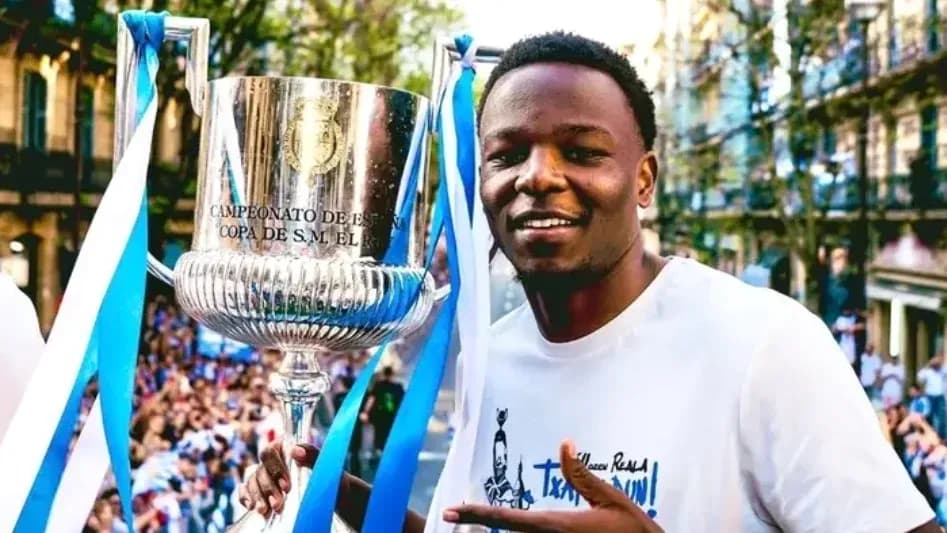
Real Sociedad responded with faith of their own: a contract extension through 2028. He signed it with his parents beside him. His father’s hands shook as he held the pen. Years of uncertainty, of scraping by, suddenly translated into stability.
This was no longer a distant dream. It was a career, rooted in something real.
Carrying a nation, carrying a city
His rise has not gone unnoticed back home. Under Benni McCarthy, Ochieng has stepped into the Harambee Stars setup, and the weight there is different.
Club football is pressure. International football is responsibility.
When the Kenyan anthem plays, he knows he is not just representing himself or his employers in Spain. He is carrying the emotions of millions who see in him a proof of possibility.
Still, he refuses to drift away from where it all started. Nairobi travels with him – in every sprint, every press, every decision. He returns whenever he can, stepping back onto the same kind of pitches where he once played barefoot, talking to kids who remind him of himself. His message is simple: your situation is not your limit. It is your starting line.
A simple life, a restless ambition
Away from the pitch, Ochieng keeps his life stripped back. Music fills the gaps – Afrobeat and old Kenyan classics that pull him home even when he is thousands of kilometres away. He reads motivational books, watches tactical analysis, walks to clear his head, laughs with teammates about ordinary life.
Video games, often football games, give him a way to stay inside the sport while his body rests.
None of it softens his edge. If anything, it sharpens it.
He insists that nothing is finished. Not the story, not the player, not the legacy he wants to leave. La Liga is not the destination; it is the platform. The aim is to leave a mark that lingers long after he steps off the grass for the last time.
So he keeps running. For his family. For his city. For the people who sold what they could so he could chase a future none of them had seen.
The boy who once sat alone with his bags on a Gran Canaria pavement now walks into Spanish stadiums as a Real Sociedad forward and a Kenya international.
The question is no longer whether he belongs. It is how far this journey, born on the dust of Nairobi, can still go.