.svg&w=384&q=75 "naujapitch logo")
Everton vs Manchester City: A Tactical Analysis of the 3-3 Draw
Under the lights at Hill Dickinson Stadium, a 3-3 draw between Everton and Manchester City felt less like a routine Premier League fixture and more like a clash of evolving identities. Following this result in Round 35 of the 2025 Premier League season, the table tells one story – Everton in 10th on 48 points with a goal difference of 0, City 2nd on 71 points with a goal difference of 37 – but the squads and structures on show hinted at deeper tactical currents.
I. The Big Picture – Two 4-2-3-1s, Two Very Different DNAs
Both sides lined up in a 4-2-3-1, but the shapes carried contrasting intentions.
Everton’s version, under Leighton Baines, was pragmatic and combative. With 44 goals for and 44 against overall in 35 matches, and an average of 1.3 goals both scored and conceded, this is a side built on balance rather than chaos. At home they average 1.4 goals for and 1.3 against, and that measured profile was reflected in the double pivot of T. Iroegbunam and J. Garner shielding a back four of J. O’Brien, J. Tarkowski, M. Keane and V. Mykolenko.
Ahead of them, the trio of M. Rohl, K. Dewsbury-Hall and I. Ndiaye buzzed behind Beto, tasked with turning Everton’s direct surges into sustained pressure. With 11 clean sheets overall but also 9 games failed to score, Everton are a team that oscillate sharply between solidity and sterility; the 3-3 here showed both their resilience and their volatility.
Manchester City, by contrast, brought Champions League-chasing firepower. Overall they have 69 goals for and 32 against, with an attacking average of 2.0 goals per game and just 0.9 conceded. On their travels they still carry 1.7 goals scored on average, conceding 1.1, a profile of controlled aggression rather than reckless adventure.
Pep Guardiola’s selection underlined that. G. Donnarumma anchored a back four of N. O’Reilly, M. Guehi, A. Khusanov and M. Nunes, with Nico and B. Silva as the double pivot. The attacking band of A. Semenyo, R. Cherki and J. Doku supported E. Haaland, the league’s top scorer with 25 goals and 7 assists. On paper, City’s 4-2-3-1 was a high-possession, high-territory machine; in practice, Everton’s directness and set-piece threat dragged it into a shootout.
II. Tactical Voids – Injuries and Discipline
The absentees subtly reshaped both game plans.
Everton were without J. Branthwaite, J. Grealish and I. Gueye. Branthwaite’s hamstring injury removed a left-sided centre-back comfortable defending wide spaces, placing greater responsibility on Mykolenko and O’Brien to defend the channels. Grealish’s creativity and ball-carrying from the left, backed by 2 goals and 6 assists this season, was a major loss between the lines. Without him, Baines leaned more on Ndiaye’s vertical running and Dewsbury-Hall’s late arrivals rather than slow, positional domination of City’s half. Gueye’s absence reduced Everton’s ball-winning in midfield, making Garner’s workload even heavier.
On City’s side, R. Dias, J. Gvardiol and Rodri were all missing – a structural earthquake. Without Dias and Gvardiol, Guardiola turned to Guehi and Khusanov as the central pairing, a duo strong individually but less experienced together. Without Rodri’s metronomic presence, Nico and B. Silva had to split responsibilities: Nico as the primary screen, Bernardo as the connector. That weakened City’s ability to both suffocate transitions and recycle pressure after losing the ball.
Disciplinary trends framed the contest’s edge. Everton’s yellow-card distribution shows a late-game spike: 22.39% of their yellows arrive between 76-90 minutes, with another 16.42% between 91-105. Their red cards also skew late, 50.00% between 76-90. This is a side that tends to play on the disciplinary edge as fatigue and emotion rise. Garner, with 10 yellows this season, embodies that risk, and his role as both playmaker and enforcer in this match meant every tackle carried strategic weight.
City, by contrast, spread their yellows more evenly, but still see 21.67% between 46-60 and 20.00% between 76-90. Bernardo Silva’s 9 yellows mark him as their primary risk point in midfield; his job here, caught between building play and halting Everton counters, was always going to be fraught.
III. Key Matchups – Hunter vs Shield, Engine Room vs Engine Room
Hunter vs Shield was defined by E. Haaland against an Everton defence that, overall, concedes 1.3 goals per game but has held 11 clean sheets. Haaland’s numbers are brutal: 25 goals from 96 shots, 54 on target, plus 3 penalties scored and 1 missed. His duel profile – 232 contests, 125 won – underlines his physical dominance. Against a centre-back unit of Tarkowski and Keane, with O’Brien’s aggression outside them, City sought to isolate him with Doku and Cherki drawing full-backs wide.
Everton’s shield was collective. O’Brien, who has already blocked 16 shots this season, and Garner, with 113 tackles and 53 interceptions, formed the spine of Baines’ defensive plan. The idea: compress the central zone around Haaland, force City to play wide and then contest the second ball ferociously.
In the Engine Room, the duel between creators and stoppers was nuanced. For Everton, Garner again was the fulcrum. His 1,617 passes with 49 key passes and 86% accuracy show a player who can both break and make play. Without Gueye, his screening duty doubled, but so did his importance in launching counters into Ndiaye and Beto.
City’s creative axis revolved around R. Cherki and Bernardo. Cherki, with 11 assists and 57 key passes from 1,198 passes at 86% accuracy, is one of the league’s most incisive final-third architects. His freedom in the half-spaces, supported by Doku’s 132 dribbles attempted and 74 completed, was designed to unpick Everton’s compact 4-2-3-1 block. Yet every time Cherki drifted inside, he moved into Garner’s zone – a constant tug-of-war between incision and interruption.
IV. Statistical Prognosis – Chaos as a Rational Outcome
Following this result, the 3-3 scoreline feels less wild when filtered through the numbers. City’s season-long xG profile (implied by 69 goals from 34 games) suggests they consistently generate high-quality chances, especially with Haaland and Doku in tandem. Everton’s balanced 44-for, 44-against record, plus their tendency to oscillate between clean sheets and blanks, hints at a team that can both frustrate and explode.
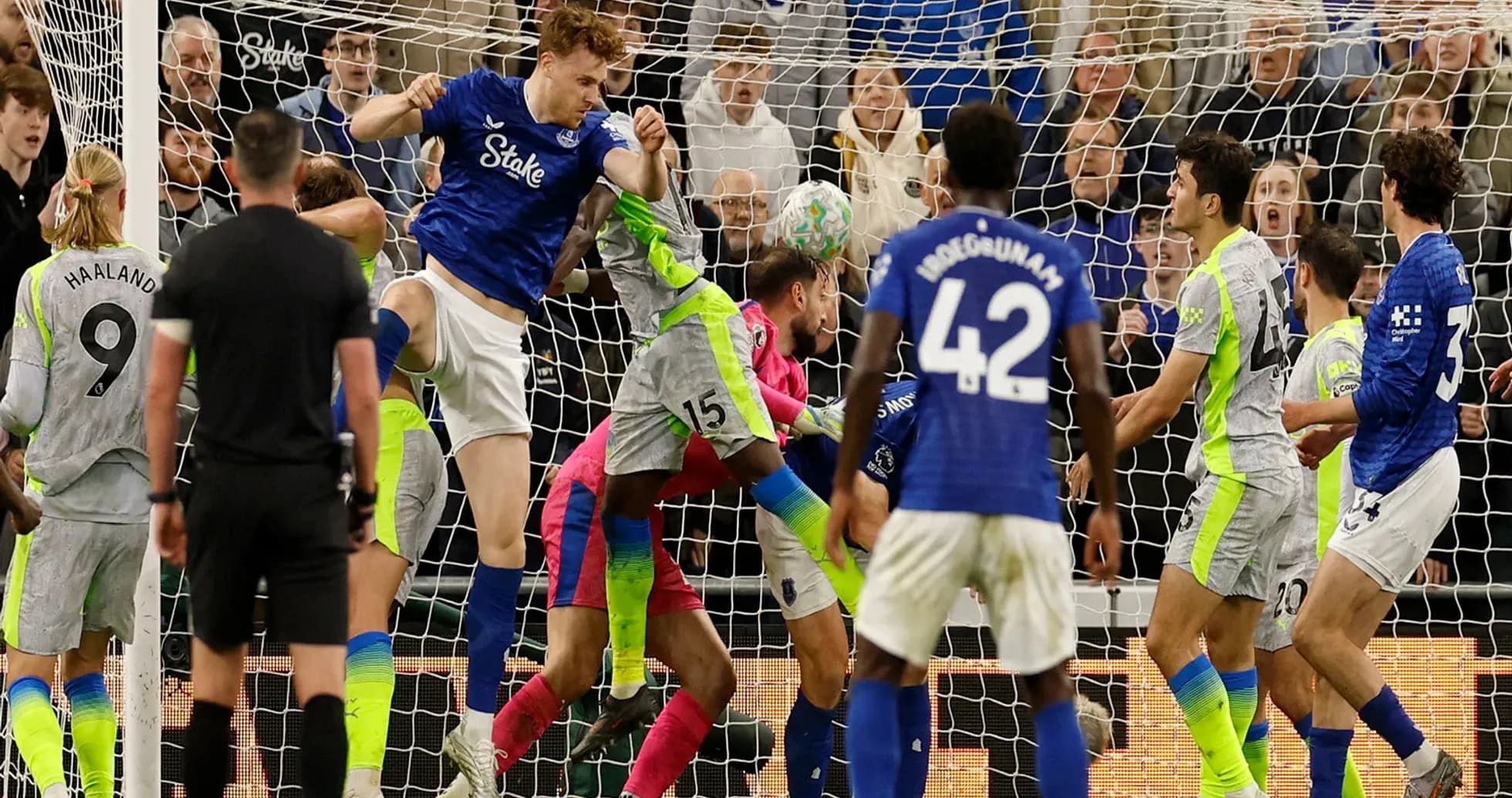
City’s defensive metrics – just 32 conceded overall and 14 clean sheets – usually point to control. But without Dias, Gvardiol and Rodri, the underlying solidity was compromised. Everton’s home average of 1.4 goals for always threatened to inflate against a makeshift structure, especially with set-pieces and direct attacks into Beto.
In narrative terms, this 3-3 was the logical intersection of City’s attacking inevitability and Everton’s volatile equilibrium. The Hunter found space, the Shield bent but refused to break, and in the absence of key structural pieces on both sides, the match spilled into the kind of open, breathless contest that the raw numbers had quietly been warning about all along.