.svg&w=384&q=75 "naujapitch logo")
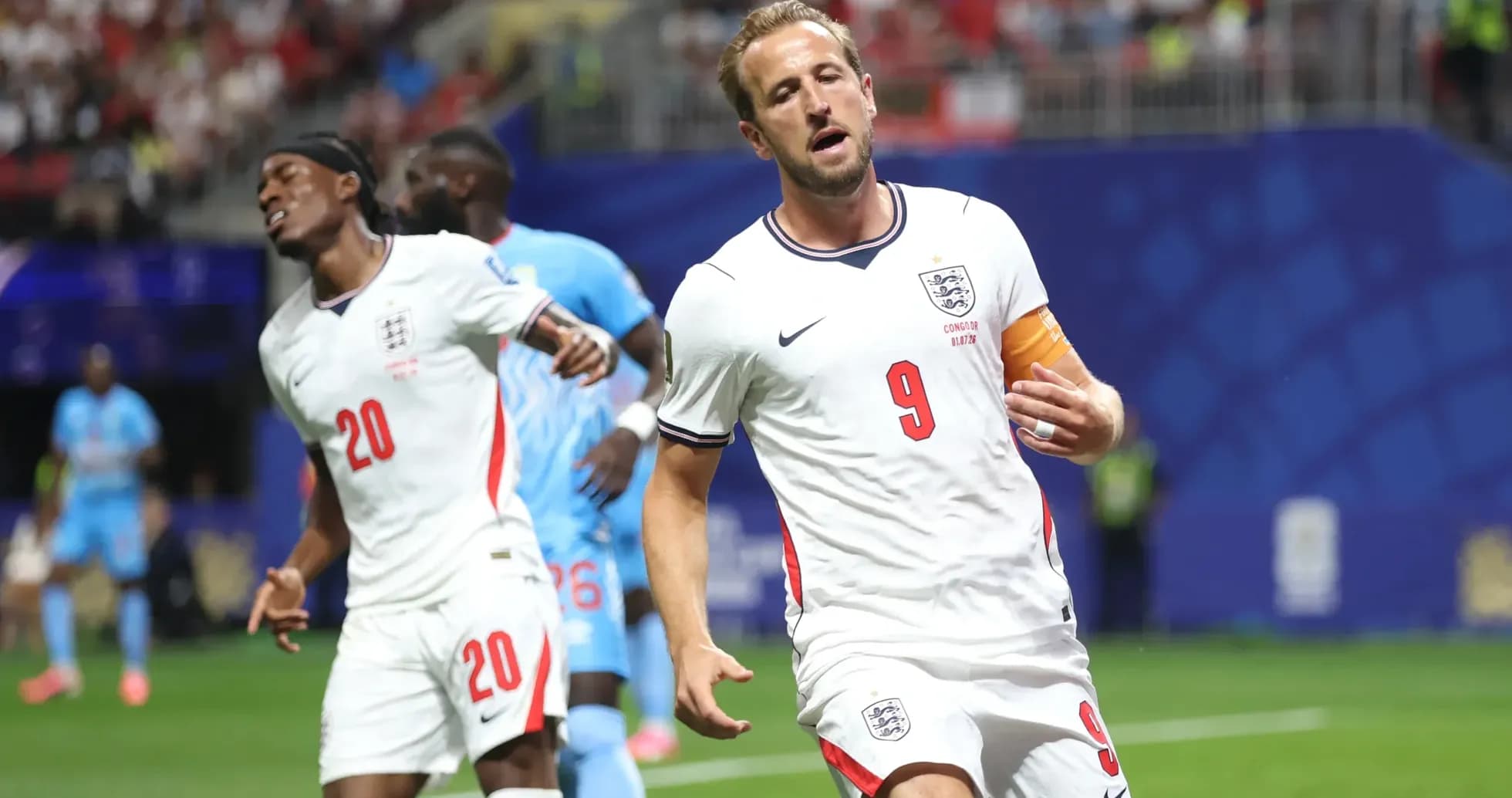
England Overcomes Congo DR 2-1 in World Cup Knockout Match
England 2-1 Congo DR at Mercedes-Benz Stadium sends Thomas Tuchel’s side into the World Cup Round of 16 with momentum, overturning an early deficit to convert group-stage dominance into knockout-stage resilience. England move from 7 to 10 points in the competition with their goals-for tally rising from 6 to 8 and goals-against from 2 to 3, while Congo DR exit after a brave but ultimately overpowered display.
Match Report
The tie opened with a shock for the favourites. On 7' Congo DR struck first: Congo DR goal — B. Cipenga (assisted by C. Mbemba). A set-piece delivery found Mbemba attacking the second ball and his header across goal was turned in by Cipenga, giving Congo DR a 0-1 lead and forcing England to chase.
England’s frustration surfaced on 19' when Jude Bellingham went into the book: 19' J. Bellingham (England) — yellow card (Tripping). Congo DR matched that aggression on 28', as N. Sadiki was cautioned: 28' N. Sadiki (Congo DR) — yellow card (Tripping), reflecting a midfield battle that was becoming increasingly combative.
Tuchel made a decisive attacking shift just after the hour. On 61', A. Gordon replaced M. Rashford (England), adding direct running from the left, and simultaneously 61' B. Saka replaced N. Madueke (England), injecting more incision on the right. Sebastien Desabre responded on 64' to manage his front line: 64' M. Elia replaced N. Mbuku (Congo DR), looking for fresher legs to threaten in transition.
England continued to tilt the pitch and Tuchel further adjusted the structure on 70' with a more progressive full-back profile: 70' E. Eze replaced D. Spence (England), effectively adding another ball-carrier between the lines.
The pressure finally told on 75'. England goal — H. Kane (assisted by A. Gordon). Gordon, already influential off the bench, attacked the left channel and cut the ball back for Kane, who finished clinically to level at 1-1 and validate Tuchel’s substitutions.
Congo DR tried to reassert control in midfield and refresh their attack on 76'. First, 76' E. Kayembe replaced N. Mukau (Congo DR) to add fresh energy in the centre, and simultaneously 76' T. Bongonda replaced B. Cipenga (Congo DR), removing the scorer but introducing a more creative wide threat.
Yet it was England who found the decisive moment. On 86', England goal — H. Kane (assisted by A. Gordon). Once again Gordon created from the left, and Kane’s movement in the box was too sharp for the Congo DR back line as he guided in the winner to make it 2-1, completing the turnaround and underlining the impact of Tuchel’s in-game changes.
Desabre threw on more changes at 89' to chase an equaliser: 89' J. Kayembe replaced A. Masuaku (Congo DR), adding an attacking full-back option, and 89' F. Mayele replaced S. Moutoussamy (Congo DR), committing an extra forward presence. England’s final adjustment came in stoppage time, shoring up defensively: 90+1' J. Stones replaced D. Rice (England), adding aerial security and experience to see out the closing moments.
Fixture Statistics & Tactical Audit
- xG: England 2.04 vs 0.8 Congo DR
- Possession: England 60% vs 40% Congo DR
- Shots on Target: England 7 vs 2 Congo DR
- Goalkeeper Saves: England 1 vs 5 Congo DR
- Blocked Shots: England 3 vs 2 Congo DR
The underlying numbers support England’s comeback as both deserved and measured. With higher xG (2.04 vs 0.8) and more shots on target (7 vs 2), England’s attack progressively wore down Congo DR’s block, particularly after the introduction of Gordon and Saka. Congo DR’s game plan was compact and counter-oriented, reflected in lower possession (40%) and limited penalty-box presence (only 2 shots inside the box), but they were kept in the contest by Lionel Mpasi Nzau’s workload — his 5 saves mirrored England’s 7 efforts on target, underlining how often the underdogs were forced to rely on their goalkeeper. England’s 91% pass accuracy and territorial control translated into sustained pressure rather than early goals, but over 90 minutes the shot quality and volume made a 2-1 scoreline broadly fair, with Congo DR’s opener their main high-value moment.
Standings Update & Seasonal Impact
England advance from the Round of 32 with their competition totals now reading 10 points, 8 goals for and 3 against, for a goal difference of +5. Already arriving from Group L in strong form, this comeback win reinforces their status as a leading contender in the knockout bracket, marrying defensive stability across the tournament with the attacking edge of Kane and the bench options Tuchel can deploy.
Congo DR, who came into the Round of 32 on 4 points with a +1 goal difference (4 scored, 3 conceded), exit the competition with 4 points, 5 goals for and 5 against, their goal difference now neutral at 0. Their ability to strike early against a top seed will be a positive takeaway, but the step up in opposition quality at this stage exposed the limits of their defensive resistance over a full 90 minutes.
Lineups & Personnel
England Starting XI
- GK: Jordan Pickford
- DF: Djed Spence, Ezri Konsa, Marc Guéhi, Nico O'Reilly
- MF: Elliot Anderson, Declan Rice, Noni Madueke, Jude Bellingham, Marcus Rashford
- FW: Harry Kane
Congo DR Starting XI
- GK: Lionel Mpasi Nzau
- DF: Aaron Wan-Bissaka, Chancel Mbemba, Axel Tuanzebe, Arthur Masuaku
- MF: Ngal'ayel Mukau, Samuel Moutoussamy, Noah Sadiki
- FW: Nathanaël Mbuku, Yoane Wissa, Brian Cipenga
Post-Match Verdict
England’s display was ultimately clinical in the final third (2 goals from 2.04 xG and 7 shots on target) and controlled in possession (60% with 91% pass accuracy), but it required assertive in-game management to unlock Congo DR’s disciplined shape. The substitutions of Gordon and Saka transformed the attacking dynamics, with Gordon directly assisting both of Kane’s goals, turning sustained territorial dominance into scoreboard impact. Congo DR were resilient defensively for long spells — Mpasi’s 5 saves and the team’s 2 blocked shots testify to their commitment — yet their reliance on low-volume, low-xG attacks (0.8 xG from 7 shots) left them with too little margin once England found their rhythm. In the end, this was less a defensive collapse from Congo DR than a gradual erosion under sustained pressure, and a demonstration of England’s capacity to solve problems within games at knockout level.