.svg&w=384&q=75 "naujapitch logo")
France Dominates Sweden 3-0 in Tactical Showcase
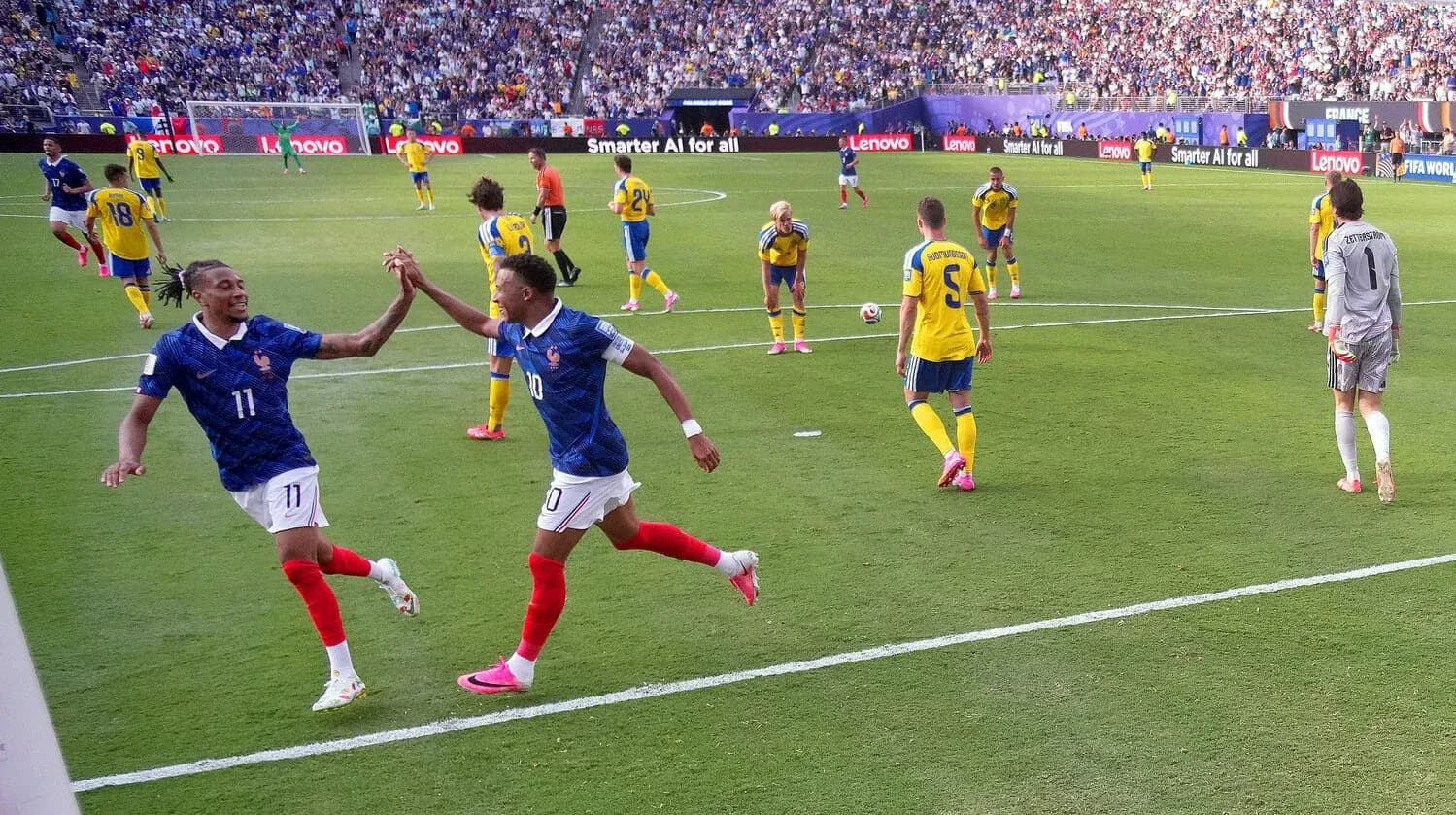
France’s 3-0 win over Sweden at MetLife Stadium was a textbook example of a dominant, possession-based 4-2-3-1 dismantling a more reactive 4-4-2. Didier Deschamps’ side controlled 61% of the ball, generated 25 shots and 3.17 xG, and systematically stretched Graham Potter’s Sweden until the defensive structure finally cracked.
Structurally, France’s 4-2-3-1 was built on a very high technical base. Aurélien Tchouaméni and Adrien Rabiot formed a double pivot that dictated tempo and rest defense. With 551 passes and 88% accuracy (485 accurate), France circulated the ball with patience, using short combinations to pull Sweden’s two banks of four out of shape. The full-backs, Jules Koundé on the right and Lucas Digne on the left, provided width from deep, allowing the three attacking midfielders to play in very narrow pockets between Sweden’s midfield and defense.
Ousmane Dembélé and Bradley Barcola operated as inverted wide midfielders in the line of three, constantly moving into the half-spaces rather than hugging the touchline. Michael Olise, nominally central, drifted laterally to overload whichever side had the ball. This created repeated 3v2 and 4v3 situations around Sweden’s central midfielders Lucas Bergvall and Yasin Ayari (before their substitutions), forcing Sweden’s wide midfielders Anthony Elanga and Elliot Stroud to collapse inside and leaving the full-backs exposed.
Kylian Mbappé’s role was pivotal. As the lone forward in the 4-2-3-1, he alternated between pinning Victor Lindelöf and Gustaf Lagerbielke on the last line and dropping off to receive between the lines. His movement disrupted Sweden’s back four, opening channels for third-man runs from Barcola and Dembélé. The first goal at 45' – Mbappé finishing from a Dembélé assist – encapsulated this pattern: France worked the ball into the right half-space, Dembélé attacked the gap between full-back and center-back, and Mbappé arrived on the blind side to finish.
Sweden’s 4-4-2 was clearly designed to be compact and vertical. With only 39% possession and 352 passes at 80% accuracy (280 accurate), their plan hinged on quick transitions to the front two, Viktor Gyökeres and Alexander Isak. However, France’s rest defense, anchored by Dayot Upamecano and William Saliba, was excellent. With Tchouaméni screening and both full-backs positioned intelligently behind the ball when attacks developed, Sweden rarely found clean outlets; they managed just 8 total shots, 3 on goal, and an xG of 0.65.
The second half exposed the cumulative effect of France’s territorial dominance. The 53' goal from Barcola, assisted by Olise, highlighted how Sweden’s block had been stretched horizontally. As Sweden’s midfield shifted to one side to close a passing lane, Olise received between lines and slipped Barcola into the space behind the full-back. By then, Sweden’s wide midfielders were caught in no-man’s land: too deep to press the pivot, too narrow to help the full-backs.
Mbappé’s second goal at 74', again from an Olise assist, underlined France’s control of depth. With Sweden forced to step higher chasing the game, France repeatedly found vertical lanes behind the defense. Olise’s timing and weight of pass, combined with Mbappé’s diagonal runs from inside to out, made it almost impossible for Sweden’s center-backs to hold a coherent line.
From a defensive standpoint, Mike Maignan (France) had a relatively controlled evening. Sweden did register 3 shots on goal, and Maignan’s 3 saves, combined with a goals prevented figure of 1.16 for France, indicate that when Sweden did break through, the chances were of reasonable quality. However, the low volume of Swedish shots reflects how rarely they accessed central zones in front of goal. France’s back four maintained compact distances, and the pivots tracked runners aggressively, forcing Sweden wide and into low-percentage attempts.
At the other end, Jacob Widell Zetterström (Sweden) was heavily exposed. France produced 12 shots on goal, and the Sweden goalkeeper made 9 saves, with his own goals prevented also at 1.16. This suggests that without his interventions, the scoreline could have been even more lopsided. Sweden’s defensive block allowed too many shots from inside the box (France had 16 shots inside the area), a direct consequence of being pinned deep and unable to clear second balls after initial clearances.
Potter’s substitutions around 66' and 82' – introducing Besfort Zeneli, Taha Abdi Ali, Benjamin Nygren and Mattias Svanberg – were aimed at injecting ball-carrying and fresh legs into midfield and the wide areas. Yet by that stage, the tactical narrative was fixed: Sweden’s 4-4-2 struggled to progress the ball through France’s press, and their attempts to go more direct were comfortably handled by Upamecano and Saliba.
Deschamps’ changes, bringing on Malo Gusto for Koundé, Désiré Doué for Dembélé, Theo Hernández for Digne, Jean-Philippe Mateta for Olise, and Rayan Cherki for Mbappé, were largely about energy management and preserving structure. Importantly, the substitutions did not alter the basic 4-2-3-1 shape; France maintained their positional framework and continued to control territory, even with the game effectively decided.
Statistically, the match paints a coherent tactical picture. France’s 61% possession, 551 passes at 88% accuracy, and 25 total shots align with a side that dominated both territory and rhythm. Their 3.17 xG closely matches the 3 goals scored, indicating clinical but not anomalous finishing. Sweden’s 8 shots, 0.65 xG, and limited attacking volume confirm that their 4-4-2 rarely turned defensive solidity into sustained threat.
Defensively, the blocked shots numbers – 4 for France, 1 for Sweden – show how often France were able to contest Swedish attempts at source, while Sweden’s back line was frequently forced into last-ditch goalkeeping rather than collective shot suppression. With both teams’ goals prevented at 1.16, the real difference lay not in goalkeeping but in structure: France repeatedly created high-quality chances from well-orchestrated positional attacks, while Sweden’s plan never consistently escaped France’s control zones.