.svg&w=384&q=75 "naujapitch logo")
Craig Gordon's Inspiring World Cup Farewell After Injury
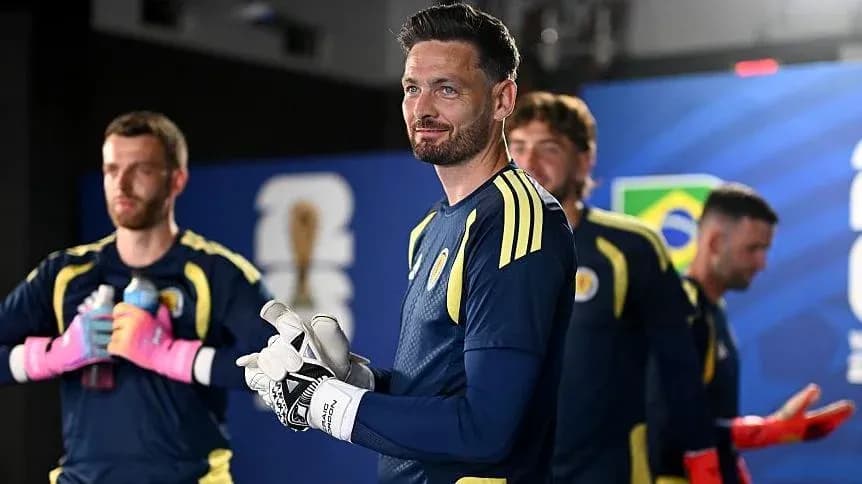
Craig Gordon did not just limp back from injury. He dragged himself through one of football’s darkest places and somehow emerged on the biggest stage of all, bowing out with Scotland at a World Cup.
Rory Loy, who knows that road better than most, could only call it what it was: “incredible”.
The former striker was speaking on BBC’s Scottish Football Podcast, reflecting on Gordon’s decision to retire from playing, announced on Thursday. For Loy, this was not a pundit reaching for clichés. This was a man who had lived the same nightmare.
He suffered the same double leg break that almost ended Gordon’s career. Loy was in his early 20s when it happened. Gordon was 39.
“At 20, 23, you’re still young, you’re motivated, your body’s young to try and come back from it,” Loy explained. The subtext was clear: youth gives you a kind of blind optimism. You heal quicker. You believe you’re invincible.
Gordon had none of that on his side. Late 30s. A veteran goalkeeper with hundreds of games behind him, his body already carrying the miles and the scars. That is when his shin snapped.
“The shin bone just snaps basically,” Loy said, stripping away any romance. It breaks, it heals, but it never quite goes back to what it was. The damage runs deeper than the X-ray.
Once the bone is set, the real battle begins. Walking changes. Running changes. Every stride feels slightly alien. “Your whole biomechanics, the way you walk, the way you move, the way you do everything, it just changes.”
Loy needed orthotics in his boots to cope with his altered movement, a constant reminder that his body had been redesigned by trauma. “There’s just so many different layers to it,” he added – the physical rehab, the fear of going into tackles, the hesitation in every 50-50, the doubt that creeps in when you plant your foot.
Now place that burden on a 39-year-old goalkeeper, asked to dive, twist, explode off either leg, land awkwardly, and do it all again three days later. Then ask him to do it at international level, with a World Cup on the horizon.
“For him to go through that type of thing at the age he was at and still have the motivation to come back and play football just sums up the type of mindset he had,” Loy said.
That mindset turned what should have been a career-ending injury into a prelude. Gordon did not just come back to make up the numbers or quietly see out his days on a bench. He came back to reclaim a Scotland shirt, to stand in goal at a World Cup, and to close his international story on the sport’s grandest platform.
Loy’s admiration, though, was not reserved for the comeback alone. Strip away the emotion and you are left with a simple truth: Gordon was a top-class goalkeeper long before his leg broke, and he remained one after it.
“Away from all of that, the level of goalkeeping and saves he had was incredible,” Loy said.
The word hangs there. Incredible. Used once for the comeback, once for the saves. In Gordon’s case, you cannot separate the two. The technique and the mentality, the reflexes and the resilience, all part of the same legacy.
He leaves the game with his body marked, his story bent but not broken, and his final chapter written on a World Cup stage. For a goalkeeper who refused to accept the limits of age and injury, there was no more fitting way to go.