.svg&w=384&q=75 "naujapitch logo")
Enzo Fernández and the Topo Gigio Gesture in Football History
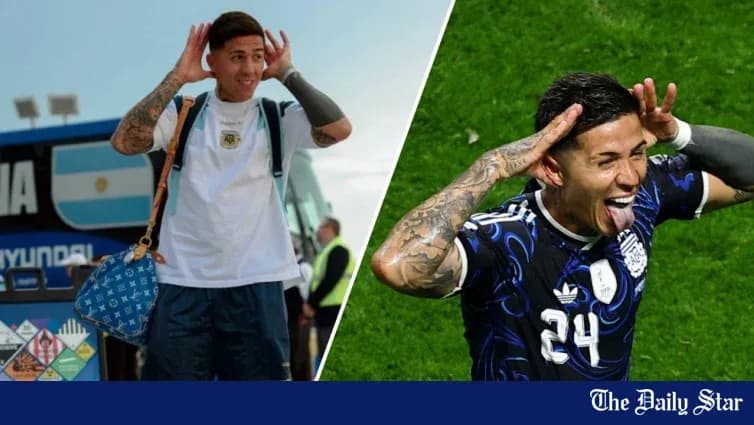
Enzo Fernández stepped onto the airport tarmac in Kansas City with the same swagger he had shown in the World Cup semifinal. No goal this time. No roaring crowd. Just a gesture – hands cupped behind his ears, the now unmistakable "Topo Gigio" celebration – aimed at the cameras as Argentina prepared to fly to New York.
The message was clear enough. He’s still talking. Or, more accurately, still asking who can’t hear him now.
Thunderstorms over the East Coast pushed Argentina’s arrival at almost midnight, but the delay did nothing to mute the noise around Fernández. By the time Lionel Scaloni’s squad landed for Monday’s World Cup final against Spain at MetLife Stadium, the Chelsea midfielder’s celebration had already ricocheted across social media and sports talk shows, dissected almost as intensely as his performances.
A mouse, a legend, and a gesture of defiance
For outsiders, it might look like a simple bit of showmanship. In Argentina, it’s loaded with history.
"Topo Gigio" began life not in a stadium, but on television. Created in 1958 by Italian artist Maria Perego, the puppet mouse became a beloved children’s character across Latin America in the 1980s and 1990s. Its signature pose – hands cupped behind the ears, inviting the audience’s reaction – eventually slipped from kids’ TV into football’s most charged moments.
The gesture’s true football baptism came on April 8, 2001. Superclásico. Boca Juniors vs River Plate. Juan Román Riquelme, already a genius, already a symbol, walked straight into legend.
After scoring against River, Riquelme turned toward the presidential box and cupped his hands behind his ears, right in front of then-club president Mauricio Macri. At the time, Riquelme was locked in a tense contract dispute with Boca’s hierarchy. The celebration was instantly read as a public act of defiance, a pointed “Are you listening now?” to those in power, even as Riquelme later said it was dedicated to his daughter.
By then, the pose had outgrown the puppet. It had become a statement.
From Riquelme to Messi to Fernández
Once Riquelme had stamped it into Argentine football culture, other stars picked it up and repurposed it for their own battles.
Lionel Messi reached for it in one of the most combustible nights of his international career. After Argentina’s stormy World Cup quarter-final win over the Netherlands in Qatar in 2022, Messi celebrated with the "Topo Gigio" gesture, a move widely seen as a direct response to Dutch coach Louis van Gaal and the pre-match comments that had irritated the Argentina camp. It was the quietest of gestures, in the loudest possible moment.
Fernández has now written his own chapter.
In the semifinal against England – a rivalry that goes far beyond football – he found the net and immediately went to the ears. Same cupped hands. Same defiant body language. Different context, same electricity. In a match dripping with history and tension, the celebration cut through the chaos, another image destined to live on in Argentina’s World Cup folklore.
This wasn’t just a young midfielder enjoying his moment. It was a player stepping into a lineage, borrowing a symbol that has followed Argentina’s greatest football arguments and turning it toward a new generation.
A light session, a heavy stage
Before leaving Kansas City, Scaloni kept things relatively calm. Argentina went through a light training session, the kind of loosened-up preparation that belies the magnitude of what comes next.
No tactical secrets spilled. No grand declarations. Just a group that has been here before, fine-tuning for one more game on the biggest stage.
Yet around them, the noise grows. Spain await at MetLife Stadium on Monday, a final that pitches two footballing cultures with deep scars and deeper ambitions against each other. In that setting, every touch, every look, every celebration carries extra weight.
Fernández’s "Topo Gigio" has already travelled from a semifinal flashpoint to an airport runway and into the buildup of a World Cup final. The gesture started with a puppet mouse, passed through Riquelme and Messi, and now rests with a 23-year-old midfielder who refuses to blend into the background.
On Monday in New York, with the world watching, the question is simple: will he be cupping his ears again – and if he is, who will he be asking to listen this time?