.svg&w=384&q=75 "naujapitch logo")
Chelsea's Fragile Season Exposed by Nottingham Forest's Tactical Masterclass
Stamford Bridge had the feel of a crossroads rather than a coronation. In a Premier League season drifting into its final act, Chelsea arrived at Round 35 with the table insisting they were still contenders for Europe – 9th with 48 points, a positive goal difference of 6 from 54 scored and 48 conceded – but the form line screaming crisis: “LLLLL” heading into this game. Nottingham Forest, 16th on 42 points with a goal difference of -2 (44 for, 46 against), came to London in the opposite mood, riding a “WWWDW” surge and quietly confident on their travels, where they had already claimed 7 wins from 18.
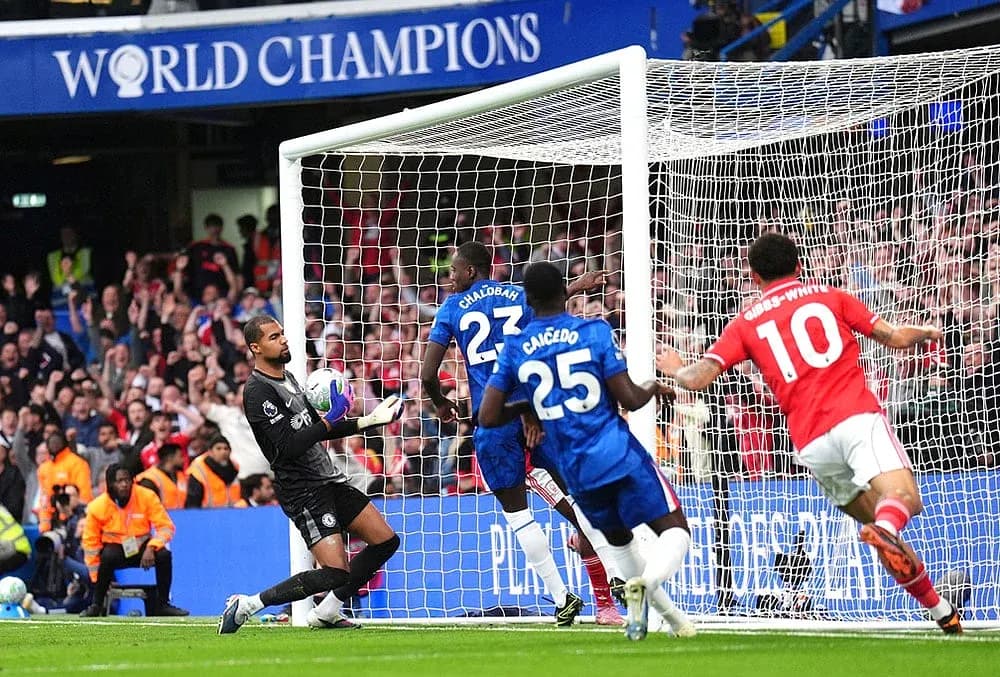
By full time, the narrative belonged to Forest. A 3-1 away win, built on a ruthless first half and disciplined game management, underlined how far Vitor Pereira’s side have come as an away outfit and how fragile Chelsea’s season-long foundations remain.
I. The Big Picture: Structures and Seasonal DNA
The formations told an immediate story. Calum McFarlane stayed loyal to Chelsea’s season-defining shape: a 4-2-3-1 that has been used in 30 league matches. Robert Sánchez in goal, a back four of Malo Gusto, Trevoh Chalobah, Tosin Adarabioyo and Marc Cucurella, a double pivot of Romeo Lavia and Moisés Caicedo, with Cole Palmer, Enzo Fernández and J. Derry supporting Joao Pedro.
This structure reflects Chelsea’s broader statistical profile. Overall this campaign, they have averaged 1.5 goals for per game (1.3 at home) and 1.4 goals against (1.3 at home), a side that scores and concedes in almost equal measure. Nine clean sheets in total and seven matches at Stamford Bridge without scoring point to volatility rather than control.
Forest’s 4-4-2 at Stamford Bridge was more than a tactical wrinkle; it was a statement. While they have leaned on 4-2-3-1 in 29 league games, Pereira chose a more traditional two-striker setup: Matz Sels behind a back four of Z. Abbott, Cunha, Morato and L. Netz; a flat but mobile midfield of D. Bakwa, Ryan Yates, Nicolás Domínguez and J. McAtee; with Igor Jesus and Taiwo Awoniyi paired up front.
That choice aligned with Forest’s away identity. On their travels, they have averaged 1.4 goals for and 1.4 against, almost mirroring Chelsea’s overall balance but with a sharper edge in transition. Seven away clean sheets underline a capacity to bunker in when needed, while five away games without scoring show that when the counter-attack misfires, they can look blunt. At Stamford Bridge, it did not misfire.
II. Tactical Voids: Absences and Discipline
Both squads were thinned in ways that shaped the contest. Chelsea’s attacking depth was compromised: M. Mudryk was suspended, while A. Garnacho and P. Neto were listed as inactive, and J. Gittens sidelined with a muscle injury. For a side already prone to home inconsistency – 24 goals scored and 24 conceded in 18 matches at Stamford Bridge – losing direct runners and one‑v‑one threats narrowed McFarlane’s options once Forest sank into their block.
Forest’s absentees were concentrated in defence and wide areas. O. Aina, W. Boly, Murillo, D. Ndoye, I. Sangare, N. Savona, John Victor and C. Hudson-Odoi were all missing, a spine’s worth of athleticism and experience. Yet Pereira trusted Morato and Cunha to anchor the central defence, with L. Netz and Abbott as full-backs, and they repaid him with a compact, disciplined performance that absorbed Chelsea’s pressure and protected Sels.
The disciplinary profiles of both teams foreshadowed the game’s edge. Chelsea’s yellow-card distribution this season spikes late: 22.35% of their cautions arrive between 76-90 minutes, and their red-card pattern shows a worrying spread across all phases, with 28.57% of reds in the 61-75 window. Forest, meanwhile, peak in the middle phases, with 23.21% of yellows between 46-60 and another 23.21% from 61-75. This is when their pressing aggression is most likely to spill over.
Those numbers translated into the narrative: Chelsea chasing, Forest contesting every duel, the match tilting towards late chaos that the visitors ultimately managed better.
III. Key Matchups: Hunter vs Shield, Engine Room vs Enforcer
The headline duel was always going to be Joao Pedro against Forest’s defensive structure. With 15 league goals and 5 assists, plus 48 shots (28 on target), he has been Chelsea’s primary “Hunter” all season. His 29 key passes and 67 dribble attempts speak to a forward who both finishes and creates.
The “Shield” he faced was not just Morato and Cunha, but a collective away record that has seen Forest concede 25 goals in 18 away games – 1.4 per match – roughly in line with Chelsea’s home scoring average. At Stamford Bridge, Forest’s back line narrowed the channels into Pedro, forcing him to drop deeper and combine rather than attack the box with freedom. Morato’s reading of the game and Cunha’s physical duels blunted Chelsea’s central threat, while Netz and Abbott tracked wide rotations from Palmer and Derry.
In midfield, the “Engine Room” battle set the tone. For Chelsea, Caicedo is the enforcer and metronome. Across the season he has produced 83 tackles, 14 successful blocks and 56 interceptions, with a remarkable 92% passing accuracy from 1,877 passes. But his edge comes with risk: 10 yellow cards and 1 red, making him one of the league’s most card-prone players.
Opposite him, Yates and Domínguez formed Forest’s axis, with McAtee drifting inside to overload zones. Their task was twofold: disrupt Chelsea’s build-up through Caicedo and Lavia, and launch quick vertical transitions into Igor Jesus and Awoniyi. Time and again they succeeded, pinning Chelsea’s double pivot back and preventing Enzo Fernández from dictating between the lines. As Chelsea chased the game, Caicedo’s need to step higher increased the risk of those midfield turnovers that Forest thrive on.
Forest’s own creative heartbeat, M. Gibbs-White, started from the bench but loomed over the tie as the league’s 5th‑rated attacking midfielder: 13 goals, 4 assists, 46 key passes and 52 dribble attempts. His presence among the substitutes gave Pereira a late-game “Hunter” to unleash if Chelsea overcommitted. Even without him starting, the structural threat of a fresh playmaker informed how Chelsea had to guard against the counter.
IV. Statistical Prognosis: xG Hints and Defensive Solidity
Even without explicit xG numbers, the season-long data sketches the expected goals landscape of this matchup. Chelsea, averaging 1.5 goals for and 1.4 against overall, tend to play in games where chances flow both ways. Forest, at 1.3 goals for and 1.3 against overall, are more conservative but, away from home, tilt closer to Chelsea’s profile: 1.4 for, 1.4 against.
Heading into this game, the logical xG prognosis was a relatively even contest, perhaps shaded by Chelsea’s home advantage but undermined by their fragile form and Forest’s strong away record. Chelsea’s nine clean sheets and Forest’s nine suggested that at least one side would crack under sustained pressure; their combined propensity to concede around 1.3–1.4 goals per match each implied a scoreline with multiple goals rather than a stalemate.
Following this result, Forest’s 3-1 victory feels less like an upset and more like the statistical balance tipping decisively in favour of the side with clearer tactical identity and momentum. Chelsea’s 4-2-3-1 again produced territory and spells of possession, but without the missing wide threats and with Joao Pedro crowded, they lacked the cutting edge to match Forest’s efficiency.
Forest’s 4-4-2, meanwhile, looked like the logical evolution of an away team comfortable at 1.4 goals for and against: compact, selective in its pressing, and devastating when the ball broke into space for Awoniyi and Igor Jesus. With Gibbs-White as a high-impact option and a defensive unit that, even without several injured regulars, held its line, Forest turned their seasonal numbers into a statement win in west London – and left Chelsea staring at a table that no longer flatters their talent.