.svg&w=384&q=75 "naujapitch logo")
Canada vs Bosnia & Herzegovina Match Report: 1-1 Draw Analysis
Canada 1-1 Bosnia & Herzegovina at BMO Field leaves Group B finely poised, with both sides moving to 2 points from two games and maintaining identical records. Canada stay top of the group on goal difference, while Bosnia & Herzegovina remain second, both consolidating positions already described as advancing to the Round of 32 but missing the chance to take full control of the section.
Match Report
The game’s first major incident arrived on 11', when Alistair Johnston (Canada) collected a yellow card for tripping, an early sign of Canada’s aggressive front-foot approach out of possession. On 21', Bosnia & Herzegovina struck first: 21' Bosnia & Herzegovina goal — J. Lukic (assisted by S. Kolasinac). Kolasinac surged forward from left-back and delivered low into the area, where Lukic finished to give the visitors a 1-0 lead and punish Canada’s high defensive line.
As the first half closed, Bosnia & Herzegovina picked up two quick cautions that reflected the physical edge of their defending. On 45', E. Demirovic (Bosnia & Herzegovina) received a yellow card for roughing after a late challenge as Canada tried to transition. Then at 45+1', J. Lukic (Bosnia & Herzegovina) was booked for roughing, a check that halted another Canadian attempt to break through midfield.
Canada continued to push after the interval but their back line also came under pressure. On 53', L. De Fougerolles (Canada) was shown a yellow card for holding, dragging back a forward runner to stop a potential Bosnian counter and underlining Canada’s vulnerability when their full-backs advanced.
Jesse Marsch then made a triple attacking change on 61' to inject pace and directness into Canada’s play. At 61', J. Shaffelburg replaced L. Millar (Canada), offering more vertical running from the left. Simultaneously at 61', P. David replaced J. David (Canada), refreshing the centre-forward position, and 61' A. Ahmed replaced T. Buchanan (Canada), adding fresh legs and line-breaking runs from midfield.
Bosnia & Herzegovina responded with their own double change on 62', aiming to restore control and energy in the middle and final thirds. At 62', S. Bazdar replaced J. Lukic (Bosnia & Herzegovina), removing the goalscorer who was already on a yellow card, and 62' A. Gigovic replaced I. Basic (Bosnia & Herzegovina) to strengthen central midfield. On 74', Sergej Barbarez further rotated his wide and attacking midfield options: 74' I. Sunjic replaced E. Bajraktarevic (Bosnia & Herzegovina), and 74' K. Alajbegovic replaced A. Memic (Bosnia & Herzegovina), both moves aimed at reinforcing defensive structure and ball retention as Canada’s pressure grew.
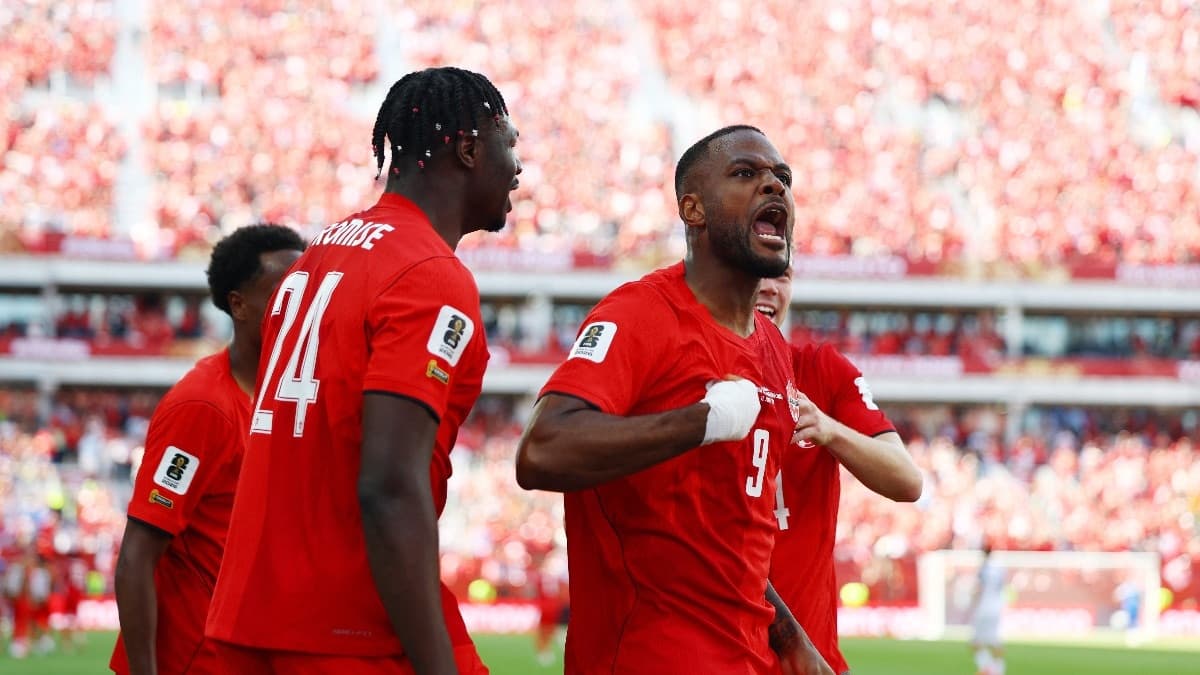
Canada’s next adjustment was to their strike pair. On 76', C. Larin replaced T. Oluwaseyi (Canada), adding a more physical penalty-box presence to attack Bosnia & Herzegovina’s back line. The change paid off quickly. On 78', Canada finally broke through: 78' Canada goal — C. Larin (assisted by P. David). David, who had earlier come on for Jonathan David, linked play and slipped a clever pass into the area, where Larin finished clinically to level the score at 1-1 and reward Canada’s sustained territorial dominance.
With the game finely balanced, Bosnia & Herzegovina made a late defensive-minded substitution on 84': 84' D. Burnic replaced S. Kolasinac (Bosnia & Herzegovina), sacrificing their attacking left-back for extra midfield stability to protect the point. Canada’s final change came deep into stoppage time, with an eye on control and fresh legs in central areas. At 90+1', J. Osorio replaced S. Eustaquio (Canada), adding energy and late-arrival threat from midfield.
There was one final disciplinary note in added time. On 90+3', N. Katic (Bosnia & Herzegovina) received a yellow card for holding, hauling down an opponent as Canada tried to launch one last attack. Despite late pressure, neither side could find a winner, and the match closed at 1-1.
Fixture Statistics & Tactical Audit
- xG: Canada 1.25 vs 0.98 Bosnia & Herzegovina
- Possession: Canada 61% vs 39% Bosnia & Herzegovina
- Shots on Target: Canada 4 vs 3 Bosnia & Herzegovina
- Goalkeeper Saves: Canada 2 vs 1 Bosnia & Herzegovina
- Blocked Shots: Canada 4 vs 1 Bosnia & Herzegovina
The underlying numbers suggest a marginally fair draw tilted slightly towards Canada. With higher xG (1.25 vs 0.98), more shots on target (4 vs 3), and a clear edge in possession (61% vs 39%), Canada constructed more sustained pressure, particularly after their 61' triple substitution. Bosnia & Herzegovina’s lower shot volume but comparable xG points to a more selective, counter-oriented attack that produced relatively high-quality chances when they did break. Canada’s four blocked shots to Bosnia & Herzegovina’s one underline how aggressively Bosnia & Herzegovina defended their box, often getting bodies in front of efforts rather than relying on goalkeeper intervention. The single save for Nikola Vasilj compared with Canada’s two saves reflects that, despite having less of the ball, Bosnia & Herzegovina forced slightly more difficult work from Maxime Crépeau relative to their overall shot count. Overall, the 1-1 scoreline aligns with the balance of chances: Canada did enough to avoid defeat but not quite enough in the final third to justify a win on the data.
Standings Update & Seasonal Impact
From a group perspective, the draw keeps both sides on identical trajectories. Canada, who started the day on 1 point with 1 goal for and 1 against (goal difference 0), move to 2 points with 2 goals scored and 2 conceded, maintaining a goal difference of 0. Bosnia & Herzegovina, likewise beginning on 1 point with 1 goal for and 1 against, also climb to 2 points, now with 2 goals scored and 2 conceded, and the same neutral goal difference. Canada remain first in Group B and Bosnia & Herzegovina second, preserving the current order in a section where both are already in positions described as advancing to the Round of 32. The consequence is a tightly compressed group in which head-to-head margins and goal difference in the remaining fixtures are likely to determine who tops the section and secures the more favourable knockout path.
Lineups & Personnel
Canada Starting XI
- GK: Maxime Crépeau
- DF: Alistair Johnston, Luc De Fougerolles, Derek Cornelius, Richie Laryea
- MF: Tajon Buchanan, Ismael Koné, Stephen Eustaquio, Liam Millar
- FW: Jonathan David, Tani Oluwaseyi
Bosnia & Herzegovina Starting XI
- GK: Nikola Vasilj
- DF: Amar Dedić, Nikola Katić, Tarik Muharemović, Sead Kolašinac
- MF: Esmir Bajraktarević, Benjamin Tahirović, Ivan Bašić, Amar Memić
- FW: Ermedin Demirović, Jovo Lukić
Post-Match Verdict
Canada delivered a proactive but only partially clinical performance, dominating possession (61%) and generating the higher xG (1.25) without turning that territorial control into a decisive volume of clear chances. Their key attacking improvement came after the 61' triple change, when the introduction of Jacob Shaffelburg, Ali Ahmed, and Promise David increased vertical running and combination play, culminating in Cyle Larin’s equaliser from David’s assist. Defensively, Canada were occasionally vulnerable in transition, as reflected in Bosnia & Herzegovina’s relatively efficient xG return (0.98 from just 8 total shots), with the early Lukic goal exposing space behind the full-backs.
Bosnia & Herzegovina executed a compact, counter-attacking game plan effectively for long stretches. Despite having just 39% of the ball, they produced 3 shots on target and nearly matched Canada’s xG, indicating that their attacks, though fewer, were well-constructed when they did emerge. Their defensive work was rugged and committed, illustrated by 20 fouls and 3 yellow cards, as well as 1 blocked shot inside a low block that forced Canada into wide and speculative efforts. However, as the match wore on, their inability to relieve pressure consistently and the need for increasingly defensive substitutions invited Canada forward. In the end, a draw reflects Bosnia & Herzegovina’s disciplined resistance and Canada’s persistence, leaving both sides with work to do in refining their balance between control, chance creation, and defensive security ahead of the decisive group fixtures.