.svg&w=384&q=75 "naujapitch logo")
Mexico Celebrates World Cup Opening Victory
The signs were there long before a ball was kicked.
Street vendors ran out of green jerseys as fast as they could pull them from plastic bags. Pavements turned into makeshift club shops. Every second person seemed to be wrapped in a Mexico shirt, a flag, or both.
Around El Ángel de la Independencia, the city’s beating sporting heart, hundreds gathered on the eve of the opener. Drums, chants, dancing. Car horns joining in as an improvised brass section. If this was the warm-up, the main event was always going to be wild.
By the time Mexico had beaten South Africa 2-0 to open this World Cup — shared across Mexico, Canada, and the USA — the country had its excuse. Not that it needed one.
Paseo de la Reforma turns into a World Cup carnival
The players did their part. The rest belonged to the streets.
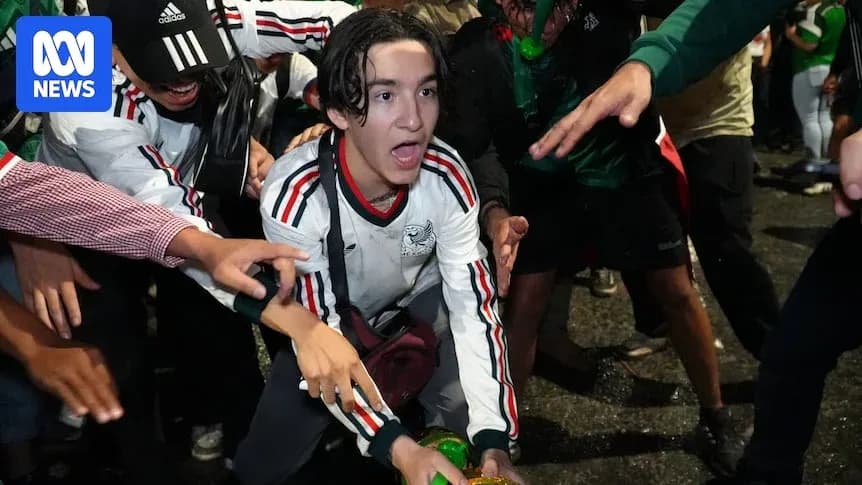
As the final whistle sounded, fans poured out and flowed toward Paseo de la Reforma, the grand boulevard that slices through the capital. For one night, cars gave way to people. It stopped feeling like a road and started feeling like a festival.
Beer flew in arcs overhead, drenching strangers who didn’t care. Cans of fake snow hissed into the air. Conga lines snaked past plastic World Cup trophies held aloft like the real thing. Street stalls did brisk business in tacos, tortas, churros, and anything else that could be eaten with one hand while the other clutched a flag or a drink.
Glow sticks lit up the night. A free concert turned the whole stretch into a single, rolling chorus.
To an outsider, it might have looked like the aftermath of a final. For Mexico, this is routine. Any major win by the men’s national team, and the city knows exactly where to go. Their version of Fed Square is a monument on a heaving roundabout, a rallying point where the stamina for celebration seems endless.
They do not go home early. They do not wind down gently. They stay until the night gives up.
Roars, cramps, and a 17-year-old’s name
The party had actually started hours earlier.
Outside the stadium, traditional performers worked the crowds, feeding the anticipation. Inside, 80,000 fans created a wall of noise that never really dipped. The opening ceremony was a show of its own, the crowd roaring along, especially when Shakira — World Cup royalty by now — took over.
But nothing matched the sound when the ball hit the net.
Raúl Jiménez’s header, years after the horrific head injury that once threatened his career, ripped a roar from the stands that felt personal. It was more than a goal; it was a shared release, a reminder, a thank you that he was still here, still scoring.
Then came the future.
When 17-year-old Gilberto Mora stepped onto the pitch as a second-half substitute, the reaction was almost as loud. No hesitation, no prompting. The stadium rose to him. His name rolled around the arena, a chant reserved for players expected to shift the country’s footballing story.
On the touchline, coach Javier Aguirre understood the weight of it all. He has lived this before, playing at the 1986 World Cup on home soil. Now he watches a new generation dealing with the same emotional surge.
“The start of the World Cup, is a brutal scenario, it makes your legs shake a little,” he said.
“You come from the training centre to here, the people, the fans are in the street and that tells the player, ‘Wow, wow, wow.’
“Never, never in 25 matches we had one case of cramps, today we had three players with cramps.
“It’s a very strong emotional state.”
The body gave away what the faces tried to hide. Mexico handled the occasion, but it took something out of them.
The squad now has to come down from the high, reset, and prepare for the next group game. For the players, the lid must go back on.
For the fans, it has been blown clean off.
“It means everything. It means a lot,” one supporter said amid the chaos.
“It’s putting us back on the map. It shows that Mexico is present in the world of football.”
Infantino’s “chillax” and the questions ahead
Somewhere in all this, Gianni Infantino will have allowed himself a smile.
The FIFA president had spent the previous day bristling at criticism of his organisation in the build-up to the tournament. He reached for the language of a different era, urging everyone to “chillax” and let the football speak.
On this evidence, the message landed — at least for a night. The first whistle blew, the goals went in, and the mood shifted. The “chill pills,” as he framed them, have been swallowed. The party has started.
But the music does not drown out every concern.
Mexico lives and breathes football. Across the northern borders, the picture changes. In Canada and the United States, “soccer” still fights for space in a crowded sporting calendar. The star-studded fixtures will pull in huge crowds. The question hangs over the rest.
- Will steep ticket prices leave too many empty seats when the so-called smaller nations take the stage?
- Will fans treat those matches as essential viewing, or as background noise in a tournament stretched across a continent?
And in the US, another shadow looms. Immigration and Customs Enforcement — ICE — has become a loaded acronym for many communities. Its presence, or even the fear of it, could shape who feels safe enough to turn up, to sing, to belong inside the stadiums.
These are not side issues. They will define how this World Cup feels away from the goals and the highlights.
For now, though, Mexico has seized its moment. One win, two goals, a capital city turned into a sea of green, and a teenager’s name already echoing into the night.
If this is only the beginning, what will it look like if this team dares to go deep into the tournament?