.svg&w=384&q=75 "naujapitch logo")

Burnley vs Aston Villa: Premier League Clash of Survival and Champions League Aspirations
Turf Moor hosts a meeting of contrasting ambitions on 10 May 2026, as relegation‑threatened Burnley welcome Champions League‑chasing Aston Villa in the Premier League. With Burnley 19th in the league and Villa 5th, the stakes are clear: the hosts are fighting to keep faint survival hopes alive, while the visitors are trying to lock in a top‑four finish.
Context and stakes
In the league, Burnley sit 19th with 20 points from 35 matches, firmly in the relegation zone and carrying a goal difference of -36. Their recent form is grim: “LLLLL” across the last five league games, part of a longer run where defeats have piled up and confidence has drained.
Aston Villa arrive in a far stronger position. They are 5th with 58 points from 35 games, described in the table as in the “Promotion - Champions League (League phase)” bracket. Their form line of “LLWDW” suggests some late‑season inconsistency but still enough wins to keep them in the hunt for Europe’s elite competition.
This is round 36 of the regular season, so both sides are running out of time to change their fate. For Burnley, every home match now feels like a must‑win; for Villa, every point is precious in a tight race for Champions League qualification.
Burnley: structure, struggles and survival hope
Across all phases, Burnley have played 35 league matches, winning just 4, drawing 8 and losing 23. They have scored 35 goals and conceded 71, averaging 1.0 goals for and 2.0 against per game. At Turf Moor, the picture is marginally better but still bleak: 2 wins, 5 draws and 10 defeats from 17 home fixtures, with 15 scored and 26 conceded.
The season‑long form string “LWLLDLLWWLLLLLLLDDLLDDDLLWDLLDLLLLL” underlines how rare victories have been. Their biggest winning margin at home is only 2-0, and their heaviest home defeat is 1-3, which hints at a team that often loses by manageable margins but struggles to impose itself.
Tactically, Burnley have been flexible to the point of instability. Their most used formation is 4-2-3-1 (10 matches), followed by 5-4-1 (9 matches) and 3-4-2-1 (8 matches), with occasional switches to 4-3-3, 4-4-2, 3-4-3 and 4-5-1. That variety suggests a coaching staff searching for a balance between defensive solidity and attacking threat, without ever truly finding it.
Defensively, the numbers are stark. Burnley concede on average 1.5 goals per home game and 2.5 away, with only 4 clean sheets all season (all at home). They have failed to score 13 times (9 at home), which is a major concern against a side of Villa’s quality. Discipline is another issue: the card data shows a spread of yellow cards across the match, with notable spikes between 16–30 minutes and 76–90 minutes, plus three red cards in total. Late‑game fatigue and pressure could again be a factor.
On the positive side, Burnley have converted both of their penalties this season (2 scored, 0 missed), showing composure from the spot when chances arise. However, with no individual scoring data for Burnley provided, their attacking threat appears more collective than star‑driven.
Aston Villa: controlled aggression and attacking focal points
Villa’s season profile is much more stable. Across all phases they have 17 wins, 7 draws and 11 defeats from 35 matches, scoring 48 and conceding 44 (1.4 scored, 1.3 conceded per game). Away from home they have a solid, if not dominant, record: 6 wins, 5 draws and 6 losses from 17 away fixtures, with 20 goals scored and 24 conceded (1.2 for, 1.4 against).
Their form string “DLLDDWWWWLWWWWWWWWLWDLWLDWDLLLWDWLL” shows long winning runs interspersed with short slumps, underlining a high‑ceiling team capable of momentum. The biggest away win is 0-2, and their heaviest away defeat is 4-1, indicating that while they can control games on the road, they are not immune to off‑days.
Tactically, Villa are remarkably consistent. They have lined up in 4-2-3-1 in 31 league matches, only occasionally shifting to 4-4-2 (3 matches) or 4-2-2-2 (1 match). That stability gives them clear automatisms in and out of possession: a double pivot for control, a trio of advanced midfielders to connect and press, and a lone striker as the focal point.
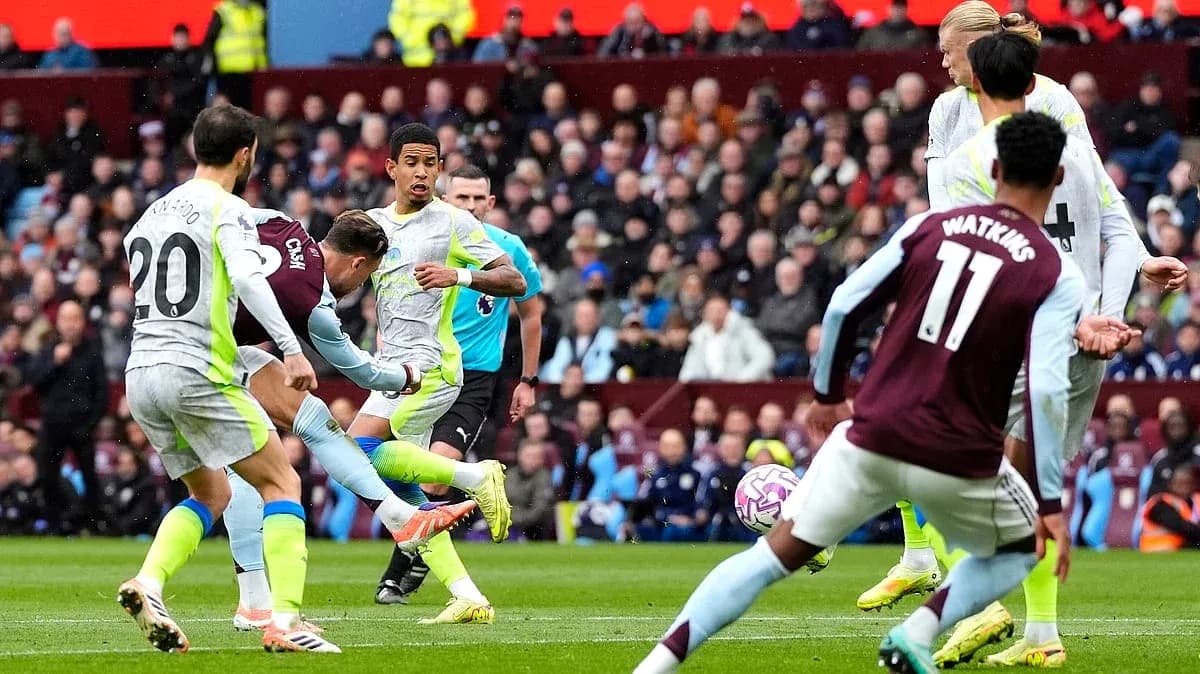
Individually, the standout figures from the data are Ollie Watkins and Morgan Rogers. Watkins has 11 league goals and 2 assists from 34 appearances (30 starts), taking 50 shots with 30 on target. His 22 key passes and 430 total passes at 72% accuracy underline his role not only as a finisher but as a link player. He is also heavily involved physically, with 267 duels (107 won) and 31 fouls drawn, making him central to Villa’s attacking and pressing game.
Rogers, operating from midfield or the attacking line, has 9 goals and 5 assists in 35 starts. He has taken 56 shots (31 on target) and provided 42 key passes, completing 997 passes at 75% accuracy. His dribbling numbers (115 attempts, 41 successful) and 47 fouls drawn show a ball‑carrying threat who can destabilise defensive blocks between the lines.
Neither Watkins nor Rogers has scored or missed a penalty in the league this season (0 scored, 0 missed), and Villa as a team have not taken a penalty (0 total). Their threat, therefore, is built on open‑play combinations rather than set‑piece reliance.
Defensively, Villa have kept 9 clean sheets (6 at home, 3 away). While they concede slightly more on their travels, the away figures are still respectable. Their yellow cards cluster between 46–60 minutes, suggesting a team that often ramps up intensity early in the second half, which could be significant if Burnley struggle after the interval.
Head‑to‑head: Villa’s recent dominance
The last five competitive meetings between these sides, all in the Premier League, show a clear tilt towards Aston Villa:
- 05 October 2025 at Villa Park: Aston Villa vs Burnley 2-1 – Aston Villa won.
- 30 December 2023 at Villa Park: Aston Villa vs Burnley 3-2 – Aston Villa won.
- 27 August 2023 at Turf Moor: Burnley vs Aston Villa 1-3 – Aston Villa won.
- 19 May 2022 at Villa Park: Aston Villa vs Burnley 1-1 – Draw.
- 07 May 2022 at Turf Moor: Burnley vs Aston Villa 1-3 – Aston Villa won.
Across these five matches, Aston Villa have 4 wins, Burnley have 0, and there has been 1 draw. Notably, both previous Premier League meetings at Turf Moor in this sample ended 1-3 in favour of Villa.
Tactical patterns to expect
Burnley’s likely approach, given their formation history and league position, is to prioritise defensive security with either a back five (5-4-1) or a compact 4-2-3-1, aiming to limit space for Watkins and Rogers between the lines. Their low scoring rate and high number of games without a goal suggest they will look for set‑pieces, counter‑attacks and transitional moments rather than sustained possession.
Villa, with their habitual 4-2-3-1, will expect to dominate the ball. The double pivot should look to control Burnley’s sporadic counters, while the three advanced midfielders and Watkins rotate to find overloads in wide areas and half‑spaces. Given Burnley’s tendency to concede more heavily away but still leak goals at home, Villa’s wide players and full‑backs could be key in stretching a deep block.
The physical battle will matter. Burnley’s card profile and Villa’s aggressive second‑half pressing pattern hint at a match that could become increasingly tense after the break, especially if the score is level or Burnley are chasing.
The verdict
On form, league position and head‑to‑head record, Aston Villa are clear favourites. They have a settled system, in‑form attacking leaders in Watkins and Rogers, and a recent history of winning at Turf Moor by 1-3 scorelines.
Burnley’s home crowd and desperation for points give them an emotional edge, but the data points to structural issues at both ends of the pitch: too many goals conceded, too few scored, and a run of defeats that is hard to ignore.
If Villa play to their average level, their superior attacking quality and tactical cohesion should be enough to take all three points. Burnley will need an unusually efficient performance at both ends – and possibly a moment of fortune – to disrupt the pattern of recent meetings and keep their survival hopes flickering.