.svg&w=384&q=75 "naujapitch logo")
Australia vs USA: A Group D Showdown with High Stakes
They circled other fixtures first. France. Brazil. The usual royalty. Not many outside the US or Australia looked twice at this one when the draw dropped.
Yet here we are: a Group D showdown crackling with needle, narrative and the sense that somebody badly misread the room.
From “lay-up” to live threat
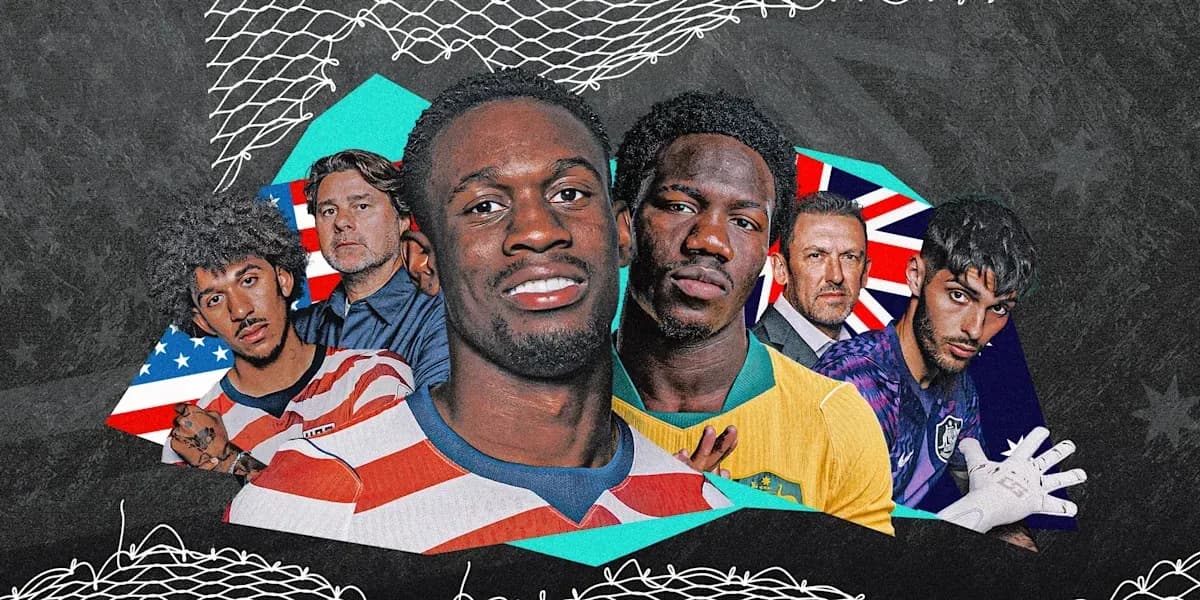
When the groups were announced, former MLS forward Mike Grella casually labelled the Socceroos a “lay-up” for the hosts. Landon Donovan went harder, tipping Australia to finish bottom and branding Tony Popovic “smug”.
It has not aged well.
Donovan has spent this tournament swinging at everyone from France – calling them “arrogant” – to Popovic, and copping public scorn from the likes of Zlatan Ibrahimovic and Thierry Henry along the way. If you’re picking a football brain to listen to, most would side with the two legends over the Fox Sports analyst.
Inside the US camp, though, the players have little interest in the studio sideshow.
“All the talk is nonsense to me,” Tim Weah said on Tuesday. “When you look at the Australian team, they are a young team that have a lot of fight, a lot of grit and a lot of hunger, just like us. We respect them in the same way that we would respect any other opponent.
“I don't know what the media is trying to do, but we're not really focused on that. We're focused on the bigger picture and doing what we have to do as a team to be prepared.”
The bigger picture now features a very real Australian problem. The US brushed past the Socceroos in a pre-tournament warm-up, both sides then opened their World Cup campaigns with convincing wins, and suddenly the supposed “lay-up” has become the Americans’ main rival to top the group.
For those who wrote Australia off from afar, it looks clumsy at best, arrogant at worst. Out on the fringes of the football map, the Socceroos were an easy target compared with perennial dark horses Türkiye or the ever-mystical Paraguay. Easy to mock, easier still to underestimate.
They don’t look so easy anymore.
Bad blood in the thin air
There’s history here, and it isn’t friendly.
The last time these two met, in a feisty friendly in Colorado last October, the Socceroos handed Popovic his first defeat in charge but left a deeper mark on the US squad. The game turned nasty, the refereeing let far too much go, and both teams walked off feeling they’d been kicked to bits.
Christian Pulisic limped out after heavy treatment from Jason Geria. Mauricio Pochettino, then in charge of the US, tore into his players at half-time, demanding they stop being pushed around.
“Watching that game last year, you could see they were up for it,” Sebastian Berhalter said this week. “They were putting in challenges, and I think that's one of the reasons Mauricio had that halftime rant, and said, 'These guys can't kick us around.' I think he was right.”
The US responded. They raised the temperature in the second half, matched the physicality and came from behind to win 2-1. Both goals arrived with Pulisic off the pitch, a detail the Americans have not forgotten. They walked away believing they could go toe-to-toe with Australia in a scrap as well as a football match.
“That game in Colorado was fun,” Weah said. “That experience was fun. It was aggressive. I think from that game, we’ve changed a lot. We’ve gotten a bit more aggressive as well.”
Pochettino, now overseeing a squad that has clearly toughened up, knows the line they have to walk.
“I think we need to play on the edge of the line,” he said. “With not crossing the lines of the rules.”
Berhalter, who made his World Cup debut replacing Pulisic in the second half against Paraguay, expects more of the same.
“It's going to be a physical game, but a fun game, and we’re excited,” he said. “[The Socceroos] are going to fight. We like teams that have that brotherhood, you know? We like teams that you can see they’re hungry, they want to fight.”
The respect is real. So is the memory of studs left in and tackles that arrived a fraction late.
Popovic’s kids grow up fast
Popovic walked out of the win over Türkiye with a 2-0 scoreline and something more valuable: proof that his young side can execute a grown-up game plan on this stage.
Clinical counters. A rock-solid defensive base. No panic, no sense that the occasion swallowed them.
One of his most telling comments afterwards had nothing to do with the score.
“Yes, they should get a boost, of course,” he said. “Ceiling? They're nowhere near it. They’re a young group with no experience in the World Cup, very limited experience playing for their national team. Their ceiling should come in four or eight years, really, most of these boys. We know we need that, but we are delighted with the result.”
The numbers back him up. The starting XI in Vancouver carried an average age of just 24 years and 226 days – the youngest Australia have ever fielded at a World Cup. Seven members of this squad will be 22 or younger on the tournament’s opening day: Lucas Herrington, Patrick Beach, Mohamed Touré, Alessandro Circati, Cristian Volpato, Paul Okon-Engstler and Nestory Irankunda.
Only Senegal, with eight, bring more such youngsters among the 48 teams.
This is not a golden generation in its prime. It is a group still learning on the job, still working out its own limits. That makes them dangerous. They don’t yet know what they can’t do.
The cauldron in Seattle
Drop that storyline into Lumen Field and the whole thing takes on a different edge.
Seattle’s stadium is already a character in its own right. Home to the Seattle Seahawks and Seattle Sounders, it’s a steep, steel-sided bowl that opens at the north end to frame the city skyline, a pyramid of seats and a towering video screen rising into the view. It is loud enough to register seismic tremors – up to 2.3 on the scale – when the locals really let loose.
Cristian Roldan has lived that noise since 2015.
"I fully expect this crowd to be extremely loud. And, they’re going to energise our group,” he said. “This is one of the loudest stadiums in the world when you think about Seahawks games or Sounders games.
“Just seeing the Belgium game against Egypt and how the atmosphere was there, I fully expect the city of Seattle to come out and show out, and I think the guys are going to feel that type of energy.”
World Cup capacity: 66,925. Almost all of them will be draped in red, white and blue, desperate to drown out the upstarts from the other side of the Pacific.
For the US, it’s a chance to flex at home, to turn the volume up and crush the group’s surprise package. For Australia’s kids, it’s the perfect test: hostile, deafening, unforgiving.
Once, this fixture looked like a “lay-up”. Now it looks like a fault line. One of these teams will walk out of Seattle with control of Group D and a statement to the rest of the tournament.
The other will leave knowing the noise wasn’t the only thing shaking.