.svg&w=384&q=75 "naujapitch logo")
The Art of Interceptions in Football: Dayot Upamecano's Mastery
An interception lasts less than a heartbeat. A defender reads the picture, steps into the lane and cuts out a pass before it ever reaches its target. It looks instinctive. It isn’t. In that split second, the brain calculates speed, distance, angle; the body accelerates, swerves and somehow stays upright.
That tiny movement exposes how tightly thought and action are wired together – and how quickly fatigue can fray that wiring. As legs grow heavy and concentration thins, players still have to decide whether to jump a lane or hold their ground, still have to adjust their speed step by step. Get it wrong by a fraction, and one man – and sometimes an entire back line – is suddenly naked.
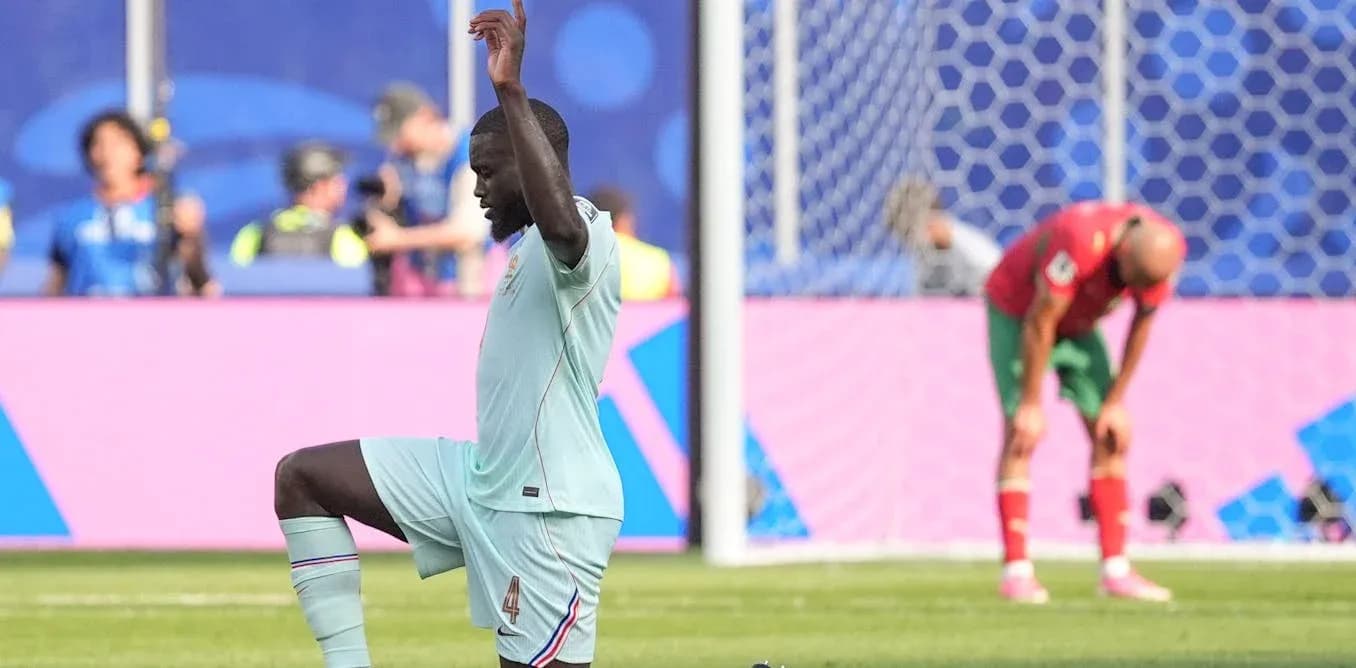
At the start of the 2026 World Cup semi-final week, no one embodied that work better than Dayot Upamecano. The France defender led the tournament with 12 interceptions. Twelve moments where he read the future quicker than the forward in front of him. Twelve times he turned a potential threat into a French attack, often before the danger had fully registered for anyone else in the stadium.
Cape Verde, on their first World Cup adventure, built much of their resistance on the same skill. Thrown into Group H against Euro 2024 winners Spain, they spent long stretches without the ball. They still walked away from that opener with a 0-0 draw – and with 15 interceptions. Over four matches they averaged roughly 13 per game, scrapping their way out of the group and finally falling 3-2 after extra time to defending champions Argentina in the round of 32.
Those numbers do not prove interceptions alone carried Cape Verde into the knockouts. A high total can just as easily betray a team pinned back for long periods. But cutting out passes gave them oxygen. Each touch in the lane stalled opponents who dominated possession and opened doors to counterattack before those opponents could reset.
The brain behind the tackle
To understand how fatigue eats into this craft, you have to break down what an interception actually demands.
First comes prediction. A defender must judge where the ball is heading and whether they can realistically arrive first. Research on anticipation in sport shows that experienced players do not simply react to the ball; they combine what they know about the situation with cues from an opponent’s movement. A passer’s body shape, stride pattern and approach to the ball all leak information about where the pass is going.
Once the ball leaves the boot, speed takes over. In an experimental study on well-trained amateur footballers, players were less inclined to go for an interception as the pass got faster. When they did go, their success rate dipped. The ball was simply moving too quickly for their bodies – and their calculations – to keep up.
Distance weighs on the decision too. Work on senior male futsal players showed that the defender’s starting distance from the ball strongly influenced whether an interception was on. Yet even after the first step, the job was not fixed. Players kept adjusting their speed relative to the ball’s path right up to the final touch. An interception is not one decision. It is a rolling process.
Experience sharpens those judgments, but never makes them perfect. In a football-specific study comparing more expert and less expert athletes, both groups initially overestimated how often they could complete an interception task. With practice, their estimates grew more accurate. They learned, in effect, what their bodies could and could not do.
That learning becomes harder once fatigue sets in.
When the mind tires before the legs
Mental fatigue is the quiet enemy: the tiredness and dulled alertness that creep in after long periods of intense focus. In one study involving 20 professional male footballers, players completed a demanding 30-minute mental task before a training match. Their passing decisions suffered. The legs were ready; the brain was a half-step slow.
Another study on well-trained male players found that mental fatigue reduced both the speed and the accuracy of football-specific decisions. These experiments did not look directly at interceptions, but the overlap is obvious. Reading a pass lane relies on the same processes: selecting the right visual cues, judging speed and distance, predicting what comes next and acting under time pressure.
Then comes the weight of physical fatigue. A ball that felt reachable in the 20th minute can be a hopeless chase in the 85th. Research on 24 trained male players showed that acute physical fatigue cut down how far and how intensely they moved. It also altered their positioning and elements of their team play.
A related study drew a sharp line between players with stronger and weaker decision-making skills. Under acute physical fatigue, the better decision-makers held their positions and overall effectiveness, partly by choosing to move at a slower pace. They accepted that their physical ceiling had dropped and adjusted. Those with weaker decision-making pushed out similar physical numbers but lost their defensive shape and impact.
So the smart defender under fatigue is not the one who simply runs more. It is the one who recalibrates. They must still estimate where the ball is going, but now they must also account for what their tired body can actually deliver – and do it without abandoning a vital zone.
Beating the eyes
Opponents, of course, are not passive. They do everything they can to poison the information a defender relies on.
Research on deception in competitive sport explains how athletes disguise intention. A passer might open their hips towards one teammate, sell the idea with their shoulders and eyes, then zip the ball somewhere else entirely. By the time the real target reveals itself, the defender has already shifted weight into the wrong passing lane.
Wait longer and you see more of the truth – but the ball has travelled further and the window to intercept shrinks. Jump early and you might arrive first, or you might be left grasping at air while the pass whistles behind you. Every interception lives in that tension.
These insights matter for how teams train. Work on designing realistic practice stresses that training must preserve the key information and actions that players face in real matches. For interceptions, that means live, moving opponents. It means varied pass speeds, realistic starting distances, and deliberate use of disguise. Static drills against predictable passes only polish technique; they do not harden decision-making.
Coaches also have to think about the state players are in when they make these calls. Fatigue does not just sap running power. In some situations, it distorts the decision itself. Monitoring distance covered and sprint counts can miss the quieter drop: the shrinking ability to make rapid, accurate judgments.
The goal is not to churn out defenders who dive at every passing lane and rack up interception totals on a data sheet. The best defenders learn which chances are truly reachable and keep adjusting that judgment as the ball travels. They sense when their legs have faded and subtly alter their choices without surrendering structure.
By the time Upamecano stretches out a boot to nick the ball away, the visible action is only the final frame. The real work happened a moment earlier, in a mind and a body calculating under pressure, racing against fatigue, and just beating the game to its next move.