.svg&w=384&q=75 "naujapitch logo")
World Cup 2023: Barça Players Dominate the Tournament
This is the biggest World Cup ever staged. It might also be the most Barça-soaked tournament the game has ever seen.
Played across the United States, Mexico and Canada, this World Cup will feel strangely familiar for anyone who spends their weekends at the Olympic Stadium or glued to Barça broadcasts. Wherever you look, there is a hint of blaugrana: in the line-ups, on the touchlines, in the stories that have travelled from La Masia to the global stage.
Sixteen current Barça players on show
The most obvious thread is the sheer weight of the current squad. Sixteen Barça players, spread across eight national teams, have packed their bags for the World Cup. That is a full dressing room’s worth of talent exported to the biggest stage, and it guarantees that culers will have skin in the game almost every day of the tournament.
But the story doesn’t stop with the present. The competition is littered with familiar faces who once wore the shirt, a moving showcase of careers that began or blossomed in Barcelona and now return to the spotlight under different flags and colours.
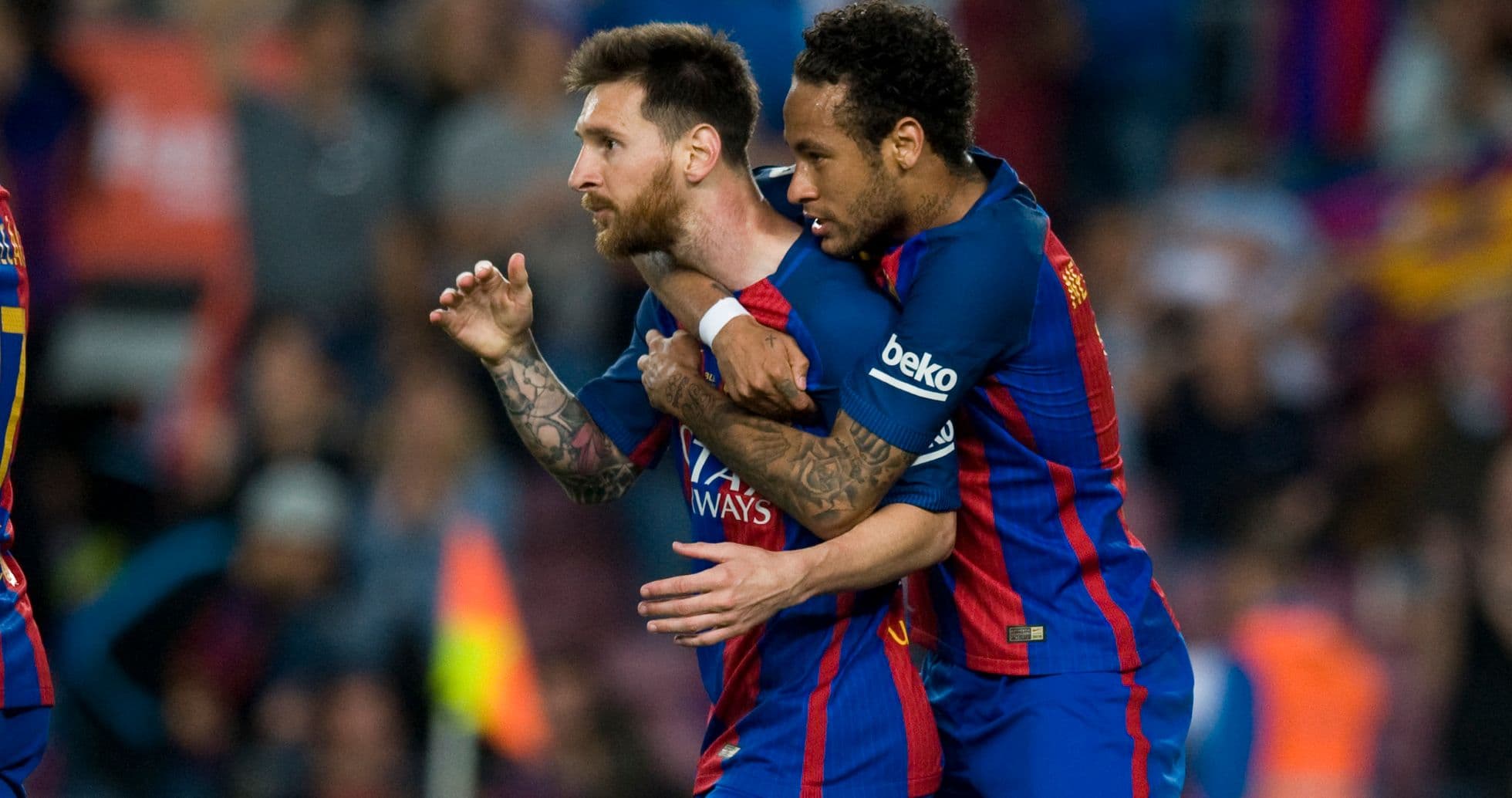
Messi, Neymar and the star power of former blaugrana
At the centre of it all stands Leo Messi. The captain of Argentina arrives as defending champion, the man who lifted the trophy in 2022 and now tries to guard it. His presence alone gives the World Cup a Barça afterglow, no matter how far removed he is from the Camp Nou era that defined him.
France, beaten finalists last time, also carry a strong Barcelona imprint. Ousmane Dembélé, the current Ballon d’Or holder, is one of Didier Deschamps’ leading weapons. The winger, whose talent once lit up the right flank in Catalonia, is joined by fellow ex-Blaugrana Lucas Digne. Marcus Thuram adds another twist to the tale: son of former Barça defender Lilian Thuram, he also passed through the FCB Escola during his father’s spell at the club. Another generation, same pathway.
Portugal arrive with their own cluster of Barça connections. João Félix, Francisco Trincão and Nélson Semedo all make the squad, each at different stages of their international journey but united by that shared line on the CV. Across the group, they will run into Colombia and an imposing figure culers know well: Yerry Mina, the former Barça centre-back, anchors the South Americans’ defence.
The links stretch deep into the draw. Franck Kessié, who spent a season in Barcelona’s midfield, is now one of the pillars of Côte d’Ivoire. Over in the United States camp, Sergiño Dest is expected to lock down the right-back slot for one of the host nations, carrying the technical schooling that shaped him in Catalonia onto home soil.
Then comes one of the tournament’s great subplots: Neymar’s return to the Brazil squad. Two and a half years after his last call-up, the former Barça forward is back in yellow. Injury will keep him out of the opening game, but his status remains untouched. Even from the sidelines, he will be one of the faces of this World Cup.
Another familiar attacking talent, Memphis Depay, also arrives with plenty to prove. Now playing his club football in Brazil, he stands as one of the primary threats in Ronald Koeman’s Netherlands side, a key figure in an attack built to hurt anyone.
Blaugrana on the benches
The Barça presence is not limited to the pitch. It stretches to the technical areas, where three national teams will be guided by coaches with strong ties to the club.
Ronald Koeman, the hero of Wembley ’92 and a former Barça manager, leads the Netherlands. His name alone evokes one of the club’s defining nights, and now he tries to script another chapter, this time in orange.
Julen Lopetegui, another former Barça goalkeeper and coach in the club’s orbit over the years, takes charge of Qatar. Thomas Christiansen, once part of the Barça set-up as a player, commands Panama. These are not traditional powerhouses, but their managers carry the same schooling that has shaped Barcelona’s footballing identity for decades.
La Masia fingerprints across the globe
Injury will also shape some of the early storylines. Ez Abde, one of Morocco’s most in-form attackers and another with Barça roots, is set to miss his team’s opening match. Even so, he remains central to their plans. Alongside him, centre-back Chadi Riad, a product of La Masia, is expected to play a prominent role in the North African back line.
Riad is far from alone. The conveyor belt from La Masia has scattered talent across continents and positions, and this World Cup is a live exhibition of that work.
Spain’s left flank, for instance, is steeped in Barcelona education. Both of Luis de la Fuente’s left-backs, Marc Cucurella and Alejandro Grimaldo, came through the Barça academy. So did young winger Víctor Muñoz, currently recovering from injury but still part of the national conversation.
Beyond Spain, the trail continues. Uruguay defender Santi Bueno carries the same schooling into a rugged back line. Japan’s Take Kubo, another former La Masia prospect, brings flair and intelligence to the flanks of a side that has grown used to upsetting bigger names on this stage.
Paraguay’s leading striker, Antonio Sanabria, is yet another forward shaped in Barcelona’s youth ranks. South Korea midfielder Seung-Ho Paik, once considered one of the brightest prospects in the academy, now pulls the strings in the heart of an Asian powerhouse that never shies away from a fight.
Look at any group, any matchday schedule, and the pattern repeats itself. A full-back here, a winger there, a coach on the touchline, a star with a past in Catalonia.
This World Cup is vast in geography and scale. Yet wherever the ball rolls, Barça’s fingerprints are already on it.