.svg&w=384&q=75 "naujapitch logo")
Tuchel's Stark Assessment of England's Left Flank
Thomas Tuchel did not bother to sugar-coat it. England’s left side, in his eyes, has gone missing.
The Three Lions manager tore into his options on that flank, delivering a stark assessment of Anthony Gordon, Marcus Rashford and the rotating cast of left-backs Nico O’Reilly and Djed Spence after back-to-back underwhelming group performances at the World Cup.
Left flank under fire
Tuchel thought he had cracked it. Gordon dazzled in the final warm-up against Costa Rica, the combinations down that side flowing, the movement sharp, the threat obvious. Tuchel walked away from that friendly convinced a long-standing problem had finally been solved.
“I saw the game against Costa Rica and thought: ‘OK, left side is solved, this unit, they find their link,’” he said.
Then the tournament started.
Across England’s opening two group games, Tuchel saw the same pattern: not enough “connection and penetration” on that flank, not enough “verticality”, not nearly the same quality as in that Costa Rica dress rehearsal. The unit that once looked fluid now looked fractured.
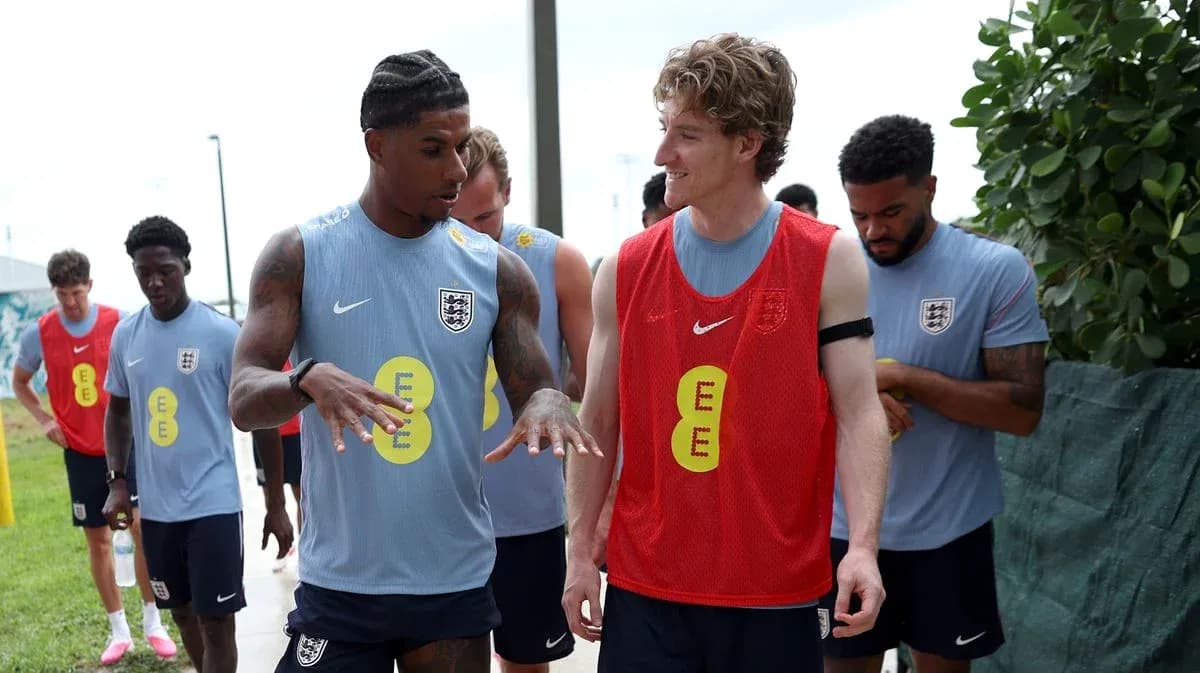
He did not spare individuals. Gordon, the man who had lit up that final friendly, has not reproduced that form on the biggest stage. Rashford, when given the chance to start, has not matched Gordon’s decisiveness.
“Marcus is in a good place, but when he started he was not as decisive as Anthony, that's just it,” Tuchel said, bluntly.
The issue, though, runs deeper than one winger. Tuchel pointed straight at his full-backs as well, explaining why O’Reilly was jettisoned for Spence against Ghana. The manager sees a malfunctioning “unit” rather than a single weak link.
“The unit on the left side hasn't provided the same quality as they did against Costa Rica,” he admitted. “It turns out we played the first match and they're not clicking, I’m not even sure why.”
Rashford’s role has become an awkward balancing act. Tuchel clearly values him, repeatedly stressing his trust, yet the numbers from the start have not justified that faith. Off the bench, though, Rashford changes games.
“He struggled to have the same influence for us from the start, and yet from the bench he was always pushing,” Tuchel said. “Marcus is just also very good from the bench, and it's sometimes nice to hold someone back.”
For now, Rashford remains a “candidate to start” against Panama. But the warning is unmistakable: whoever plays, that side must “click a bit more and provide a bit more threat.”
No magic formula for low blocks
England’s problems are not confined to the left wing. Their goalless draw with Ghana left Tuchel’s team frustrated, their status as potential Group winners suddenly under threat, and the manager openly wrestling with a familiar modern riddle: how to break down a stubborn low block.
“It is difficult to accelerate the match against these low blocks,” he said. “You see this in the Champions League as well, you see it in the Premier League.”
The Ghana game followed that script. England had the ball, Ghana had the discipline. Tuchel’s side created half-openings but rarely carved out the clear, ruthless chance that decides this kind of contest. He knows exactly where the detail is missing.
“It needs this one moment of quality and a bit more precision with the crossing,” he explained. “A bit more timing with the crosses, maybe a bit more awareness with the crosses.
“Who is arriving with the cross? Are we arriving aggressively enough with the cross? How can we shoot more from outside the box, have a deflection and force this goal in.”
Tuchel, a serial problem-solver at club level, did not pretend to hold a secret tactical code for these situations.
“I haven’t found the recipe where ‘they do this, then we do this - and then we are fine,’” he admitted. “Maybe I am proven wrong but I don’t think anyone likes to play against Ghana.”
Ghana, under new boss Carlos Queiroz, celebrated every foray over the halfway line, every defensive stand, every second ticked off the clock. At full-time, they rejoiced in a 0-0 that felt like a victory. England trudged away, aware they had “done enough to win” yet failed to land the decisive blow.
Tuchel refused to label it a low point. He compared it to cagey Champions League group nights in Copenhagen or Leipzig, where a superior side controls the game but runs into a wall of resistance and counter-attacking threat.
“The highs should not get too high. The lows should not get too low,” he said. “We did enough to win the Ghana game and we also had to control their counter attacks. Twice they were dangerous. But it is time to believe and time to keep on going.”
Panama next – and no room for naivety
Now comes Panama at the MetLife Stadium, ranked 42nd in the world, 23 places above Ghana. On paper, that number alone should sharpen English focus.
They must win to be sure of topping the group. Tuchel expects another long, attritional evening against a team prepared to sit deep and suffer.
“We will try to find a very active and aggressive approach now against Panama but we cannot just be stupid and naive,” he said.
He is preparing for another packed defence, another shifting wall of bodies.
“We will face another deep block in another kind of formation. We now see a back five. For many moments in the match we see a back six, we see a back seven.”
The task is clear: England must find that “one moment of quality” they lacked against Ghana, while tightening the misfiring connections down the left that so irritate their manager.
Selection questions and a famous warning
Outside the camp, the reaction to the draw has been predictable. The chorus grows: where is Cole Palmer? Why no Trent Alexander-Arnold to unpick the lock? Why not a technician like Phil Foden to prise open a packed defence?
Every tournament brings the same reflex. The players not there, or the ones on the bench, suddenly become the solution to every problem.
Tuchel is not buying it.
“I cannot engage this after a draw,” he said, pointing out that Spain, Brazil and Portugal have all had their own stumbles. For him, the more telling message came not from pundits or fans, but from a “very famous” and “very well respected” coaching colleague.
After Ghana appointed Queiroz, the text landed: “Your most difficult game is now the second game, I tell you that.”
Tuchel took that seriously. He saw a disciplined, awkward opponent and a match that “played out to be difficult” in exactly the way he had been warned.
“So I have a bit of respect for what we’re playing here, and then we need to trust also our players and respect them,” he said. “It helps no-one if we question things now.”
He stood firmly behind his squad choices.
“We selected a group from the evidence that we had. It cannot be that you’re not selected as a player and suddenly you will be. This is not how it works. We want to step up in the next game.”
The message is stark and simple. The answers must come from those already in the dressing room. The left side has to wake up. The attack has to find that single, ruthless action against deep defences. The manager will not tear up his plan or his squad list after one stalemate.
Panama will test that resolve. The question now is whether England’s misfiring flank and frustrated forwards can turn Tuchel’s damning verdict into a turning point, or whether this World Cup will remember his left side as the flaw that never quite got fixed.