.svg&w=384&q=75 "naujapitch logo")
Terry Butcher’s Iconic Courage and England’s Leadership Dilemma
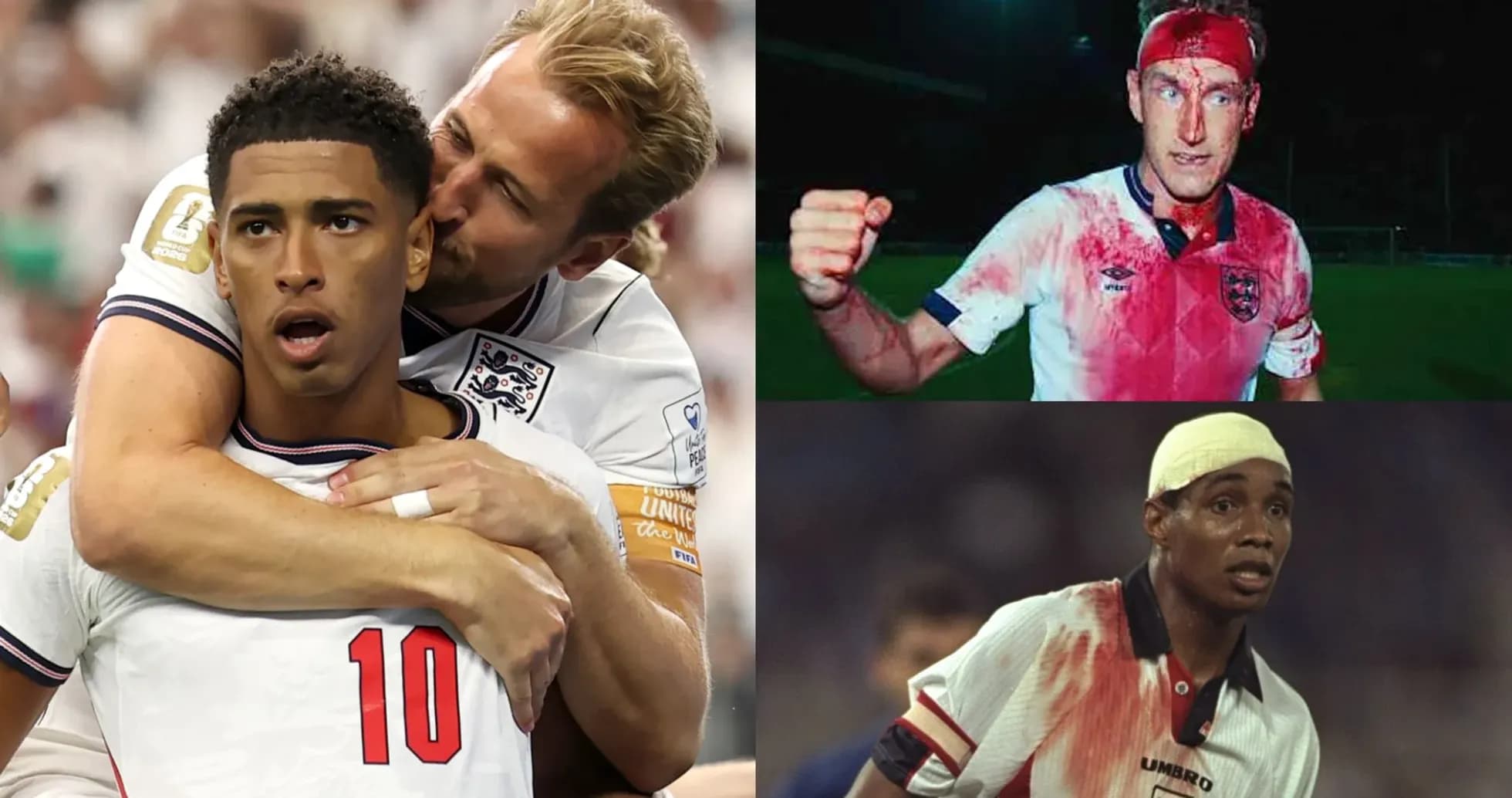
The image is still seared into English football’s collective memory. Stockholm, September 1989. Terry Butcher, head bandaged, face streaming, England shirt soaked a violent red as he threw himself into one last header. No change of kit. No thought of coming off. Just a centre-half who refused to stop.
That night against Sweden turned Butcher into an icon of a certain kind of English courage. The kind that shrugs at blood and snarls at pain. The kind that, for him, should come as standard every time a player pulls on the Three Lions.
He’s not alone from that era. Paul Ince, with his own blood-smeared display in Rome in 1997 to drag England to the 1998 World Cup, and Stuart Pearce, the embodiment of defiance from the penalty spot, belong to that same lineage. They are the reference points. The benchmark.
So who carries that flame now?
“The Biggest Warrior We’ve Got”
Ask Butcher, and one name comes straight out.
“Oh, that's a good one. It's a good question. The biggest warrior we've got at the moment? I’d probably say Jude Bellingham, someone like that.”
No hesitation. No long list.
“He'd be more of a warrior, he does get worked up and he's fiery. I like that. Perhaps sometimes too fiery, but that's the way he plays. He lives on the edge sort of thing. He wants to put himself about and gets frustrated like everybody else. I think Jude would be the one for me.”
It’s a telling choice. In an era where blood on a shirt means immediate substitution and a fresh kit, Bellingham stands out not for stitches or scars, but for edge. For the snarl in his game, the refusal to drift through a match unnoticed.
Butcher was speaking as part of Domino’s ‘Shirtiette’ campaign, a tongue-in-cheek nod to getting messy. Yet his answers cut to something more serious: what England have lost, and what they might still be able to rediscover.
A Game That Has Gone Soft?
The former Ipswich and Rangers defender doesn’t pretend nothing has changed. In fact, he leans into it.
“Yeah, it's faded out of the game because the game is a different sort of animal now. It's more technical. It's more about ways of playing rather than just getting stuck in.
“There's no sort of real physicality in football. It's all about the technique. It's all about creating overloads and all the technical terms. The nearest that comes to our day is probably on set plays and particularly corners when everybody seems to take on a wrestling image and try and bundle people to the ground.”
He can see the upside.
“The game has changed and you can see that it's changed for the better in many instances, but I just think a bit more physicality would certainly help.”
There it is. The tension at the heart of the modern game. The tactical sophistication, the patterns, the pressing traps – all progress. But in Butcher’s eyes, something vital has been trimmed away.
“It certainly helps with the fans because the fans always like to see someone getting stuck in, but you can't do that now because you do run the risk. If you do intimidate players and if you do throw your weight around, then you're in danger of getting not a yellow card, but a red card.”
The rules have shifted. The culture has softened. And somewhere in that process, the archetypal English enforcer has slipped towards extinction.
Leaders Lost in a Zonal World
England head into the sharp end of another campaign still chasing the end of a 60-year wait for a major trophy. They have goals. They have talent. They have depth.
Do they have leaders?
Asked if there is a commanding presence in the current defensive unit, someone to organise, to plug leaks, to bark and drag standards up, Butcher’s answer is blunt.
“No, I don't think there is. I don't think there's been anybody there for a long, long time.”
He reaches back to his own dressing rooms for contrast.
“I think gone are the days when you can speak harshly at players. I had Bryan Robson, he used to speak harshly at me if I did something wrong and then I'd have a go back at him if he did something wrong - but he didn't do anything wrong generally so I didn't have to go back at him! But you let your feelings be known vocally, very quickly and very strongly.”
The modern game looks different even in the details.
“Nowadays you don't do that. I think one of the reasons is that players, particularly on set plays, in the corners and free-kicks, they don't mark a specific opponent. They are zonal, so there's no need for them to shout or do anything else.”
The tactical shift has, in his view, bled into personality.
“I think the way that football is now, players are too nice with each other. There's no one demanding more of each other. There's no leaders in the group. It's players and just a bunch of individuals getting on with it. They may say things in the dressing room, but on the pitch there doesn't seem to be anyone that really does shout and point a finger.
“[Jordan] Pickford does that sometimes and he points a finger. Not many in the England team do. It's just a case of getting on with their job and being the best that they can be themselves.”
He misses the noise. The rawness.
“I liked the vocal side. I enjoyed it. I enjoyed praising people as well as also shouting at them to urge them on, ‘come on lads’ and all that sort of thing. You see it occasionally, but not very often. I'd like to see it more.”
Bellingham, Rice and the Armband After Kane
For now, the captaincy is settled. Harry Kane wears the armband, scores the goals and rewrites records – 81 and counting for his country. But even Kane cannot go on forever, and England will soon enough need a new figurehead.
Could that be Bellingham, the young midfielder Butcher has already anointed as the squad’s biggest warrior?
“I was the captain of a few clubs and I used to kick doors down and I used to be vocal and I used to swear at referees and all these kinds of things. Not what you would really expect a captain to do, but that was what it was in those days.”
His standard for leadership is not gentle.
“I think Bellingham will in time mature, particularly on the international scene. I think then he could be eligible for the captaincy. I think at the moment he's one of the lieutenants, one of the wingmen, he's underneath that captaincy level.”
So not yet. Not quite. But on the runway.
“Declan Rice would be an obvious candidate for a captaincy, particularly following in the footsteps of Harry Kane,” Butcher adds, underlining the Arsenal midfielder’s credentials as a natural successor.
Kane, though, refuses to loosen his grip on the present.
“Harry Kane could play forever. The way he's going about his business, the way he looks after himself, the way he behaves, he’s like [Cristiano] Ronaldo and he could play forever. Harry didn't have much pace to lose, but his brain seems sharper, his reactions seem sharper. I think that he's got a lot more to do.”
The message is clear: the next generation of captains is forming, but the current one is far from done.
A New Stage, Old Demands
Next up, the stakes rise again. Kane, Bellingham and the rest of this England side close out their Group L campaign at the 2026 World Cup on Saturday, facing Panama in New Jersey. A different continent, a different backdrop, but the same unforgiving spotlight.
Thomas Tuchel will demand control, fluency, goals. Supporters in North America and back home will demand something else as well – a spark, a surge, a performance that feels like more than a tactical exercise.
They want moments that stick. The kind that stain shirts and shape legends.
Butcher’s blood-soaked night in Stockholm belongs to another age. The question for this England team, as they chase history again, is simple enough.
Who will be willing to leave their mark the way he did?