.svg&w=384&q=75 "naujapitch logo")
Special Olympics Journey: Scunthorpe Team Aims for Gold
In a corner of Scunthorpe, far from the noise and neon of New York, another England story is taking shape.
While the national team chase a World Cup final on Sunday, a small Central Park in North Lincolnshire stages its own version of ambition: a squad of players with intellectual disabilities grinding through drills in the evening heat, eyes fixed on Special Olympics gold.
A decade of quiet graft
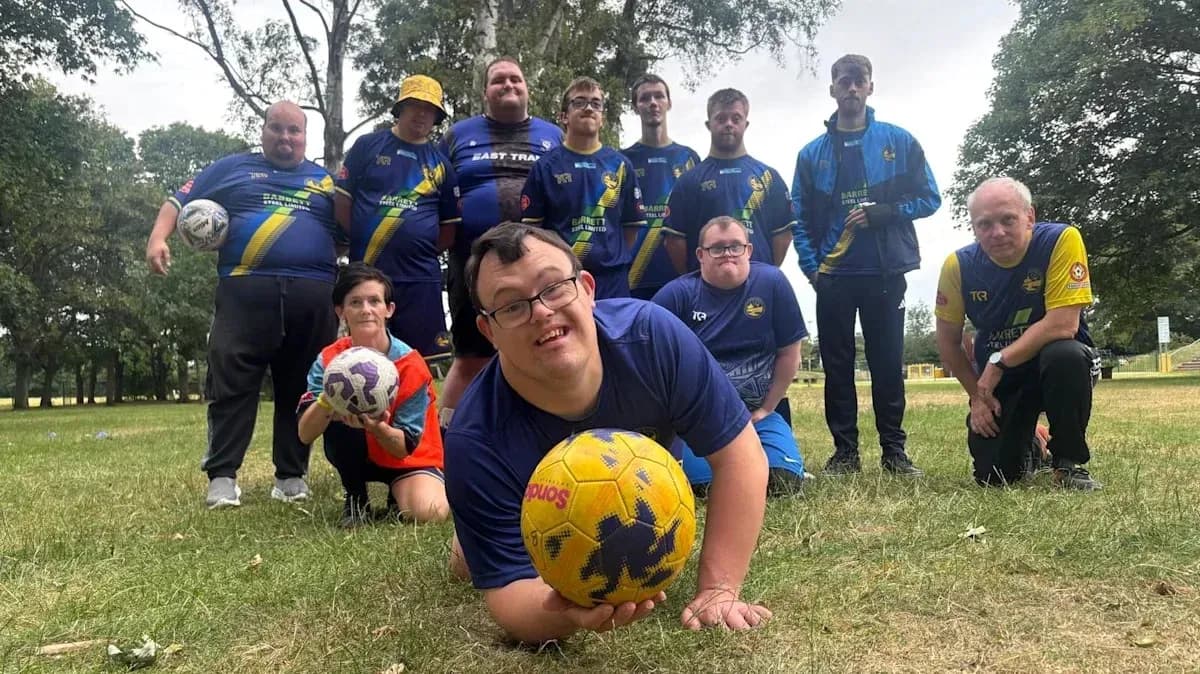
Under the trees, in the shade, the routine looks familiar: passing patterns, shooting drills, shouts of encouragement. But this is not a team thrown together for a summer tournament. This is the product of about 10 years of work, a project that began with a handful of young adults with Down's syndrome and has steadily grown to embrace players with autism, ADHD and other learning disabilities.
When these players first came together at Bottesford Town Football Club, progress was measured in tiny steps. A bit more eye contact. A louder call for the ball. A first confident touch in front of others. Football was the vehicle; social confidence and independence were the destinations.
Now the change is unmistakable. They train in their own colours. They talk about tactics. They talk about medals.
This summer, they will walk out at the Special Olympics GB National Summer Games at Alexander Stadium in Birmingham, held between 26 and 30 August. For them, it is their World Cup.
Jake’s corners and a golden target
Ask Jake what this all means and the answer is immediate.
“I feel happy,” he says of the chance to compete at the Games.
He is proud of his role. “I take corners,” he explains, before offering a quick masterclass on how to “wrap” the ball into the net. There is no hesitation when the conversation turns to targets. He has been here before, part of a squad that took silver at the Special Olympics in 2017. This time he wants more: two goals and a gold medal.
Jake is one of around 1.5 million people in Great Britain living with an intellectual disability. Special Olympics GB exists to make sure as many of them as possible have the chance to play, to belong, to compete all year round in their communities. For Jake, that pathway runs straight through Bottesford Town.
A mother’s promise
His mum, Sue, has been there from the very beginning. She helped set up the team at Bottesford Town, has driven the minibus, rattled the fundraising buckets, and watched not just one son but two grow with the club. Her other son, Aiden, also has disabilities and is now learning to coach the team.
The idea started with a simple problem. Jake loved football but couldn’t keep pace in mainstream teams.
“He found it too difficult and couldn't keep up with the team,” she says. The solution was to create something built around him and his friends. She approached Bottesford Town FC and asked for a chance.
“For Jake to be able to play football was just such a big thing for him,” she says. “It's his passion. He loves football and he wanted to be able to play it.”
The impact has gone far beyond first touches and shooting drills. The group have sharpened their football skills, but they have also built friendships that stretch well past the touchline.
“When your child is born and you find out they have a disability, it's a complete unknown,” Sue says. “But my commitment was always that my boys would access as much as possible in their lives.”
Bottesford Town FC, she says, have been “amazing” in backing that commitment, opening up their facilities – the sports hall for winter training, the 4G pitch that gives the players a consistent surface all year round.
Setbacks, then a bigger challenge
Not everything has been a steady rise. The team were accepted into the Special Olympics in 2021, only to see the Games cancelled because of the Covid-19 pandemic.
“It set quite a few of them back. Jake was one of those who struggled,” Sue admits. The dream had been dangled in front of them, then taken away.
The squad regrouped. The next obstacle was financial rather than physical. To send two teams to this year’s Games, they needed to raise £10,000 to cover travel and accommodation. For a community team, that figure loomed as large as any elite opponent.
They set about it anyway. Events, appeals, relentless persuasion. The sort of off-pitch effort that rarely makes headlines but underpins every moment of joy on the field.
Training ramps up
With the funding drive in motion, manager Michael Potts has turned the focus back to the football. Training, he says, is “ramping up” as the Games approach, and the mood among the players is clear enough: they are “excited”.
The 4G surface has become an ally. The reliable bounce and pace have helped the squad refine their technique, sharpen their passing and build confidence in possession. As the team has expanded to include players with a wider range of intellectual disabilities, the coaching staff have had to evolve too, tailoring sessions to different needs, different learning styles, different personalities.
It is careful work, but the results are there in the way the ball moves and the way the players talk to each other.
A ‘rock solid’ last line
At the back, Mason sets the tone. He is the goalkeeper and he does not hesitate when asked to describe his defence.
“Rock solid,” he says.
He has thought about the wider game too. Asked what advice he would offer the England men’s team as they chase their own prize, he keeps it simple: train hard, and make sure the goalkeeper concentrates on “throwing the ball out” properly.
He speaks from experience. At his last competition he saved a penalty, a moment that still clearly burns bright. Like Jake, he is aiming for gold in Birmingham.
Alongside him, Taylor anchors the defence. He has been with the team for 10 years and has watched it grow around him. Training, he says, is going well. His message to anyone thinking about joining a similar set-up is direct: train hard. His own ambition is bolder still. He predicts scoring four goals at the Games, from defence.
Eyes on Birmingham
As the sun drops and the shadows lengthen across Central Park, the drills keep going. Pass and move. Call and respond. The noise is part laughter, part instruction, part determination.
For an outsider walking back through the park, one image lingers: a group of players in matching kit, moving with purpose, demanding more of themselves and each other as a major tournament draws near.
They are not chasing contracts or television deals. They are chasing something more fundamental – a chance to test themselves on a national stage, to turn years of unseen work into something tangible, something they can hang around their necks.
The next time this team gathers after Birmingham, the question will be simple: how many of those dreams did they manage to turn into gold?