.svg&w=384&q=75 "naujapitch logo")
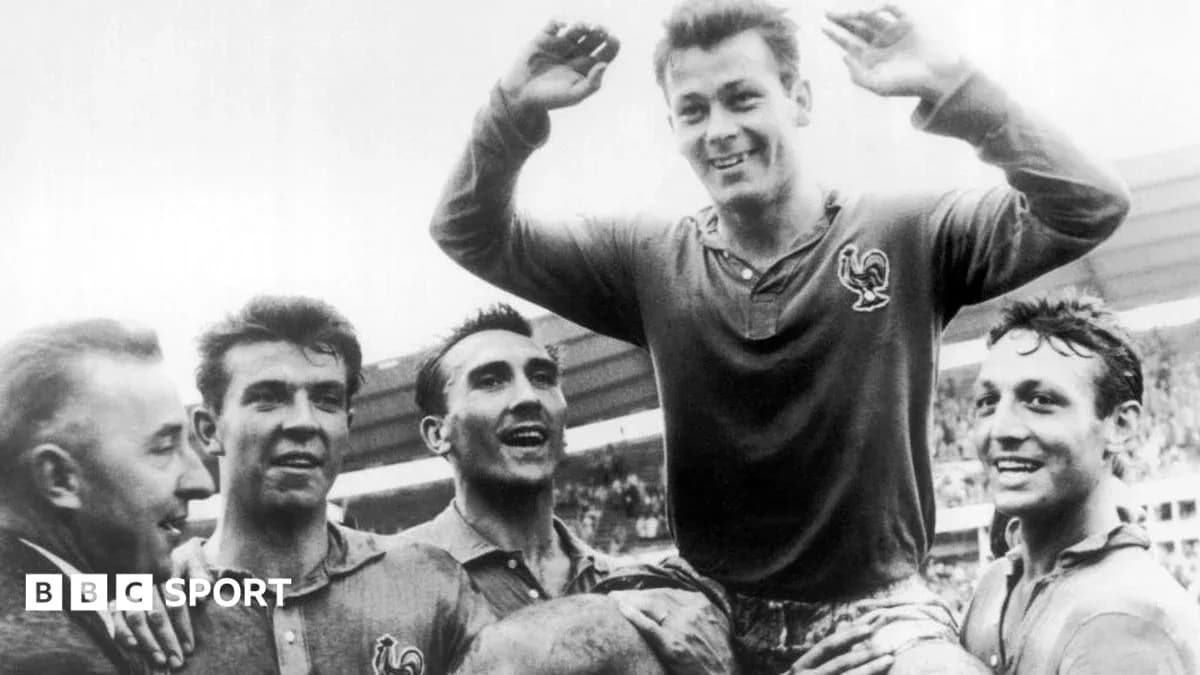
Just Fontaine: The Legendary World Cup Record-Holder
Just Fontaine’s name surfaces every four years, like clockwork. A quiz answer, a line in a record book, a number that seems almost mythical: 13 goals at a single World Cup.
Then you remember he did it in borrowed boots. And he was not even meant to start.
No golden boot, no gleaming trophy. For finishing as top scorer at Sweden 1958, Fontaine went home with an air rifle, handed over by a Swedish newspaper who called him a “sharp shooter”. It fits the story. His legend has always felt slightly out of step with the modern game – gigantic achievement, modest trimmings.
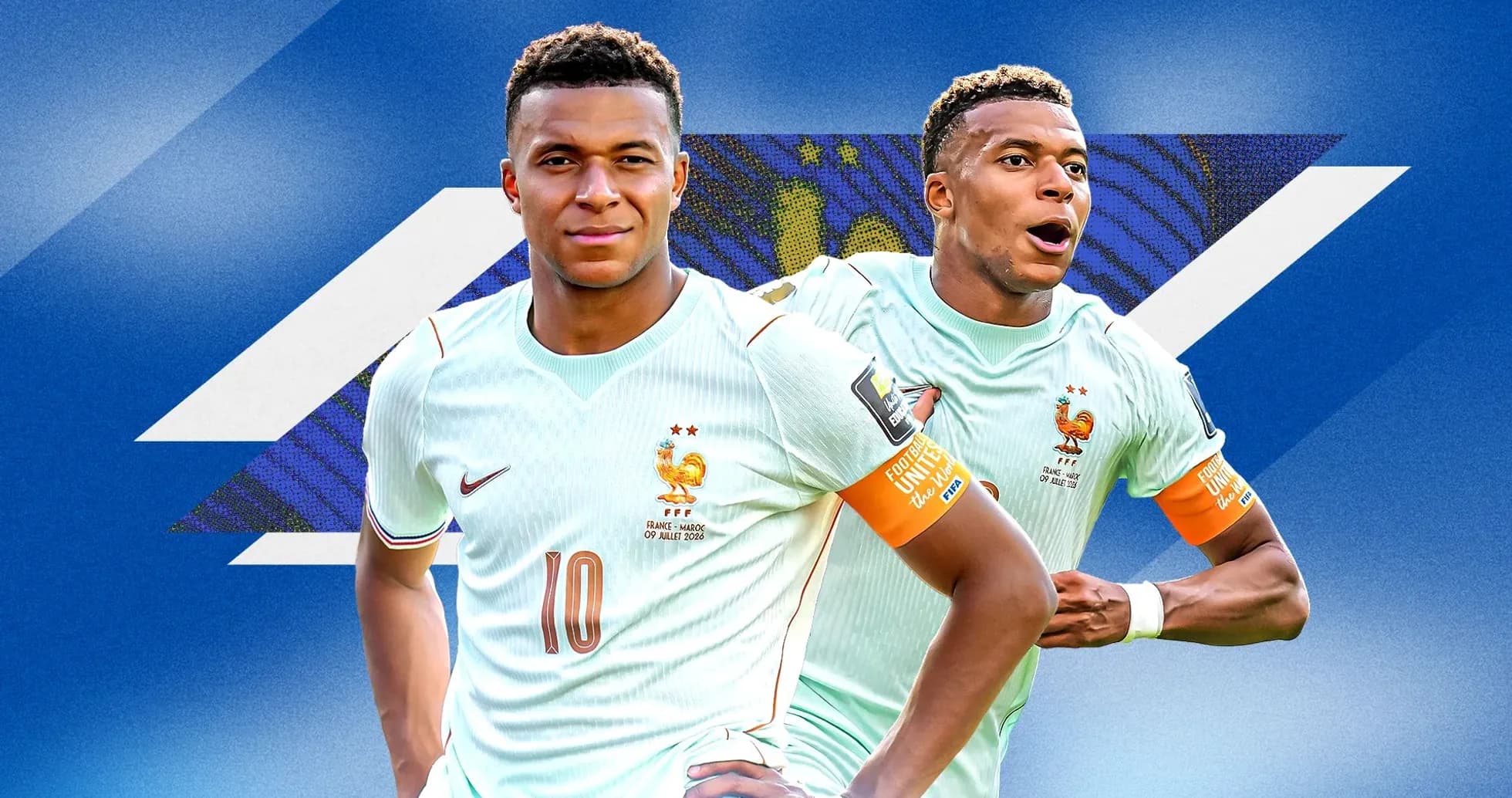
Now, in 2026, the record suddenly feels closer than it has in decades. Lionel Messi, Kylian Mbappe, Erling Haaland, Harry Kane, Jude Bellingham – the modern game’s most ruthless finishers are deep into a World Cup shootout of their own.
Mbappe has eight. Messi and Haaland sit on seven. Kane and Bellingham are only one back. The goals are piling up.
The format helps. With 48 teams and an extra knockout round, any side reaching the semi-finals is guaranteed eight matches. The maths is kinder to strikers than it was in Fontaine’s day.
Even so, they are still chasing a man who needed only six games.
A record-holder who became a footnote
Since 1970, the World Cup’s top scorer has passed six goals in a tournament just three times. The number 13 has loomed over every generation, untouchable. Pele, Ronaldo, Messi, Mbappe – all giants of the sport, all operating in Fontaine’s shadow when it comes to a single World Cup.
Yet Fontaine himself has drifted into obscurity. Pele, Messi and their peers are endlessly debated as the greatest of all time. Fontaine, more often than not, is a line of trivia.
That sells him short. His career, and his life, would look very different in today’s game – starting with the flag he might have played under.
The 2026 quarter-final between France and Morocco was branded the Just Fontaine derby for a reason. He was born in Marrakesh in August 1933, when Morocco was still a French protectorate. By the time Morocco gained independence in 1956, Fontaine was already established in the French league and the French national team. So when the 1958 World Cup came around, he wore the blue of France, not the red and green of his birthplace.
And even then, he was not supposed to be the main man.
The striker who started by accident
Sports journalist and historian Philip Barker lays out the sliding-doors moment. Fontaine was not first choice. Rene Bliard was. Then Bliard was injured in a warm-up match. Suddenly, manager Albert Batteux needed a new centre-forward at the last minute.
The change was so rushed Fontaine did not even have suitable boots. He borrowed a pair from team-mate Stephane Bruey for the opening game.
Imagine that now. A World Cup, a future record-breaker, and he is wearing someone else’s boots.
Fontaine had undergone a meniscus operation during the season and had been a doubt for the tournament. That concern turned into an advantage. While others arrived drained from a long campaign, he turned up fresher, sharper.
He had only five caps for France when he was thrust into the starting XI, but he was no unknown quantity. At club level he was already a prolific force.
Speaking to the BBC in 2002, Fontaine recalled how little pressure he felt.
“In those days there was not so much pressure on us,” he said. “Only two journalists followed the team around.
“Our team bosses were so convinced we would be knocked out that they only gave us three shirts each, so we were totally free from pressure.
“My mind was not on the goals record at all. I even turned down the chance to take a penalty in the third-place game!”
Reims, goals and a Ballon d’Or neighbour
By 1958, Fontaine was the spearhead of a powerful Reims side. They had just completed a French league and cup double in 1957-58. It was one of four Ligue 1 titles he would win – one with Nice, three with Reims.
A year after his World Cup explosion, he dragged Reims all the way to the European Cup final, finishing as top scorer in the 1958-59 competition with 10 goals. Real Madrid beat them in the final, but Fontaine’s reputation as one of Europe’s deadliest forwards was sealed.
Inside the France dressing room, his status was clear. Raymond Kopa, the elegant playmaker who would go on to win the 1958 Ballon d’Or with Fontaine finishing third in the voting, was both team-mate and sounding board.
“Fontaine shared a room with Kopa on international duty, this legendary player for Real Madrid,” Barker said. “They spoke about their understanding of the game.
“So he came into the team, and took to it like a duck to water.”
He did more than that. He set the World Cup on fire.
Six games, 13 goals, and borrowed boots
Fontaine’s first act at Sweden 1958 was a statement. A hat-trick in a wild 7-3 win over Paraguay in France’s opening group match. From that point, he never stopped.
He scored in every game. Group stage, knockout rounds, semi-final, third-place play-off – every time France played, Fontaine found the net. His run included a goal in the semi-final defeat to a Brazil side powered by a 17-year-old named Pele and destined to become one of football’s defining teams.
The third-place play-off against West Germany gave Fontaine one last chance to stretch the record. He took it with both hands, scoring four times in a 6-3 win.
Thirteen goals. Six matches. Borrowed boots.
The numbers are staggering, but the manner of the goals matters just as much. This was no lumbering penalty-box poacher feasting on chaos and heavy legs. On grainy black-and-white footage, with a heavy leather ball and goalkeepers far less protected, Fontaine looks startlingly modern.
Against Paraguay he times late runs into the area, breaks the offside trap and slides finishes into the corners. The movement is sharp, the finishing clinical. Barker sees a striker ahead of his time.
“Fontaine looks like a modern striker, he has so much pace,” he said. “He was a leader of the attack in the English style, said L’Equipe – courageous, combative, stubborn.
“Then scoring a hat-trick in your first game of the tournament, that must give you so much confidence.”
His third goal against West Germany stands out. Picking up the ball on halfway, he surges away from defenders and tucks his finish into the far corner. The run and the composure carry echoes of Michael Owen’s famous goal for England against Argentina in 1998.
Fontaine’s spree fitted the mood of the tournament. Sweden 1958 produced 126 goals, the second-highest tally in a 16-team World Cup after 1954. France were the most prolific side of all, scoring 23 times.
With Fontaine and Kopa orchestrating and finishing moves, Barker believes that team belongs in the same conversation as France’s modern champions.
“The 1958 tournament was the last real goal-fest tournament. You had the emerging Brazil team with Pele, but also the French team were all-time greats,” he said.
“We talk about the 1998 and 2018 teams, but this was the first great French team. The front five scored 22 goals, that shows how powerful they were.
“Yes, the defences are a bit slow, but the way France move the ball, they would score against any team. Fontaine was also setting up goals for Kopa, they are such a slick team.
“France were only stopped by 1958 Brazil, one of the greatest teams of all time. We are not talking school five-a-side, these are real standards.”
France never made it back to the World Cup with Fontaine. Injury cut his career short. It is hard not to wonder what might have happened in 1962 or 1966 had they still had that kind of predator in the penalty area.
Beyond the goals: union leader, coach, unsung giant
Fontaine’s impact on French football did not end when he stopped scoring. He helped set up the players’ union, the UNFP, and became its first president in 1961, giving a generation of professionals a collective voice.
He moved into management as well, taking charge of France for two matches in 1967. Later came spells with PSG and Toulouse, and eventually two years in charge of Morocco – a return, in a different role, to the country of his birth.
“He set up the union, he coached, he ran a couple of sports shops. From time to time, people would ask who the World Cup record holder was, and he would still relish the fact people would remember him,” Barker said.
“Fontaine used to joke that if he came back in 200 years, his record would still be going. L’Equipe called it ‘unbeatable’.”
Fontaine died on 1 March 2023, aged 89. He lived long enough to see France lift the World Cup twice, and to watch Mbappe emerge as the new face of French football, the man most likely to chase down his sacred number.
“How appropriate it would be if Mbappe beats him?” Barker said.
Maybe this is the year the record finally falls. Maybe it survives another cycle. Either way, the number remains daunting.
Thirteen. Six games. Borrowed boots. An “unsung hero”, perhaps, but still the man everyone else must catch.