.svg&w=384&q=75 "naujapitch logo")
South Korea Edges Czechia 2-1 in World Cup Match
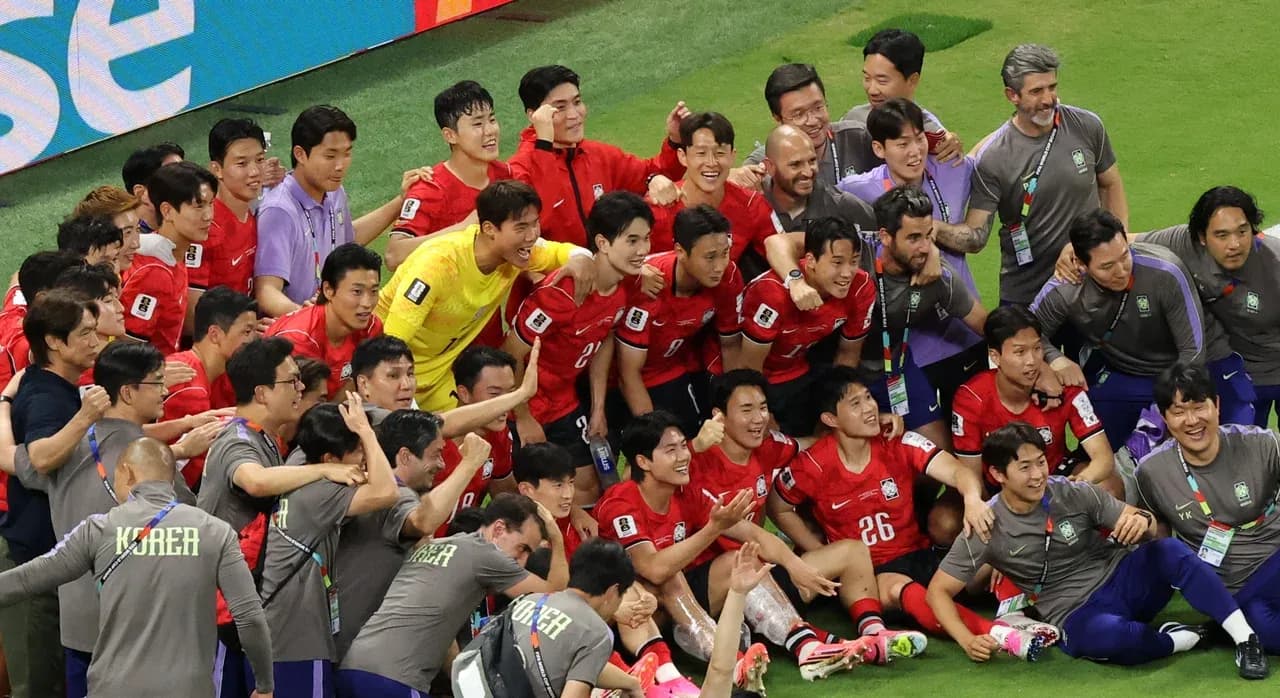
On a humid night at Estadio Akron in Guadalajara, South Korea and Czechia walked out level on paper and mirrored on the tactics board, both locked into a 3-4-2-1. Ninety minutes later, the symmetry had been broken. South Korea had edged a 2–1 victory, seized three points, and stepped into the World Cup Group A conversation as something more than a dark horse.
Following this result, the table offers a stark contrast. South Korea sit 2nd in Group A with 3 points, a goal difference of +1 (2 scored, 1 conceded in total), their form line a clean “W”. Czechia, 3rd with 0 points and a goal difference of -1 (1 scored, 2 conceded in total), are already chasing the group, their status tellingly labelled “Possible Advanced” rather than assured.
I. The Big Picture: Mirrored Systems, Different Identities
Both coaches doubled down on the 3-4-2-1. Myung-Bo Hong trusted a back three of Gi-Hyuk Lee, Kim Min-jae and Han-Beom Lee in front of Kim Seung-gyu, with a hard-working midfield box anchored by Hwang In-beom and Seung Ho Paik. Wide, Young-woo Seol and Lee Tae-seok were asked to be both full-backs and wingers; ahead of them, Kang-in Lee and Jae-sung Lee floated behind Son Heung-min.
Miroslav Koubek mirrored the shape: Ladislav Krejčí, Robin Hranáč and Štěpán Chaloupek as the defensive trio, Vladimír Coufal and Jaroslav Zelený as wing-backs, Tomáš Souček and Alexandr Sojka in the engine room, with Lukáš Provod and Pavel Šulc supporting Patrik Schick.
On paper it was a chess match of matching structures. On grass, it was South Korea’s superior technical level between the lines and their sharper rotations in the half-spaces that tilted the game.
II. Tactical Voids and Discipline: Edges in the Margins
The raw data lists no pre-match absentees, so this was close to full-strength on both sides. The real “missing” piece for Czechia was not a player but a profile: a second progressive passer in midfield to complement Souček. Without that, their build-up leaned heavily on Krejčí stepping out and Coufal advancing high, exposing them to Korean counters.
Disciplinary patterns across the tournament sample are revealing. South Korea’s card distribution shows a single yellow in the 91–105' window, accounting for 100.00% of their total yellows so far. That lone caution belongs to Gi-Hyuk Lee, who also appears in the top red cards list because of the same incident classification. It underlines a late-game edge: Korea are largely clean through 90 minutes, then willing to “take a card” to kill transitions in added time.
Czechia, by contrast, have no recorded yellows or reds in the current World Cup data. On one hand, that suggests discipline; on the other, it hints at a lack of tactical fouling in key moments, especially when trying to halt the Korean counters sparked by Kang-in Lee and Son.
III. Key Matchups
Hunter vs Shield: Hwang In-beom vs Czech Back Line
The most decisive duel of the night was not a classic striker vs centre-back battle, but Hwang In-beom against the entire Czech defensive structure. Heading into this game, South Korea’s overall scoring rate now stands at 2.0 goals per match in total, all scored at home in this World Cup sample. Hwang is at the heart of that output: 1 goal and 1 assist in total, from 3 shots (2 on target), plus 81 passes at 90% accuracy.
He operated as a deep-lying playmaker and late runner, exploiting the seams either side of Souček. Czechia’s defensive record in total – 2.0 goals conceded per match on their travels and overall – was borne out here. Their 3-4-2-1 never quite compressed enough between the lines to shut down Hwang’s vertical passing or his surges into the box.
Krejčí, who scored Czechia’s lone goal and won 7 of 13 duels, was their standout “shield” and “hunter” rolled into one. But his dual role had a cost: every time he stepped out aggressively to engage Hwang or Kang-in Lee, space opened behind him for Son’s diagonal runs or for late arrivals like Oh Hyeon-gyu once he came on. The Czech structure simply asked too much of its best defender.
The Engine Room: Souček vs Paik and Hwang
The central battle was defined by tempo. Souček is usually an aerial and second-ball dominator, but here he was drawn into lateral shuttling, trying to plug gaps between Sojka and the back three. Paik’s tidy distribution beside Hwang gave South Korea double pivots who could both receive under pressure and break the first line.
As the match wore on, the introduction of Oh Hyeon-gyu added a different kind of stress. In 28 minutes, he scored 1 goal from his only shot on target, completed 6 passes with 1 key pass, and won 3 of 4 duels. His presence pinned the Czech back line deeper, freeing Hwang to step higher and turning Souček into more of a fire-fighter than a controller.
The Creative Axis: Kang-in Lee vs Coufal and Zelený
Kang-in Lee’s numbers tell the story of a player who bent the game to his rhythm: 37 passes at 100% accuracy, 3 key passes, 6 dribbles attempted with 5 successful, and 4 fouls drawn. Stationed nominally as one of the “2” behind Son, he constantly drifted into the right half-space, forcing Zelený to narrow and leaving Coufal in two minds: step out to meet him or hold the flank.
Coufal’s own attacking contribution – 1 assist and 1 key pass from 26 passes at 65% accuracy – shows he was an important outlet. But every time he advanced, he left a vacuum behind him that Kang-in and Son could sprint into. This tug-of-war defined the right side: Czechia needed Coufal high to progress the ball, but his aggression was exactly what South Korea wanted to trigger transitions.
IV. Statistical Prognosis and Tactical Verdict
With only one group game sampled, xG numbers are not provided, but the goal patterns and volume of high-value actions allow a reasoned prognosis.
Heading into this game, South Korea’s total scoring rate of 2.0 goals per match and total concessions of 1.0 point to a side that accepts defensive risk in exchange for attacking fluency. They have yet to keep a clean sheet in total, and they have yet to fail to score in total either. Czechia mirror that openness in reverse: 1.0 goal scored and 2.0 conceded per match in total, no clean sheets, no blanks.
From a tactical lens, this match confirmed the underlying trends:
- South Korea’s 3-4-2-1 is built around technical superiority in the half-spaces and late box entries from midfield. Hwang In-beom is both metronome and finisher; Kang-in Lee is the chaos artist who manipulates defensive lines. With Oh Hyeon-gyu as an impact substitute, they have a second-wave striker capable of changing the game state quickly.
- Czechia’s version of 3-4-2-1 leans on physicality and directness, with Krejčí as a towering presence at both ends and Coufal as a high-energy outlet. But their current data – 2 total goals conceded, no clean sheets, and no penalties won to tilt margins – suggests they are too open between the lines and lack a second creative hub beyond Coufal.
Following this result, the tactical balance of Group A is clear. South Korea have a defined identity, star performers in form, and a structure that amplifies their best talents. Czechia have heart, set-piece threat, and individual quality in Krejčí and Coufal, but unless they tighten the space in front of their back three and add another progressive passer, their 3-4-2-1 risks becoming a system that flatters to deceive against elite, technically sharp opponents.