.svg&w=384&q=75 "naujapitch logo")

Frenkie de Jong's World Cup Disappointment: A Tactical Breakdown
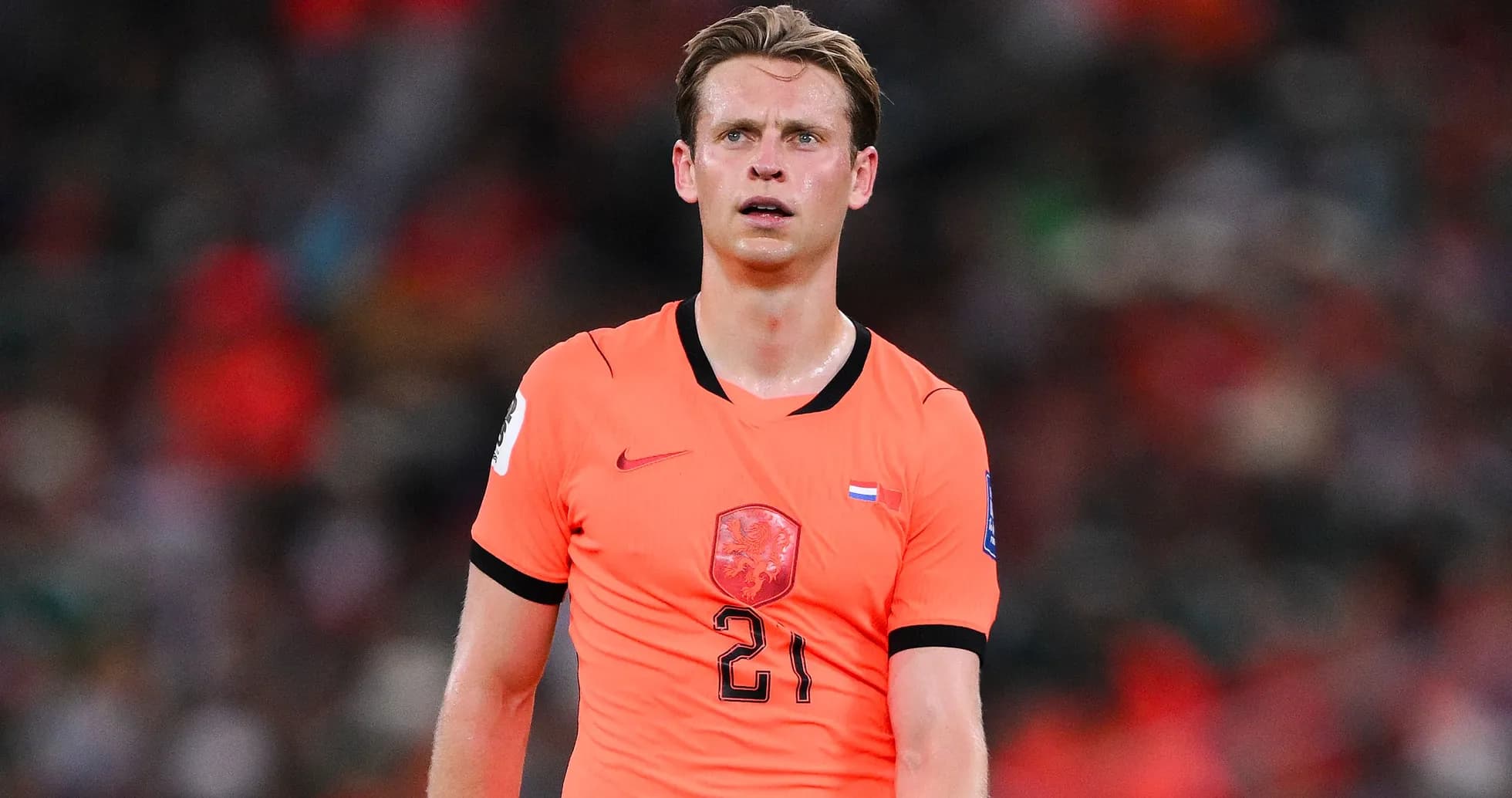
Frenkie de Jong’s World Cup ended not with a roar, but with a grim walk to the touchline and a seat on the bench as everything unraveled without him.
The Netherlands were sent home by Morocco on penalties, and their captain found himself at the heart of the inquest. Frenkie started, ran, probed and battled for almost 110 minutes, only to watch the decisive drama from the sidelines. When the dust settled, the criticism came hard and fast.
A Night to Forget
Dutch pundits tore into Ronald Koeman’s tactical plan, but the spotlight inevitably swung toward his midfield leader. In a game that demanded control and authority in the middle of the pitch, the Oranje never truly found either.
Rafael van der Vaart did not bother with nuance. Speaking on NOS, in comments carried by Mundo Deportivo, the former Dutch international delivered a brutal verdict:
“Frenkie de Jong played the worst match I have ever seen from him.”
For a player who had recently bristled at those who question his influence—arguing that many people watch football without really understanding it—the words cut deep. This was not anonymous social media noise. This was a national icon taking aim in prime time.
System Failure
Van der Vaart did not lay the blame solely at Frenkie’s feet. He went straight for the structure around him.
“It was really disappointing, but that is also because of the system. I consider midfield to be Morocco’s strongest point, and even so we decided to play against them with only two midfielders.”
That was the crux of it. Koeman chose to take on Morocco’s most formidable area with a numerical and positional handicap. The Netherlands paid for it in the one zone where Frenkie usually dictates everything: tempo, rhythm, and progression.
Van der Vaart’s frustration went beyond one bad performance.
“I am very disappointed with Holland. We got through the group stage quite well. Things were starting to work, so what goes through your mind for you to suddenly have to do things completely differently against Morocco? I do not understand anything at all.”
The message was clear. The coach ripped up a functioning plan on the eve of the biggest test, and his key midfielder got caught in the wreckage.
Caught in the Crossfire
Frenkie was far from his fluent best. That much is undeniable. He struggled to escape the Moroccan press, struggled to impose his usual calm on a chaotic game, and too often found himself outnumbered and outmanoeuvred.
Jan Mulder honed in on that hesitation.
“He was too cautious, I only saw sideways passes,” the analyst said, capturing the sense that the Barça man played within himself, unable or unwilling to take the risks that usually define his game.
But context matters. Against a powerful Moroccan midfield, the Netherlands went light in the very area they needed to reinforce. Frenkie and his partner were swamped. Passing lanes closed. Angles disappeared. The Oranje lacked control, lacked numbers, and with that, lost the rhythm that had carried them through the group stage.
This was not the stage on which a lone midfielder could solve everything with a dribble or a line-breaking pass. It was a tactical arm-wrestle, and the Dutch walked into it short-handed.
Barça Still Know What They Have
One bad knockout tie does not rewrite a career. It does not erase what Frenkie de Jong brings at club and international level: the press resistance, the glide through pressure, the ability to link defence to attack in two touches, the calm in the storm when others rush their decisions.
Across the group stage, he had been exactly that for the Netherlands—sublime, assured, central to almost everything good they did. Against Morocco, the overload finally caught up with him.
Barcelona will not be swayed by a single off-night in orange. At Camp Nou, they see the bigger picture: a midfielder who, when given a platform and a structure that fits his strengths, still bends games to his will.
The question now is not whether Frenkie de Jong is good enough. It is whether the Netherlands will build a system that is good enough for him.