.svg&w=384&q=75 "naujapitch logo")
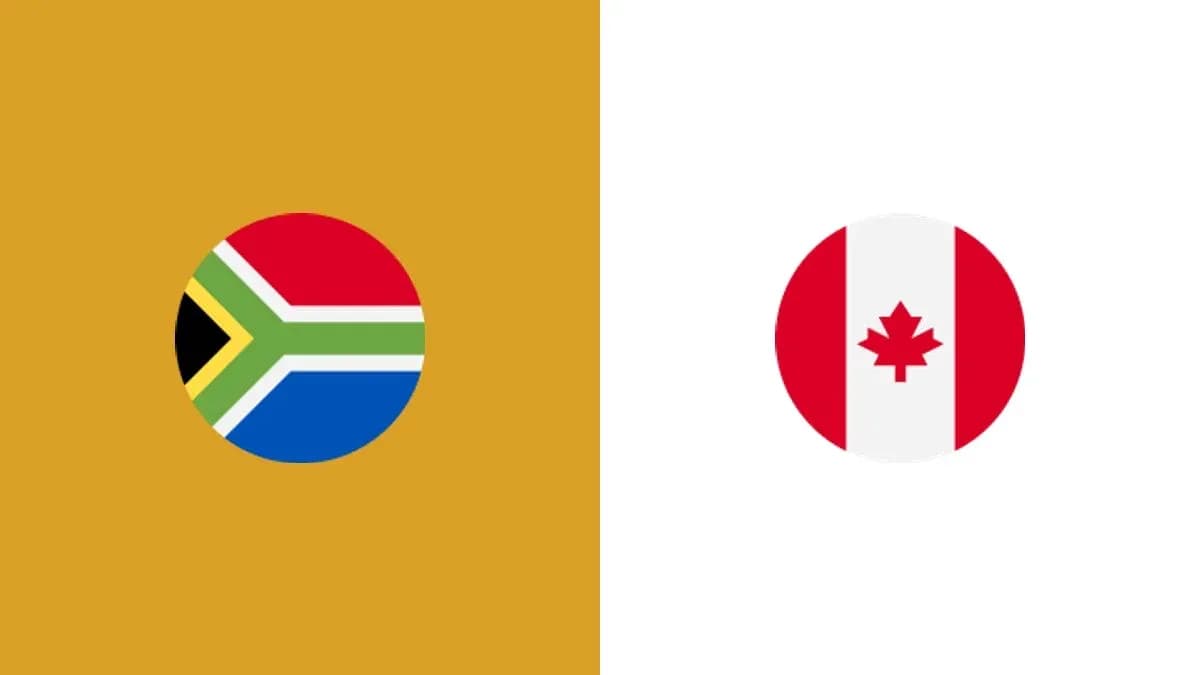
South Africa vs Canada: A Historic Clash in Los Angeles
South Africa’s date with history meets Canada’s home ambition in Los Angeles on 28 June, a Round of 32 tie that feels far bigger than its billing.
For Bafana Bafana, this is uncharted territory. For Canada, it’s a test of depth, nerve and the weight of being co-hosts without their brightest star.
Bafana’s wild road to the knockouts
South Africa did not stroll into this stage. They lurched, recovered, then roared.
Their World Cup began with a thud: a flat 2-0 defeat to Mexico and red cards for key midfielders Themba Zwane and Sphephelo Sithole. The performance was poor, the discipline worse, and the campaign looked in danger of ending before it had even begun.
Hugo Broos reacted. Three changes, a different energy, and suddenly Bafana had a foothold. Against the Czech Republic they found resilience and a result, grinding out a 1-1 draw thanks to a penalty from Teboho Mokoena. It was a lifeline, but it came at a price. Mokoena’s booking ruled him out of the decisive clash with South Korea.
That left South Africa with a stark equation in Monterrey: win or go home.
They chose chaos and courage. In a raucous Estadio Monterrey, with news of Mexico’s goals against the Czechs rippling through the stands, Bafana delivered a defensive masterclass. South Korea threw crosses, shots, runners between the lines. South Africa met all of it with grit and structure, then sliced back on the counter whenever they could.
Thapelo Maseko stole the night with a 63rd-minute strike, but the scoreline barely told his story. Operating as an inverted winger on the right, the AEL Limassol loanee tormented the Korean back line and could easily have walked away with a hat-trick. On the opposite flank and between the lines, Orlando Pirates prodigy Relebohile Mofokeng lit up the game with quick thinking, sharp decisions and direct running that constantly unsettled the favourites.
When the final whistle went on a 1-0 win, South Africa’s place in the last 32 was secured and a new chapter in their World Cup history had been written.
Canada’s smoother path, with a sting in the tail
Canada’s route has been calmer, cleaner, and far more clinical.
They opened with a solid 1-1 draw against Bosnia and Herzegovina, a performance built on control and structure. Then came the explosion: a 6-0 demolition of Qatar, with Juventus forward Jonathan David helping himself to a hat-trick and the attack finally cutting loose.
That statement win came at a cost. Midfield engine Ismael Kone fractured his leg, a brutal blow to Jesse Marsch’s plans and to a side that had just found its rhythm between the lines.
Their final Group B match, a 2-1 defeat to Switzerland, barely altered the picture. Canada had already done enough to qualify with four points, but the loss underlined a reality: this team is dangerous, yet not invincible.
They have also had to do all of this without Alphonso Davies. The Bayern Munich full-back, the face of Canadian football, returned from a long injury layoff to feature in a Champions League semi-final against PSG in April, only to suffer a recurrence. He has not played a single minute at this World Cup. For a co-host, missing that kind of dynamism on the left is a major handicap.
Two back fives that don’t blink
Strip away the storylines, and this tie leans heavily on two settled defensive units.
South Africa’s back five has been the spine of their campaign. Ronwen Williams, the captain in goal, anchors a line that has started all three matches together: Khuliso Mudau and Aubrey Modiba at full-back, with the young central pairing of Mbekezeli Mbokazi and Ime Okon in the middle.
Mbokazi, just 20 and already impressing in MLS with Chicago Fire, is being talked about as a future Bafana skipper. Okon, 22 and on the books at Hannover, has matched him stride for stride. They are raw but fearless, and they have grown with every game.
In front of them, Mokoena’s return from suspension is crucial. The Mamelodi Sundowns midfielder is expected to slot back in as the shield, likely at the expense of Sithole. His presence restores balance and offers South Africa a cleaner first pass out of pressure.
Canada mirror that stability. Goalkeeper Maxime Crepeau has been protected by the same back four in every match: Alistair Johnston, Luc de Fougerolles, Derek Cornelius and Richie Laryea. It is a line built on familiarity and clarity of roles, and Marsch has shown no desire to tinker with it.
That continuity has underpinned a run of W2 D2 L1 across their last five games, with only four goals conceded in that stretch.
Where the game tilts
The contrast between these sides is stark.
South Africa arrive with four points from three group matches, a record of W1 D1 L2 D1 in their last five overall, and only two goals scored across that run. They have survived on organisation, timing and a touch of individual brilliance when it mattered most.
Canada come in with nine goals in their last five outings, a figure inflated by that Qatar rout but still a sign of a team that can hurt opponents quickly if given space. David is the obvious threat, supported by the likes of Tajon Buchanan, Nathan Saliba, Stephen Eustaquio and Liam Millar in a likely 4-4-2 or 4-2-3-1 hybrid.
On paper, Canada have the edge in attacking depth. On the grass, this may hinge on whether South Africa can drag the tempo down, frustrate, and then spring Maseko, Mofokeng and Oswin Appollis into the spaces behind Canada’s full-backs. Evidence Makgopa, expected to lead the line, will need to occupy centre-backs and buy time for runners to join him.
The probable XIs underline the pattern:
Likely South Africa XI: Williams; Mudau, Okon, Mbokazi, Modiba; Mokoena, Mbatha; Maseko, Mofokeng, Appollis; Makgopa.
Likely Canada XI: Crepeau; Johnston, De Fougerolles, Cornelius, Laryea; Buchanan, Saliba, Eustaquio, Millar; David, Oluwaseyi.
Both coaches have kept their cards close, with no fresh injuries or suspensions confirmed in the latest squad data, but the major known absences remain Kone and the still-managed Davies.
Old memory, new stakes
There is almost no history between these nations. Just one meeting, a friendly in November 2007, when South Africa won 2-0 at home. That result means little now beyond a line in the record books.
This time, the backdrop is Los Angeles, the stage is a World Cup knockout, and the stakes are brutally simple: win and reach the last 16, lose and the journey ends.
South Africa, second in Group A, carry the momentum of a landmark victory and the belief that they can outfight anyone on their day. Canada, second in Group B, carry the expectation of a co-host desperate to stay alive in its own tournament, even if the path now takes them away from home soil.
One side is chasing a continuation of a fairytale. The other is desperate to prove that its golden generation can win knockout matches without its talisman.
When the whistle blows in LA, we find out which story has more weight.