.svg&w=384&q=75 "naujapitch logo")
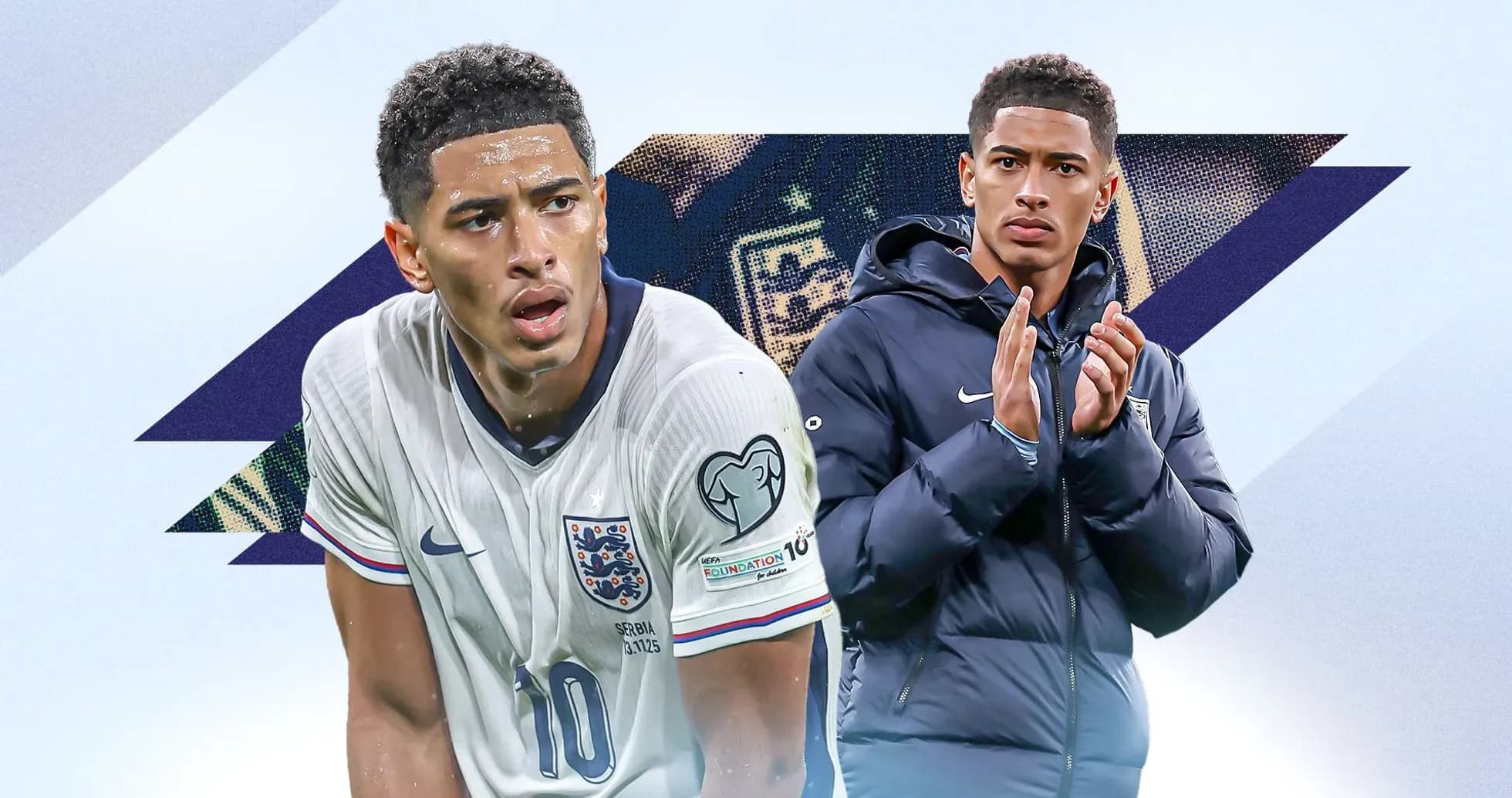
Rogers vs Bellingham: England's Selection Battle
Thomas Tuchel has barely finished unpacking his boxes at St. George’s Park, yet he has already detonated one of the most intriguing selection battles England have seen in years.
The message from the new England manager has been blunt: reputations don’t start games. Performances do. And in the space Jude Bellingham once occupied almost by default, Morgan Rogers has kicked the door open.
Rogers the riser, Bellingham the benchmark
While Bellingham has drifted in and out of recent camps, nursing injuries and working back to full sharpness, Rogers has simply played. And played well.
The Aston Villa attacking midfielder has taken his buoyant club form and stitched it straight onto the international stage. Tuchel used qualifying to experiment with his attacking structure, and Rogers became a useful constant: a creative hub, a link between lines, a genuine No.10 rather than a roaming force of nature.
The goals haven’t flowed for him yet in an England shirt, but that’s not really the point. Rogers operates like a classic playmaker, happy to knit attacks together and occupy pockets of space behind Harry Kane. Tuchel has rewarded that clarity of role.
“Rather than finding the best players a position to just have them on the field, it's maybe better to put everyone in their best position and have a competition. At the moment, the competition is between the two of them,” Tuchel said back in November, laying out the duel between Rogers and Bellingham for the role behind England’s captain.
On form, Rogers has a strong claim. Over the past year, in claret and blue and then in white, he has been reliable, inventive, and obedient to the structure Tuchel is trying to build. If he starts the World Cup as England’s No.10, it would be a reward, not a gamble.
For Bellingham, that is the challenge. To prove that his ceiling, which is higher than almost anyone else’s, matters more than the gap between his best and his recent output.
Fire, edge and a manager’s misstep
Bellingham has always played with a visible edge. It’s part of what made him a phenomenon so young: the chest-out swagger, the refusal to be cowed by anyone in any stadium. But that same edge can spill.
It did in the 3–1 defeat to Senegal last June. A friendly on paper, but Bellingham treated every decision as if it were a World Cup knockout. When a VAR call went against England, his anger flashed. Cameras caught it. So did his manager.
Tuchel later spoke to TalkSport about that night at the City Ground. He didn’t dismiss the emotion. He embraced it, with conditions.
“I think he brings an edge, which we welcome and which is needed if we want to achieve big things,” Tuchel said. “It needs to be channelled. The edge needs to be channelled toward the opponent, towards our goal and not to intimidate team-mates, or to be over aggressive to team-mates or referees.”
So far, so standard for an elite coach managing an elite talent. Then came the line that has followed Tuchel ever since.
“I see that it can create mixed emotions. I see this with my parents, with my mum that she sometimes cannot see the nice and well-educated and well-behaved guy that I see… If he smiles, he wins everyone, but sometimes you see the rage, the hunger and the fire, and it comes out in a way that can be a bit repulsive. For example, for my mother, when she sits in front of the TV, I see that, but in general we are very happy to have him, he's a special boy."
In a few sentences, the national coach managed to praise his star midfielder, diagnose his volatility, and describe him in a way that jarred with plenty of observers. “Repulsive” stuck. It turned what should have been a technical conversation about pressing, positioning and end product into something else entirely.
A relationship under the microscope
Bellingham did not return to the England setup until November as he recovered from surgery. When he did, every gesture, every glance towards the touchline, felt loaded.
Tuchel initially parked him on the bench against Serbia. A statement? A fitness call? Either way, it was noted. Three days later, Bellingham was back in the XI against Albania, a more familiar sight: England’s No.10 on the teamsheet, roaming behind Kane, the supposed centrepiece restored.
Then, with six minutes left of England’s final qualifier, his number went up. Bellingham trudged off. The cameras lingered again. The suggestion of an angry gesture as he departed was enough to fuel another round of talk shows and phone-ins.
“That's the decision, and he has to accept the decision,” Tuchel said afterwards. “His friend is waiting on the sideline, so you need to accept it, respect it, and keep on going."
The football almost vanished under the noise. Was this a power play from the manager? A young superstar bristling at authority? Or just a competitor fuming at being taken off?
Away from the touchline theatrics, former England striker Ian Wright cut to a different, uncomfortable angle in the reaction to Bellingham.
“I don't think they're ready for a black superstar who can move like Jude is moving. They can't touch him," Wright said of sections of the English media and fanbase. "He goes out there, he performs, he does what he does. It's too uppity for these people.
“They all love N'Golo Kante. He's a humble Black man, gets on with what he's doing. Someone like Jude frightens these people because of his capability and the inspiration he can give. Because if you are outspoken, Black, and playing to that level and not caring, that frightens certain people. It's a tiring exercise to speak about.”
Wright’s words framed the debate around Bellingham in starker terms. Not just a question of temperament, but of who is allowed to carry themselves with swagger in an England shirt.
Talent vs form, fire vs control
Strip away the commentary, and the core truth remains simple: when Bellingham hits his level, England change. They become a team that can punch with anyone at this World Cup. They gain a midfielder who can decide games in both boxes.
Those performances, though, have thinned out of late. Injury, adaptation, and the weight of expectation have all played their part. Tuchel, meanwhile, has found in Rogers a player who delivers exactly what the system demands, even if he cannot yet bend matches to his will in the same way.
So the dilemma before England’s opening game in Dallas is real, not manufactured. Tuchel must decide whether to trust one of the most gifted midfielders on the planet, knowing his emotions can tilt a match either way, or to back the in-form, tactically obedient Rogers, whose lack of tournament experience hangs over his candidacy.
Tuchel has tried to provoke Bellingham, to light the competitive fire without burning the house down. Instead, the spark has often landed in the wrong place, igniting rows about language, attitude and optics while the actual analysis of Bellingham’s game gets drowned out.
He will wear the No.10 shirt this summer. That much is certain. What is not certain is whether he walks out against Croatia as England’s No.10 in deed as well as number.
One way or another, Bellingham will dominate the story of England’s World Cup. It will be the image of a match-winner dragging his country forward, or of a young star wrestling with his own fury on the biggest stage.
If Tuchel gets that call wrong, the fallout will not be confined to a team sheet.