.svg&w=384&q=75 "naujapitch logo")
Declan Rice's Impact on England's Midfield and Fitness Challenges
Aaron Cresswell calls Declan Rice a “freak of nature”. It sounds like the sort of throwaway dressing‑room compliment players give each other all the time. Until you look at the numbers.
Since the start of the 2020-21 season, Rice has played 360 games for club and country. Three hundred and sixty. West Ham’s European runs, England’s endless tournament cycles, Arsenal’s tilt at the Premier League and Champions League – whenever there has been a high‑stakes match, Rice has been in the middle of it, driving, cajoling, covering ground that others simply cannot reach.
The temptation, for every manager who works with him, is obvious: just keep picking him.
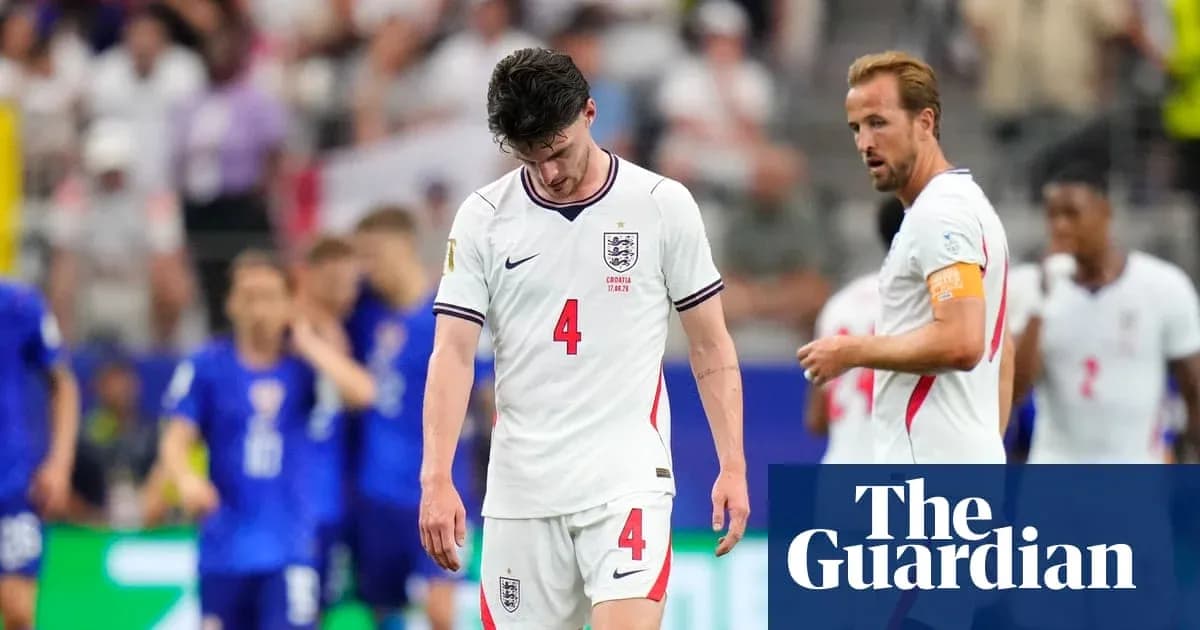
On Wednesday in England’s chaotic 4-2 win over Croatia, that finally looked like a risk.
A rare off‑day for England’s constant
This was Rice’s 63rd appearance of the 2025-26 season. It showed. The 27-year-old, usually England’s metronome and shield, looked uncharacteristically ragged.
England’s midfield shape was wrong from the start. Too much space between Rice and Elliot Anderson, too many gaps for Luka Modric to exploit, too many moments when Rice dropped so deep that he was dragged out of position. Croatia kept finding lanes that usually get shut down the moment Rice senses danger.
Thomas Tuchel tried to be diplomatic afterwards, noting that “Declan had some unusual ball losses”. That phrase alone told its own story. Rice does not lose the ball in bad areas. He does not get caught on his heels. He does not look, as he did for long spells in that first half, like a player whose legs and mind are operating on different batteries.
The tactical issues can be fixed. The bigger alarm came in the 72nd minute.
When the irreplaceable limps
This is not a normal sight. Rice is the player managers leave on when the game is slipping. The one they trust to win second balls, make the ugly tackles, see out the storm. To see him trudging off with England still under threat felt jarring.
Tuchel said Rice had discomfort in his lower back and upper hamstring. He stressed it was precautionary. Rice himself was quick to insist he will be available for Tuesday’s meeting with Ghana.
England cannot simply breathe out and move on.
What if that tightness becomes something worse? What if the miles finally catch up with a footballer who has been flogged at the highest level for six straight seasons? England already saw what happens when Rice is anything less than fully functional: the midfield malfunctioned, the balance went, Croatia poured through the gaps.
And the brutal truth is that this squad does not contain another Declan Rice.
Kobbie Mainoo is a wonderful technician, brave on the ball, press‑resistant. He is also young, still developing the physique and authority Rice brings, and he does not offer the same set‑piece threat. Jordan Henderson has the experience and leadership, but at 36 he was not used when England wanted to keep the tempo high against Croatia. If Tuchel did not turn to him then, when will he?
There is no obvious one‑for‑one solution. So Tuchel has started to look sideways.
James, the unexpected “6”
When Rice came off, Tuchel’s first move was to drop Jude Bellingham deeper. On paper, it made sense. In reality, it almost cost England.
Bellingham’s brief spell as a deeper midfielder opened the door for Croatia. They nearly forced an equaliser. The experiment lasted eight minutes before Tuchel ripped it up and went for something more radical: Djed Spence came on, Bellingham went off, and Reece James stepped out of right‑back and into midfield.
That change may end up defining England’s tournament if Rice’s minutes have to be managed.
James is not new to the role. He played in midfield during a loan spell at Wigan in 2018-19 and, more recently, under Enzo Maresca at Chelsea. Maresca’s 18‑month stint at Stamford Bridge featured a bold positional shift: James, long seen as an elite right-back or wing-back, was pushed inside.
There were doubts at first. Tuchel himself, who had coached James at Chelsea, initially insisted he saw him only as a right-back for England. But Maresca persisted and was rewarded. James grew into the role, a physically imposing, tactically sharp presence who could tackle, pass and dictate.
The high point came when Chelsea beat Paris Saint-Germain in last year’s Club World Cup final, James anchoring midfield with authority. It was no one‑off. He excelled alongside Moisés Caicedo in a 3-0 win over Barcelona last November and then dominated Rice when Arsenal visited Stamford Bridge five days later.
Those performances changed Tuchel’s mind. When he named his World Cup squad, leaving out Adam Wharton and Alex Scott, he made the logic explicit: “Reece James can play in the 6 because he does on a high level for Chelsea.”
That versatility is now central to England’s contingency plan.
If James steps into midfield, the right‑back slot can be covered. Spence is one option. Ezri Konsa and Jarell Quansah can also operate there, with Konsa capable of tucking in as an auxiliary third centre-back alongside John Stones and Marc Guéhi. That structure would free Nico O’Reilly on the opposite flank to surge forward from left-back, giving England width without sacrificing security.
On the tactics board, it works. On the treatment table, it gets complicated.
England’s gamble with fitness
James’s body has been a recurring subplot of his career. Hamstring injuries have stalked him, the latest in March ruling him out for almost two months. Chelsea have had to manage his workload with extreme care.
England are no different. Tuchel has already lost Tino Livramento to a calf injury, forcing a late call‑up for Trevoh Chalobah. It has been a draining season across the squad, with many of Tuchel’s key players going deep in European competitions and domestic title races.
James is first choice at right-back. He cannot start every game. He certainly cannot be asked to carry the load at right-back and in midfield if Rice is struggling. That is the bind England now face.
Tuchel knew fitness would shape this World Cup long before a ball was kicked. The decision to fly early to Florida for a pre‑tournament camp in the sun was rooted in conditioning and recovery. Even then, Rice joined up late after Arsenal’s run to the Champions League final, squeezing yet more high‑intensity minutes into a season already overflowing with them.
He keeps pushing to the limit. At some point, the bill arrives.
If England go all the way to the final and Rice does not get a rest, he will finish the season on 70 appearances for club and country. Seventy. For a midfielder asked to cover huge distances, contest duels, take set pieces, and act as the team’s emotional anchor, that is an extraordinary – and potentially unsustainable – load.
Tuchel cannot control Arsenal’s demands or West Ham’s past reliance. He can control what happens over the next few weeks.
England know they are a different side when Rice is absent. The evidence of the past six years is stark: they rarely look convincing without him. Yet the sight of him hobbling off against Croatia, even as he talked down the problem, was a warning.
The World Cup will not slow down for Declan Rice. The question now is whether England dare to.