.svg&w=384&q=75 "naujapitch logo")
Rhode Island Dominates Westchester SC 3–0 in USL League One Cup
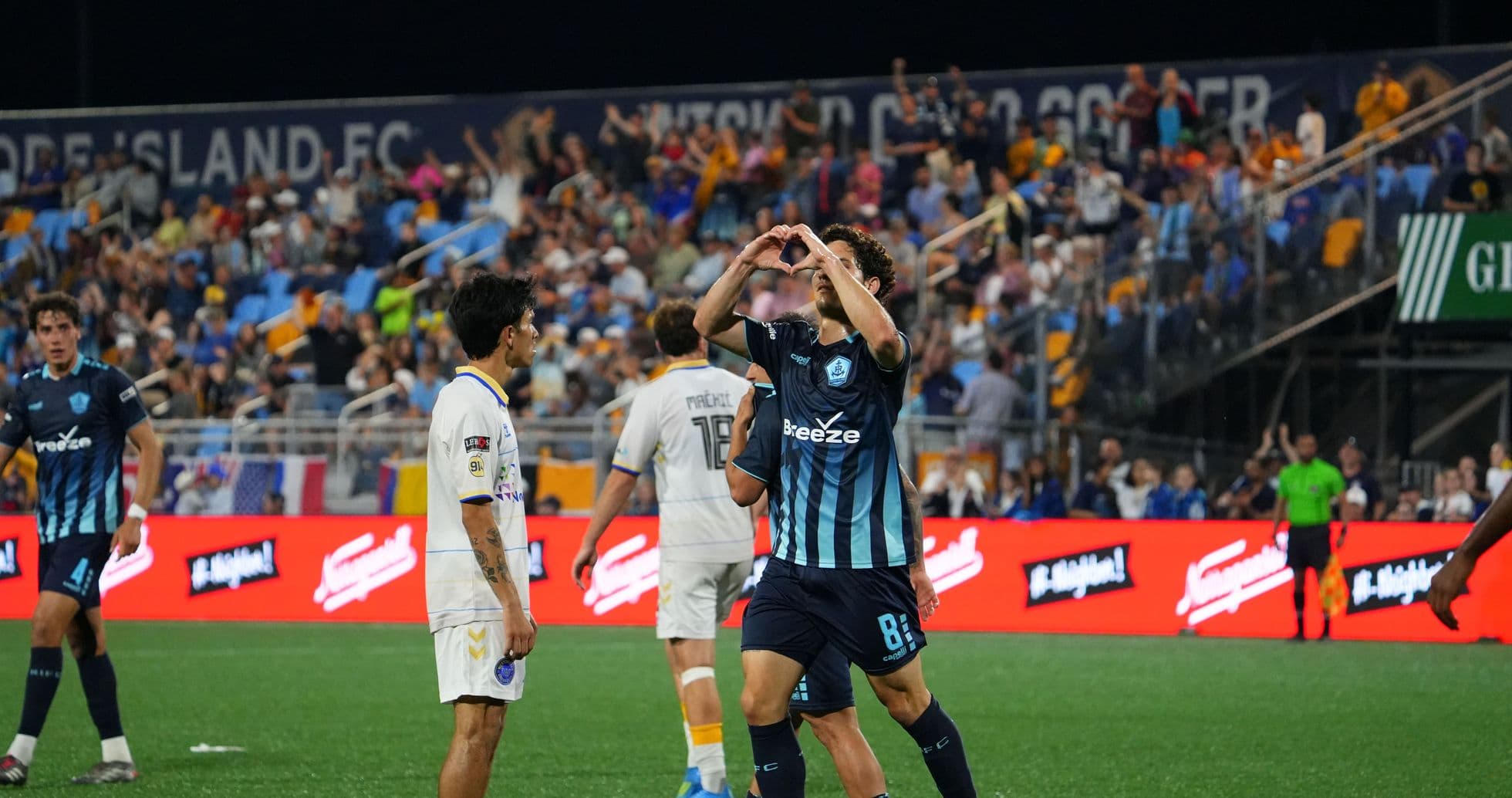
On a cool USL League One Cup night at Centreville Bank Stadium, Rhode Island authored a statement performance, dismantling Westchester SC 3–0 and reshaping the narrative of Group 5. Heading into this game, the numbers already hinted at contrasting identities: Rhode Island were efficient and controlled, with 5 goals for and just 2 against overall, while Westchester arrived as a chaotic attacking side, scoring 5 but conceding 8 in total. Over 90 minutes, those tendencies hardened into something more definitive.
Rhode Island’s campaign profile has been about balance and clarity. Overall, they had won 2 of 3, with a total goals-for average of 1.7 and a goals-against average of 0.7. At home, they were even more ruthless: 3 goals scored, none conceded, for a home attacking average of 3.0 and a defensive average of 0.0. This match, a 3–0 full-time score after a 2–0 half-time lead, fit perfectly into that emerging home identity: front-foot, clinical, and structurally secure.
Khano Smith’s starting XI reflected that stability. Koke Vegas in goal provided the platform, shielded by a back line built around the composure of K. Yao, F. Nodarse, A. Sanchez, and the versatile H. Bacharach Capdevila. In front of them, the midfield triangle of A. Shapiro-Thompson, N. Fuson, and C. Holstad knitted the game together, while A. Rodriguez and J. Williams formed the cutting edge in advanced zones, supported by the energetic wide work of N. Scardina.
The lack of explicit formation data in the raw feed doesn’t hide the tactical story: Rhode Island played like a side comfortable compressing space centrally, then springing quickly into the half-spaces. Rodriguez, wearing 10, drifted intelligently between the lines, while Williams, the 9, occupied centre-backs and attacked the box. The 2–0 cushion by half-time was no accident; it was the product of a team that knew how to turn territorial control into scoreboard pressure.
Westchester SC, under George Gjokaj, came in as a more volatile proposition. Overall, they had scored 5 and conceded 8, for a total attacking average of 1.7 but a total defensive average of 2.7. At home they had been entertaining and leaky (2.5 goals for and 2.5 against on average), but on their travels the picture was stark: 0 goals scored, 3 conceded, and an away defensive average of 3.0. This fixture only deepened that away-day fragility.
The visitors’ lineup had clear attacking talent. L. Marinelli led the line with the physical presence of a 99 shirt, supported by the wide running of S. Powder and B. Vasquez, with M. Diaz and K. Evans offering secondary threats and link play. In midfield, A. Armas was tasked with anchoring transitions, while at the back T. Timchenko, C. Dickerson, and J. Jimenez were meant to absorb Rhode Island’s pressure. Yet the structural issues that had plagued them in the group resurfaced: lines stretched, distances grew, and Rhode Island found pockets far too easily between midfield and defense.
Disciplinary patterns added another layer to the tactical picture. Heading into this game, Rhode Island’s yellow cards were concentrated in the 46–60 and 91–105 minute ranges, each accounting for 50.00% of their total cautions. That profile suggests a side that occasionally overcommits early in the second half and in late-game management phases, but crucially, they had avoided red cards altogether. Westchester, by contrast, saw 50.00% of their yellows in the 31–45 range and another 50.00% between 76–90. It paints a picture of a team that loses composure at the end of each half, precisely when game states become most delicate.
That discipline gap mattered. Rhode Island, already defensively solid with 2 clean sheets in 3 overall, could press with confidence knowing they rarely implode. Westchester, with 0 clean sheets and 1 total match failing to score, lived permanently on the edge. In this fixture, Rhode Island’s calm under pressure allowed them to protect their 2–0 half-time lead and then extend it, while Westchester’s late-half anxieties translated into fouls, broken rhythm, and a fractured press.
The “Hunter vs Shield” matchup tilted decisively towards the hosts. Rhode Island’s attack, averaging 3.0 goals at home heading into this game, faced a Westchester back line that conceded an average of 3.0 away. The 3–0 final score was almost a mathematical confirmation of that clash of profiles. On the flip side, Westchester’s total attacking average of 1.7 ran into a Rhode Island defense that conceded just 0.7 overall and 0.0 at home; Westchester’s blank on the night was entirely in line with those trends.
In the “Engine Room,” Rhode Island’s midfield three outmaneuvered Westchester’s central unit. Shapiro-Thompson and Holstad dictated tempo, while Fuson’s work rate without the ball closed the lanes into Marinelli and Vasquez. Without clear progression through Armas, Westchester were forced into longer passes that Rhode Island’s back line could read and intercept, keeping Koke Vegas largely untroubled.
From a statistical prognosis standpoint, Rhode Island’s trajectory in this group now looks upwardly stable. Overall, their goal difference heading into this fixture was +3 (8 scored, 5 conceded) in the standings snapshot; their season statistical block showed 5 scored and 2 conceded, a +3 there as well. Both data sets agree on the core truth: this is a side that scores more than it allows, and does so with control rather than chaos. Westchester, with a standings goal difference of -3 (9 for, 12 against) and a statistical profile of 5 for and 8 against (also -3), remain defined by imbalance.
Following this result, Rhode Island’s squad identity is clear: a disciplined, home-dominant unit that marries a sharp front line with a secure base. Westchester’s remains unresolved: talent in advanced areas, but a defensive structure that cannot yet withstand sustained pressure, especially away. On this night in Centreville Bank Stadium, the numbers and the narrative aligned perfectly—and Rhode Island’s XI looked every inch like a group-stage contender built for knockout football.