.svg&w=384&q=75 "naujapitch logo")
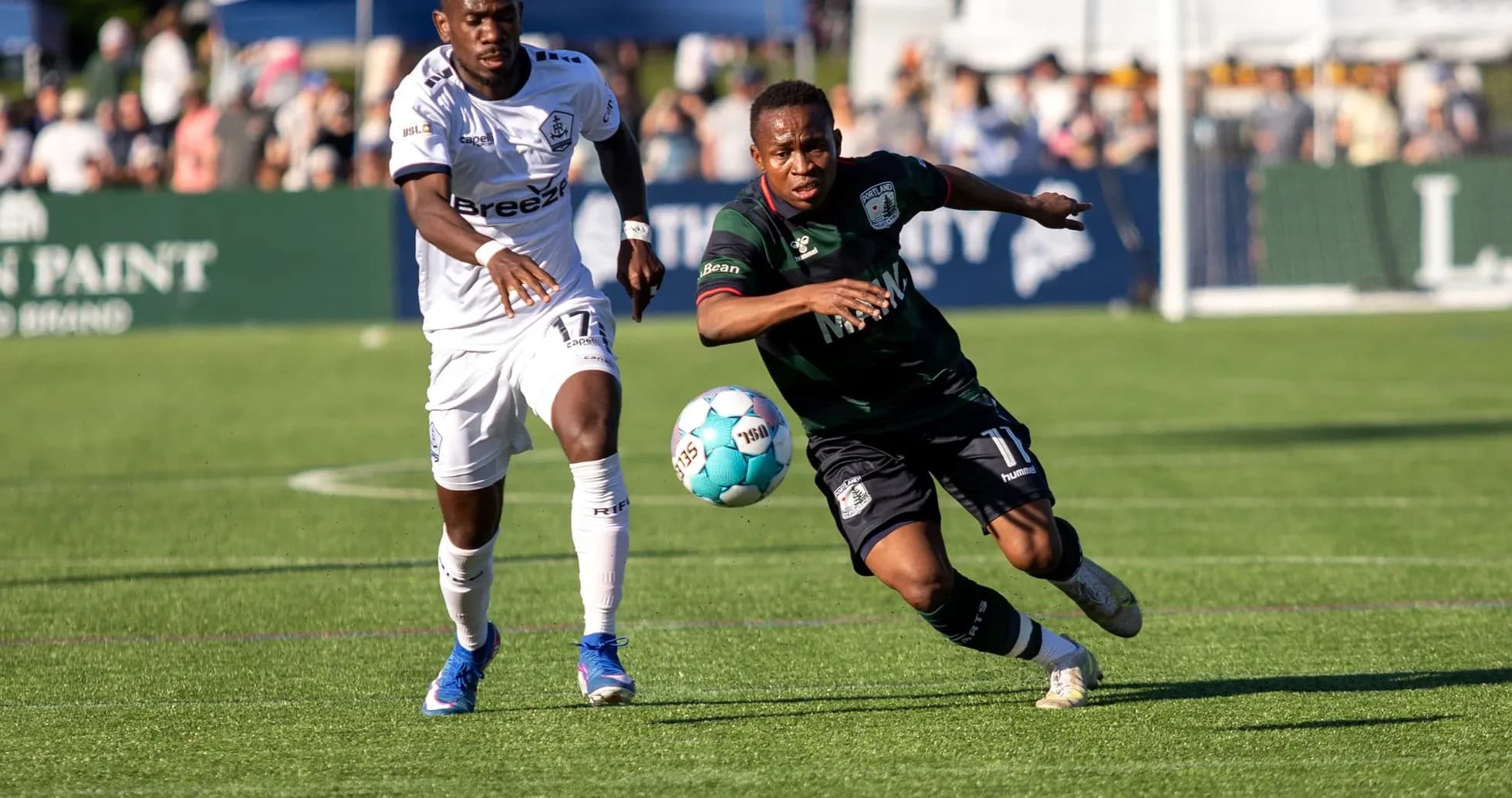
Brooklyn Dominates Portland Hearts of Pine 5-1 in USL League One Cup
Maimonides Park felt less like a group-stage backdrop and more like a proving ground as Brooklyn dismantled Portland Hearts of Pine 5-1, a result that crystallized the contrasting identities of these two USL League One Cup sides. Following this result, Brooklyn sit as a sharp-edged contender in Group 5, while Portland’s vulnerabilities, hinted at in their numbers, were brutally exposed under the lights.
Brooklyn came into this campaign with a clear statistical DNA: front-foot, high-yield football. Overall they had scored 8 goals in 3 matches, averaging 2.7 goals per game, with 5 of those at home at an average of 2.5. Just as importantly, they had only conceded 3 overall at an average of 1.0, and 3 at home at an average of 1.5. That blend of attacking intent and defensive control framed this performance. Portland’s profile was almost the mirror opposite: 5 goals scored overall at an average of 1.7, but a fragile back line leaking 9 overall at an average of 3.0, with a particularly alarming away record of 8 conceded in 2 matches at an average of 4.0. The 5-1 final scoreline did not come out of nowhere; it was the logical extension of those trends.
Tactically, Brooklyn’s XI is built around a spine that balances composure and aggression. At the back, the pairing of V. Latinovich and Gabriel Alves, supported by C. Frogson and the versatile T. Vancaeyezeele, gave L. Burns a relatively controlled night in goal. Burns’ presence behind a defence that, overall, had already kept 1 clean sheet and conceded just 3 times this campaign, allowed Brooklyn to hold a high line and compress the pitch.
In midfield, the double pivot of M. Pinto and T. McNamara provided the game’s rhythm. Pinto offered the screening and simple circulation, while McNamara, with his experience, stitched together phases and connected to the creative band of S. Stojanovic, P. Mangione and C. Olney JR. That trio was the game’s narrative engine: Mangione drifting between the lines, Olney JR attacking half-spaces, and Stojanovic offering vertical runs and late arrivals. Ahead of them, M. Anderson led the line, but Brooklyn’s attacking threat was deliberately distributed rather than focused on a single talisman, in keeping with a side that had already produced an emphatic 5-1 home win as their biggest home victory this campaign.
Portland, by contrast, arrived with a squad that looks dangerous with the ball but brittle without it. The front line of A. Camara, O. Wright and W. Varela, supported by L. Kunga and J. Drack, has enough technical quality to trouble most defences. Their overall 5 goals, including 3 on their travels at an average of 1.5, underline that they can create. But the structural issues behind them were always going to be the story. With K. Oladapo and M. Mohamed trying to anchor midfield, and a back line including K. Green, B. Evans and D. Barbosa, Portland simply could not protect their penalty area against a side as incisive as Brooklyn.
The disciplinary profiles of both teams foreshadowed the game’s emotional arc. Brooklyn’s yellow-card distribution is heavily weighted toward the 61-75 minute window, where 40.00% of their cautions arrive, with further spikes at 31-45 and 46-60 (both 20.00%). That suggests a team that plays on the edge as intensity peaks in the middle third of the match. Portland’s numbers are even more volatile: 50.00% of their yellows fall between 61-75 minutes, with 25.00% between 46-60 and 12.50% between 16-30, plus a red card previously shown in the 46-60 window. This is a side that often unravels just as matches become stretched. In a contest where Brooklyn were already three goals to one up by half-time, that tendency to lose control under pressure was always likely to turn a bad night into a heavy defeat.
The “Hunter vs Shield” dynamic in this matchup was stark. Brooklyn, as a collective attacking unit averaging 3.0 goals on their travels and 2.5 at home, were always going to probe relentlessly. Portland’s away defence, conceding 4.0 goals per game and having already suffered a 5-1 away defeat as their biggest loss, simply did not possess the shield to withstand that volume of pressure. Brooklyn’s forwards and attacking midfielders repeatedly found pockets between Portland’s midfield and back line, with Anderson, Olney JR and Mangione rotating cleverly to drag defenders out of shape. Without a true enforcer capable of closing those gaps, Oladapo and Mohamed were overrun.
In the “Engine Room” battle, McNamara and Pinto out-thought and out-worked Mohamed and M. Kidd. Brooklyn’s midfield duo controlled tempo, ensuring that even at 3-1 by half-time, the hosts did not retreat but continued to manage transitions smartly. Portland’s central unit, already part of a side that had yet to keep a clean sheet overall and had conceded 9 times, could not impose themselves. Their lone bright spot in the numbers—a perfect penalty record overall with 1 scored from 1—never came into play on a night when they were rarely in the box with enough control to draw fouls.
Following this result, the standings picture in Group 5 is brutally clear. Brooklyn, with 6 points, a goal difference of 5 (8 scored and 3 conceded overall), and a form line of WLW, look like a side whose high-risk, high-reward style is underpinned by genuine defensive solidity. Portland, with 4 points, a goal difference of -4 (9 scored and 13 conceded overall), and form of LWL, remain an entertaining but unbalanced outfit.
From a statistical prognosis perspective, the patterns suggest that Brooklyn’s blend of attacking depth and compact defending will continue to translate into strong xG and controlled concessions in this competition. Portland’s attacking talent ensures they will keep generating chances and xG of their own, but unless their away defensive metrics—8 conceded in 2 on their travels at an average of 4.0—improve dramatically, nights like this at Maimonides Park will remain less an anomaly and more a recurring chapter in their story.