.svg&w=384&q=75 "naujapitch logo")
Real Madrid 2–0 Oviedo: A Class Divide in La Liga
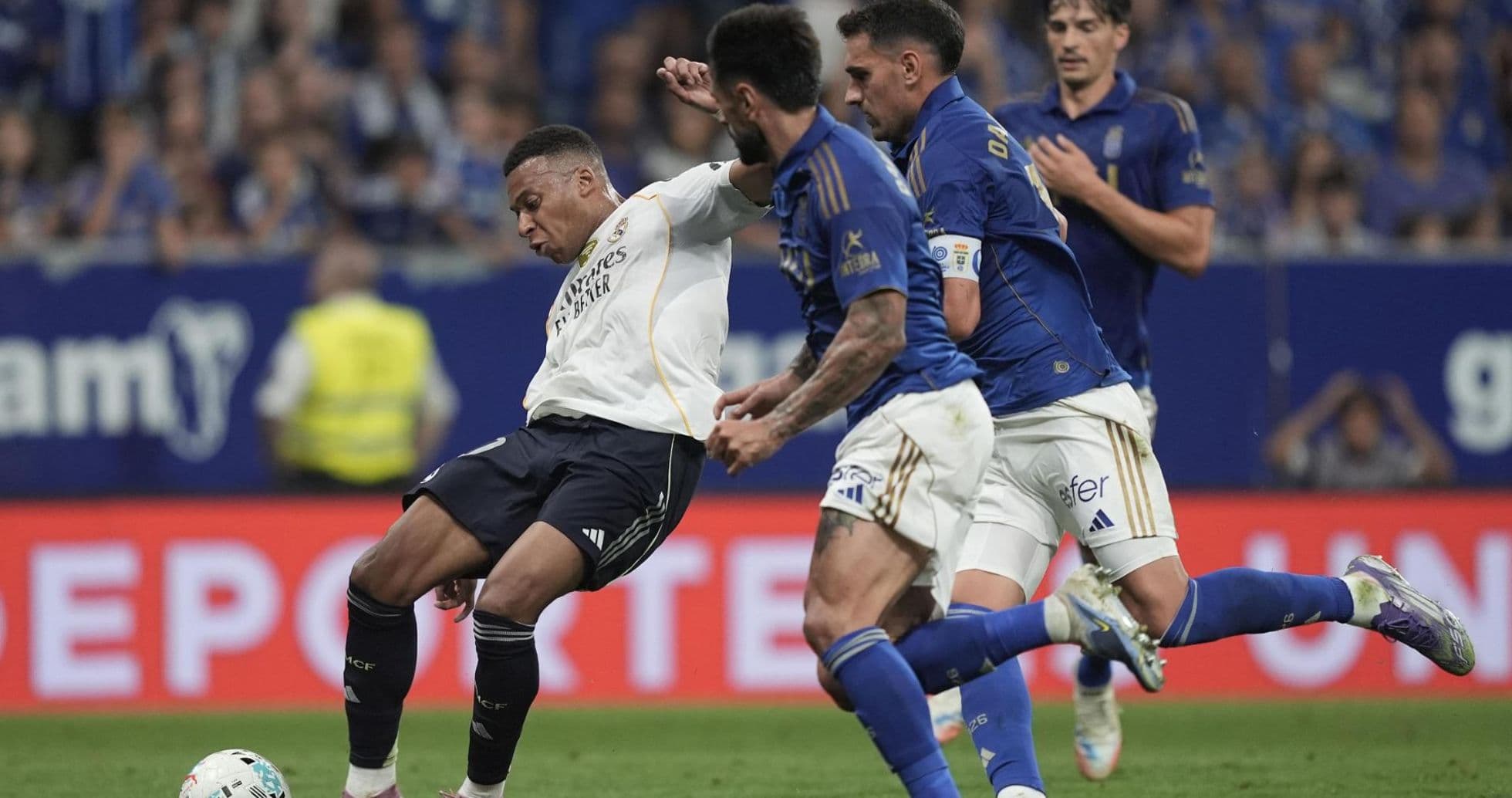
The night at Estadio Santiago Bernabéu ended with the scoreline many expected but through a more nuanced story: Real Madrid 2–0 Oviedo, a result that underlined the gulf in class between a title-chasing giant and a side staring at relegation.
I. The Big Picture – Power against desperation
Following this result in La Liga’s Regular Season - 36, the table snapshots tell you everything about the different universes these clubs inhabit. Real Madrid sit 2nd on 80 points, with a goal difference of 39 built from 72 goals scored and 33 conceded overall across 36 matches. Oviedo, by contrast, are 20th with 29 points and a goal difference of -30, their 26 goals for and 56 against painting a stark picture of a team permanently on the back foot.
Madrid’s seasonal DNA is clear: at home they have been ruthless. Across 18 home matches they have 15 wins, 1 draw and just 2 defeats, scoring 41 and conceding 14. That averages out at 2.3 goals scored and 0.8 conceded per home game, the profile of a side that expects to dominate territory and chances at the Bernabéu. Oviedo arrive as the opposite archetype: away from home they have 2 wins, 4 draws and 12 defeats from 18, with 17 goals scored and 39 conceded. Their away averages of 0.9 goals for and 2.2 against underline a team that tends to collapse under sustained pressure.
This match, finishing 2–0 with Madrid already 1–0 up by half-time, fitted neatly into those long-running patterns: Real Madrid controlled the narrative, Oviedo tried to hang on and were eventually overwhelmed.
II. Tactical Voids – Who was missing, and what that changed
The absentees list for Real Madrid was long and revealing. Eder Militao (muscle injury), F. Mendy (muscle injury) and D. Huijsen (lacking match fitness) stripped depth and aerial dominance from central defence and left-back. A. Lunin (illness) removed competition in goal, while F. Valverde (head injury) and A. Güler (muscle injury) took away two of Carlo Ancelotti’s most flexible midfield profiles: one a high-energy enforcer-creator, the other a technical conductor and top assister with 9 league assists. Rodrygo (knee injury) and D. Ceballos (coach’s decision) further thinned the creative and rotation options between the lines.
In that context, Alvaro Arbeloa’s choice of a 4-4-2 felt pragmatic and controlled. T. Courtois returned as the imposing No.1, shielded by a back four of T. Alexander-Arnold, R. Asencio, D. Alaba and A. Carreras. In midfield, E. Camavinga and A. Tchouameni formed a double pivot of power and circulation, flanked by B. Diaz and the teenager F. Mastantuono, with G. Garcia and Vinicius Junior up front. It was a blend of structure and individual flair, designed to dominate the ball without overextending a depleted squad.
Oviedo’s absences were different in nature but equally decisive. L. Dendoncker (injury) and O. Ejaria (injury) removed experience and ball security from midfield. B. Domingues (knee injury) took away a creative outlet, while J. Lopez and K. Sibo were suspended after red cards, further depleting defensive and midfield depth. Guillermo Almada’s 4-3-3 – with A. Escandell in goal, a back four of N. Vidal, E. Bailly, D. Costas and R. Alhassane, a midfield trio of N. Fonseca, S. Colombatto and A. Reina, and a front three of I. Chaira, F. Viñas and T. Fernandez – had to be more cautious than its shape suggested. On paper it was a 4-3-3; in practice, against this Real Madrid, it often flattened into a 4-5-1.
Disciplinary tendencies only heightened the risk for Oviedo. Across the season they have conceded a heavy share of yellow cards between minutes 61-75 (23.38%) and 31-60 (a combined 36.36%), while their red cards spike dramatically in the final quarter of games: 40.00% of their reds come between 76-90 minutes, with a further 20.00% between 91-105. Madrid, by contrast, distribute their yellows more evenly, with a late-game rise between 61-75 (22.06%) but no particular meltdown window.
III. Key Matchups – Hunter vs Shield, Engine Room vs Resistance
The headline duel in any Real Madrid game this season is Kylian Mbappé against the opposition defence, even if he began this one on the bench. In La Liga he has 24 goals and 5 assists in total, with 102 shots (61 on target) and a penalty record that is excellent but not perfect: 8 scored and 1 missed. That single miss matters under the “penalty truth” lens – he is not automatic from the spot, but his threat profile is overwhelming.
Oviedo’s “shield” against that calibre of forward is built around E. Bailly and D. Costas, but the broader numbers are unforgiving: overall they concede 1.6 goals per game, rising to 2.2 on their travels. F. Viñas, their top scorer with 9 league goals and 1 assist, is also their most combustible presence: he leads the league red-card table with 2 reds and 1 yellow-red, plus 5 yellows. His duels – 484 contested, 254 won – and 49 tackles show a striker who fights every ball, but his disciplinary profile makes late-game chaos a constant danger, especially against a team that keeps pushing until the final whistle.
In midfield, the “engine room” battle was between Madrid’s double pivot and Oviedo’s trio. A. Tchouameni and E. Camavinga offered verticality and ball-winning, while B. Diaz and F. Mastantuono provided interior creativity from wide starting positions. Oviedo relied heavily on N. Fonseca and S. Colombatto to screen transitions and break Madrid’s rhythm, but the structural reality was that they were outgunned. Madrid’s season-long averages of 2.0 goals for and 0.9 against overall, combined with 13 clean sheets and only 4 matches in which they failed to score, speak to a machine that very rarely loses control of territory or tempo.
IV. Statistical Prognosis – Why 2–0 felt inevitable
From a statistical standpoint, a Madrid win with a multi-goal margin was always the most probable outcome. Madrid’s home attack, averaging 2.3 goals, met an Oviedo away defence conceding 2.2 per match – a classic “hunter vs wounded shield” scenario. Even without detailed xG numbers, the underlying shot and goal profiles suggest Madrid would generate significantly higher Expected Goals than Oviedo.
Defensively, Madrid’s home concession rate of 0.8 goals per game aligned with Oviedo’s away scoring average of 0.9, making an Oviedo goal possible but not likely, especially in a stadium where Madrid have kept 6 home clean sheets overall. Combine that with Oviedo’s tendency to fail to score in 10 away matches overall and the final 2–0, with a 1–0 half-time platform, reads like the logical expression of those trends.
Following this result, Madrid’s campaign remains one of controlled dominance, even amid injuries. Oviedo’s remains a struggle against gravity, their brave but brittle 4-3-3 again exposed under elite pressure. The numbers, the shapes and the night at the Bernabéu all told the same story.