.svg&w=384&q=75 "naujapitch logo")
Newcastle United's Season Reflection: Eddie Howe's Challenges Ahead
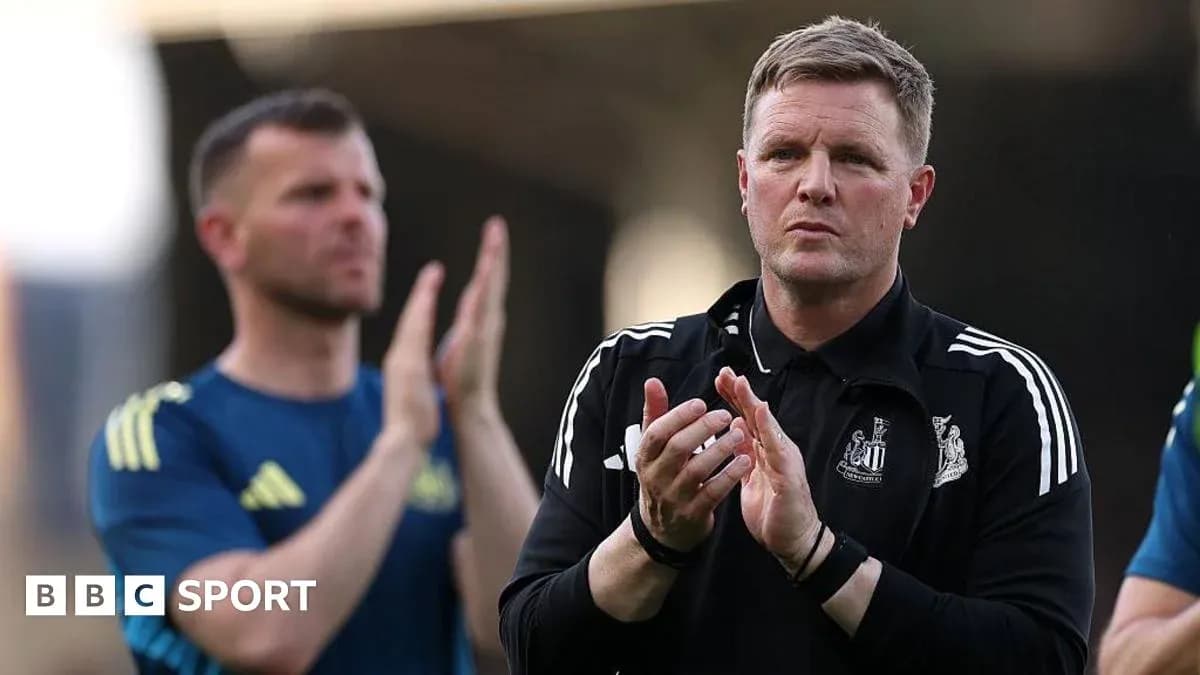
Eddie Howe walked alone at St James’ Park. At least, that is how it looked when he set off on Newcastle United’s lap of appreciation after the final home game of the season.
It did not feel that way.
The Gallowgate stayed. The songs stayed. The backing stayed. “Eddie Howe’s black and white army” rolled around the stands again and again after the 17 May draw with West Ham, echoing those euphoric nights when Newcastle had just sealed Champions League football in 2023 and 2025.
This time, though, the mood was different. Less triumph, more defiance. A fanbase clinging to a manager and a project after the most bruising campaign of Howe’s reign.
Seven points from nine had given the season a faint pulse. A hint that the worst might be over. But there was still one more game, one more test of whether Newcastle really had turned a corner.
Fulham away answered that.
Newcastle folded with a grim familiarity, slipping to a flat 2-0 defeat on the final day, their 17th league loss of the season. Heads dropped as players and staff trudged towards the away end, offering thanks that felt hollow after another limp display.
It was Groundhog Day in black and white.
“There have been a lot of bruises this season,” Howe admitted afterwards. Understatement barely covers it.
Behind the scenes, the club’s hierarchy had already moved into repair mode. Earlier in May, owners, executives and senior figures gathered in Northumberland for their annual summit, this time with a sharper edge. The question was no longer how to build on success, but how to stop the slide.
“We are in a moment right now and they want to understand why, what we are doing about it and how to fix it,” a senior source said.
The response has not been emotional. It has been cold, detailed, and unsparing. The conclusion is clear: big changes are coming. This squad will not look the same when next season starts.
Anthony Gordon sits at the heart of that. There is still a gap in valuation between Bayern Munich and Newcastle, and the club insist they will only sell on “our terms”, but all indications point towards the England international being one of the major departures.
Factor in other likely exits and the scale of the rebuild becomes obvious. At a minimum, Newcastle expect to need a new goalkeeper, a full-back, a midfielder and at least two forwards. That is the shopping list before any opportunistic deals or late-window twists.
Howe has grown “frustrated” with problems he has been unable to iron out on the pitch, and he has been blunt about what must happen now. The club, he says, are “very clear” on what is required after a 12th-placed finish that has jolted standards across the board.
New signings alone will not fix it. Howe knows that. Yet he has pointed to other clubs who have leapt up the table on the back of one smart window, using them as proof that a decisive summer can change a trajectory.
Sporting director Ross Wilson will lead that reconstruction, with Howe very much part of both the diagnosis and the cure. In one sense, that is no surprise. This is the manager who ended Newcastle’s 70-year wait for a major domestic trophy by lifting the Carabao Cup only last season.
But the bar he set has not been met. Inside the club, nobody is pretending otherwise. This season has not been good enough.
The unpredictability that once made Newcastle dangerous has curdled into something more chaotic. Just as you could never quite forecast what you would get from Howe’s team on a given day, the head coach himself has looked like a man scrambling for the right formula, reshuffling, tweaking, never quite landing on a settled answer.
“The bar needs to be reset,” he accepts. “It’s something we need to address and we need to address it very quickly.”
Newcastle’s edge has gone blunt. The numbers tell the story.
In 2024-25, no Premier League side surrendered fewer points from winning positions than Newcastle. Seven. That was it. When they went ahead, they stayed ahead. Alexander Isak, before his protracted £125m move to Liverpool, became the man Howe could trust to strike first, respond when pegged back, or kill a game off. Behind him stood a drilled, disciplined unit that knew how to manage leads and suffocate opponents.
This season, that steel vanished. Newcastle have coughed up the most points from winning positions in the division – 27 – and conceded more goals in the final 15 minutes of matches than anyone else, 21. From ruthless to brittle in the space of a year.
A fierce side has turned flaky.
The burden of juggling competitions exposed them. Unlike Aston Villa, who ended the season as Europa League winners but slipped out of both domestic cups earlier, Newcastle tried to fight on every front for as long as possible. The effort drained them.
There were flashes of evolution late in the campaign, hints of a team trying to adjust and grow. But each step forward seemed to arrive too late, or without follow-through. Even when the schedule eased and the players gained more time on the training ground and in the recovery room, the revival never quite took hold.
For many in that dressing room, this was their first 58-game season. The mental and physical toll bit hard.
“Bloody hell, it’s not easy,” said a source close to one regular. That line could have come from half the squad.
Even the staff felt trapped in a cycle. Enjoy a win and you risked being ambushed by a defeat three days later. Momentum never settled; it swung like a pendulum.
Newcastle never produced the kind of defining run that had previously powered them into Europe. Margins became their enemy. Seventy-one percent of their league defeats came by a single goal. Howe now has to find a way to drag his team back onto the right side of those tight games.
Outside the club, patience has frayed but not snapped. Yet.
Season-ticket holder Liam Phillips believes the club need a “reset” – and quickly. “He badly needs a good start next season,” Phillips says of Howe. “If Newcastle are not in the top six or seven in the first few games, I think the crowd will quickly turn.
“There has been a patience and understanding this season but if the team start badly after spending more money in the transfer market, I don’t think people will be quite as forgiving.”
That is the backdrop to a pivotal summer. Last year’s window was turbulent. Newcastle missed out on several first-choice targets, most of the signings arrived late, and there was no chief executive or sporting director in place to steady the process. The club eventually buckled and sold Isak on deadline day, having held firm for so long.
Brentford and Bournemouth have shown that you can sell key players and still rebuild cleverly. Newcastle, by contrast, have not yet seen enough return from a net spend north of £100m last summer, a window in which Howe played a major role.
Only Malick Thiaw can be called an unqualified success.
The calendar did the rest of the damage. Between September and March, the relentlessness of the schedule meant most of the new arrivals had to learn the demands of Howe’s system through video and analysis sessions rather than full-blooded work on the grass.
Jacob Ramsey had only a brief taste of Howe’s training before the fixtures piled up. Even that glimpse was jarring. The midfielder, used to a demanding regime under Unai Emery at Aston Villa, still found the volume of high-intensity running in Howe’s drills a shock at first.
It was a snapshot of the adjustment many signings face when they arrive on Tyneside. The intensity is non-negotiable. The adaptation period is real.
Howe believes last summer’s recruits will be stronger for that baptism, better equipped to deliver when the new campaign begins. They will need to be. He has built his reputation on outperforming teams with bigger wage bills; this season, that edge deserted him and Newcastle drifted into the bottom half.
The contrast with Sunderland will sting. While their bitter rivals beat Newcastle home and away and secured European qualification in a season where eight spots were available, Howe’s side missed out entirely.
This boom-and-bust pattern cannot continue. Howe’s best work has come when he has had clear weeks to prepare, to drill detail into his players and shape game plans without the constant churn of travel and recovery. He needs that rhythm again, even if the club still want to be fighting on multiple fronts.
“Every experience makes you stronger and makes you appreciate the good times,” Howe said. “We will all try and come back a better team.”
The question now is simple and stark: when the next lap of appreciation comes around, will he still be walking it alone, or leading a side that has finally learned how to turn scars into something sharper?