.svg&w=384&q=75 "naujapitch logo")
Morocco Advances to World Cup Quarterfinals with 3-0 Victory Over Canada
HOUSTON — Morocco are no longer knocking on the door of the elite. They are sitting at the table and rearranging the chairs.
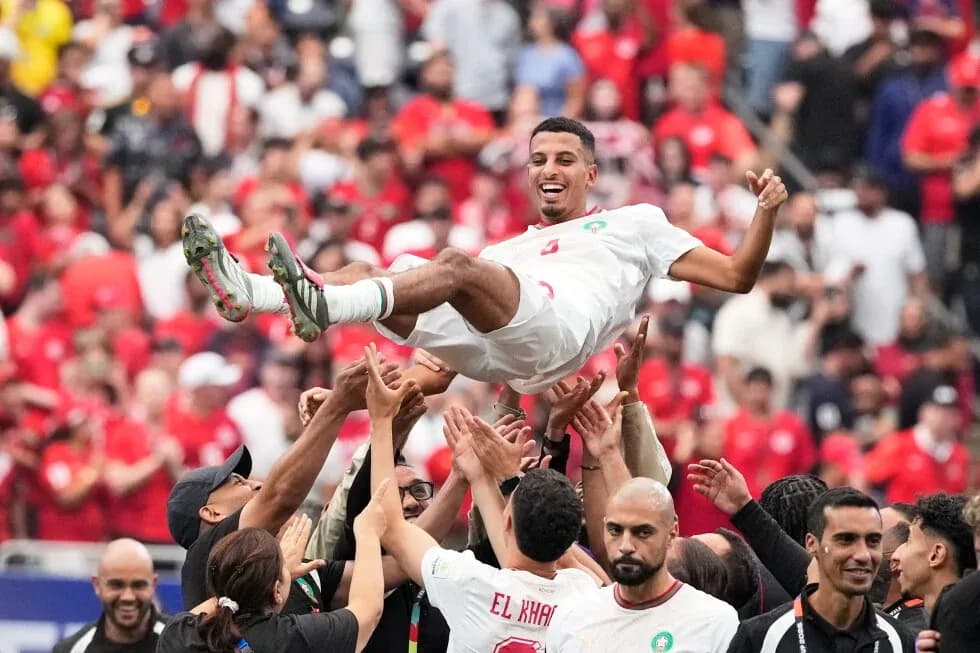
Azzedine Ounahi struck twice and Soufiane Rahimi added a late flourish as Morocco beat Canada 3-0 in the World Cup round of 16 on Saturday, becoming the first African nation to reach the quarterfinals more than once. The team that stunned the world in 2022 is back in the last eight — and this time, it feels less like a fairy tale and more like a plan.
“We are no longer a surprise,” coach Mohamed Ouahbi said through a translator. “Now when people talk about Morocco we’re a major contender and it’s a great source of pride. I think it’s only the beginning and I hope we continue to have runs like this.”
They intend to. “We want to keep going,” he added. “We don’t want to stop.”
Ounahi unlocks a tense contest
For 45 minutes, the game simmered. Tackles snapped in, tempers flickered, but neither side found a way through.
The first half’s defining image was not of a chance, but a clash: Achraf Hakimi and Richie Laryea squaring up in the 40th minute, both booked after Hakimi shoved Laryea to the turf and the Canadian retaliated. Eight yellow cards in total underlined the edge to this rematch of their 2022 group-stage meeting, which Morocco also won.
Morocco suffered an early setback when midfielder Ismael Saibari limped off in the 22nd minute, but they absorbed the disruption and waited for their moment.
It arrived five minutes after the restart.
Hakimi stood over a free kick and rolled it short. Ounahi, lurking outside the box, stepped onto the ball and whipped a right-footed shot through a crowd of bodies and into the bottom right corner. From distance, through traffic, with a quarterfinal place on the line — it was a finish of a player who now expects to decide games on this stage.
The goal settled Morocco. It rattled Canada.
Canada’s brave run hits a ceiling
Canada, co-hosts and surprise survivors of the group, had ridden a wave of national enthusiasm into their first-ever World Cup knockout win, a 1-0 victory over South Africa. For a country still far more defined by hockey than football, this run had been a revelation.
They arrived in Houston believing they could go one step further, even without Alphonso Davies. The Bayern Munich star, limited to just 15 minutes in the tournament because of a hamstring injury, failed to recover in time for this one.
“His hamstring didn’t feel right,” coach Jesse Marsch said. “We were hoping that by the time he woke up this morning that he would feel better, but he didn’t.”
Canada still carved out chances late. At 1-0, Jonathan David stood over a free kick just outside the area in the 78th minute, only to send his effort sailing over the bar. Moments later, Tajon Buchanan let fly from around 30 yards, forcing Yassine Bounou into a full-stretch, diving save.
Bounou, born in Canada to Moroccan parents, turned those Canadian hopes away with three saves and the authority of a man who has seen this stage before. His clean sheet extended Morocco’s sense of control as the minutes ticked down.
Marsch, though, refused to let the scoreline define his team’s performance.
“I told them that I was proud of them and I challenged them to understand that we can play like this all the time against the best teams in the world,” he said. “We can be better on the day. And then the challenge is, can we hold that standard for 90 minutes?”
He went further, insisting Canada had outplayed a side of genuine pedigree.
“The way we pushed, the way we were in the match, the quality we showed, the overall impact in the match, we were better,” Marsch said. “We were better than the No. 7 team in the world today.”
Morocco are actually ranked sixth in the FIFA rankings, a detail not lost on Ouahbi — nor was the suggestion that his team had been second best.
“In terms of intensity they were good,” he replied. “They were good for 98 minutes. Were they better? It’s hard to say. It takes some nerve to say that when you lose 3-nil.”
Clinical finish from a team that knows how to advance
The pressure finally told in the closing stages. As Canada pushed higher, gaps opened. Morocco, so comfortable playing with and without the ball, pounced.
In the 82nd minute, Brahim Díaz slipped a pass into the heart of the box. Ounahi arrived again, this time in stride, and drove a right-footed shot from the middle of the area to make it 2-0. If the first goal had been about precision from distance, the second was about timing and composure.
Canada’s resistance broke. Morocco smelled blood.
Deep into stoppage time, Rahimi added the third, a final strike that turned a hard-fought contest into a statement scoreline. The 3-0 margin did not reflect every twist of the match, but it did underline one reality: Morocco know exactly how to navigate knockout football now.
This is not a one-off. In 2022, they became the first African nation to reach a World Cup semifinal, finishing fourth after a run that changed the continent’s footballing narrative. Now they are back in the quarterfinals at the very next tournament, the first African side ever to do so more than once.
“We are so proud to represent Africa because it’s a continent with a lot of talent and Africa deserves to be in the best level in football,” Bounou said.
A new benchmark, and a new target
Morocco’s path has not been gentle. They knocked out the Netherlands on penalties to reach this round, sending the European power home to its earliest World Cup exit. They have embraced the expectations that come with a top-10 ranking and a recent semifinal on their résumé.
Next comes a quarterfinal on Thursday at Boston Stadium against the winner of Paraguay vs. France. It is the kind of fixture that used to feel like a dream for African sides. For this Morocco, it feels like the next step.
Ouahbi’s team carries the weight of a continent and the confidence of a group that no longer sees itself as an outsider. They have already made history, twice over. They are not interested in stopping there.
The question now is not whether Morocco belong among the world’s best. It is how far this generation can push the line of what African football can achieve.