.svg&w=384&q=75 "naujapitch logo")
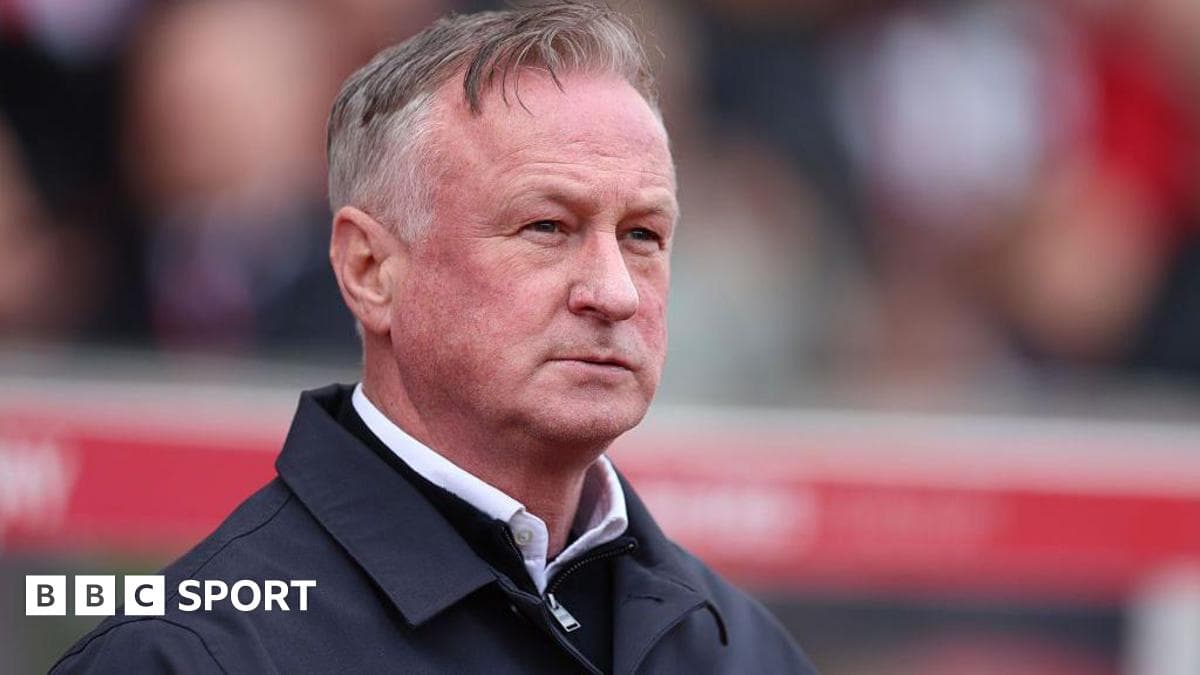
Michael O’Neill Commits to Northern Ireland for Euro 2028
Michael O’Neill has turned his back on club football – for now – and thrown his full weight behind Northern Ireland’s push for Euro 2028.
After four intense months juggling Blackburn Rovers and his country, the 56-year-old has chosen the international dugout, ending any prospect of a permanent stay at Ewood Park.
A Short, Steady Firefight at Ewood
When O’Neill walked into Blackburn in February, the job was simple and brutal: keep them in the Championship.
He did exactly that.
Fifteen league games. Five wins, five draws, five defeats. A perfectly split record that still carried enough punch to drag Rovers clear of the trapdoor, finishing 20th in the second tier and avoiding a relegation that would have shaken the club to its core.
He did it while still running Northern Ireland.
From the start, O’Neill made one thing clear: the dual role could only ever be temporary. He repeated it throughout his time in Lancashire – long term, he would have to choose. There would be no permanent job share.
The choice has now been made.
“Following discussions with the club, Michael has decided to continue his long-term commitment to his role as Northern Ireland head coach, with a focus on leading the national team towards qualification for the Uefa European Championships in 2028,” Blackburn confirmed in a statement.
O’Neill’s own words carried the tone of a man who enjoyed the challenge, but knew where his priority lay.
“Blackburn Rovers is a historic football club with a proud tradition and passionate supporters. I have thoroughly enjoyed my time working with the players, staff and everyone around the club,” he said, before drawing the line.
“After careful consideration, I have decided that my long-term focus must remain with Northern Ireland and the journey towards the European Championship campaign ahead.”
Blackburn now head back into the market. The club will begin the search for a new permanent head coach, with updates to follow, and crucially, they have time on their side before the 2026-27 season.
A Second Act With Northern Ireland
For O’Neill, the decision is as much about unfinished business as loyalty.
Across his two spells in charge of Northern Ireland, he has managed 104 games, with 38 wins, 23 draws and 43 defeats. Those numbers only tell part of the story. His first stint delivered Euro 2016 – a landmark moment and the country’s last appearance at a European Championship.
He wants another.
He will now aim to guide Northern Ireland back to the Euros for the first time since that 2016 campaign, this time with the 2028 tournament in his sights.
The Irish FA made no attempt to hide their relief.
“We are delighted Michael has decided to stay on as Northern Ireland manager. He has built another exciting squad of players and we now look forward to building on this momentum as we plan for both the Uefa Nations League campaign this autumn and the subsequent qualifiers for Euro 2028 with Michael at the helm,” read their statement.
Northern Ireland supporters will feel the same. Over the past two years, O’Neill has quietly reset the team again, just as he did in his first spell after inheriting a struggling side from Ian Baraclough.
They missed out on Euro 2024. They missed out on this year’s World Cup. But the performances have sharpened, the football has opened up, and the squad suddenly looks like it belongs to the future, not the past.
The numbers from March’s World Cup play-off defeat to Italy tell the story. The average age of O’Neill’s starting XI that night was just 22.5 years – the second youngest Northern Ireland side on record since World War Two.
And that was without three key figures: Conor Bradley, Dan Ballard and Ali McCann. Even with them, the age profile barely shifts. This is a young, ambitious group with a high ceiling and room to grow.
Clear Runway to 2028
O’Neill had hinted at this outcome, then seemed to pull back. In March, when asked about his future, he spoke of “returning to the status quo” for Northern Ireland’s June fixtures. By April, he was saying a decision still had to be made. That uncertainty set nerves jangling.
Those nerves can now settle.
The call has come early enough to suit everyone. O’Neill can fully prepare for June’s friendlies and the autumn campaign; Blackburn can plot a considered appointment rather than a rushed one.
Northern Ireland’s immediate schedule is already mapped out. Two friendlies in June – Guinea in Cadiz and France in Lyon – will sharpen the edges before the Nations League begins in September.
They have been drawn into Group B2 alongside Hungary, Georgia and Ukraine. It is a demanding section, but one that offers exactly what O’Neill tends to relish: a chance to test and harden a young side in meaningful, competitive games.
The Irish FA know the stakes. Had O’Neill walked away, the job would have been far more attractive now than when he returned in 2022, such is the potential in this squad. Instead, they keep the architect of the rebuild in place, avoiding upheaval just as the Nations League looms.
That continuity matters. The belief around this team is no longer theoretical. With O’Neill staying on, there is a growing sense that the arc of his second spell could mirror the first – a period of building, then a decisive push towards a major tournament.
The last time he had that kind of runway, Northern Ireland ended up in France in 2016.
The question now is whether this younger, bolder version can follow the same path to Euro 2028.