.svg&w=384&q=75 "naujapitch logo")
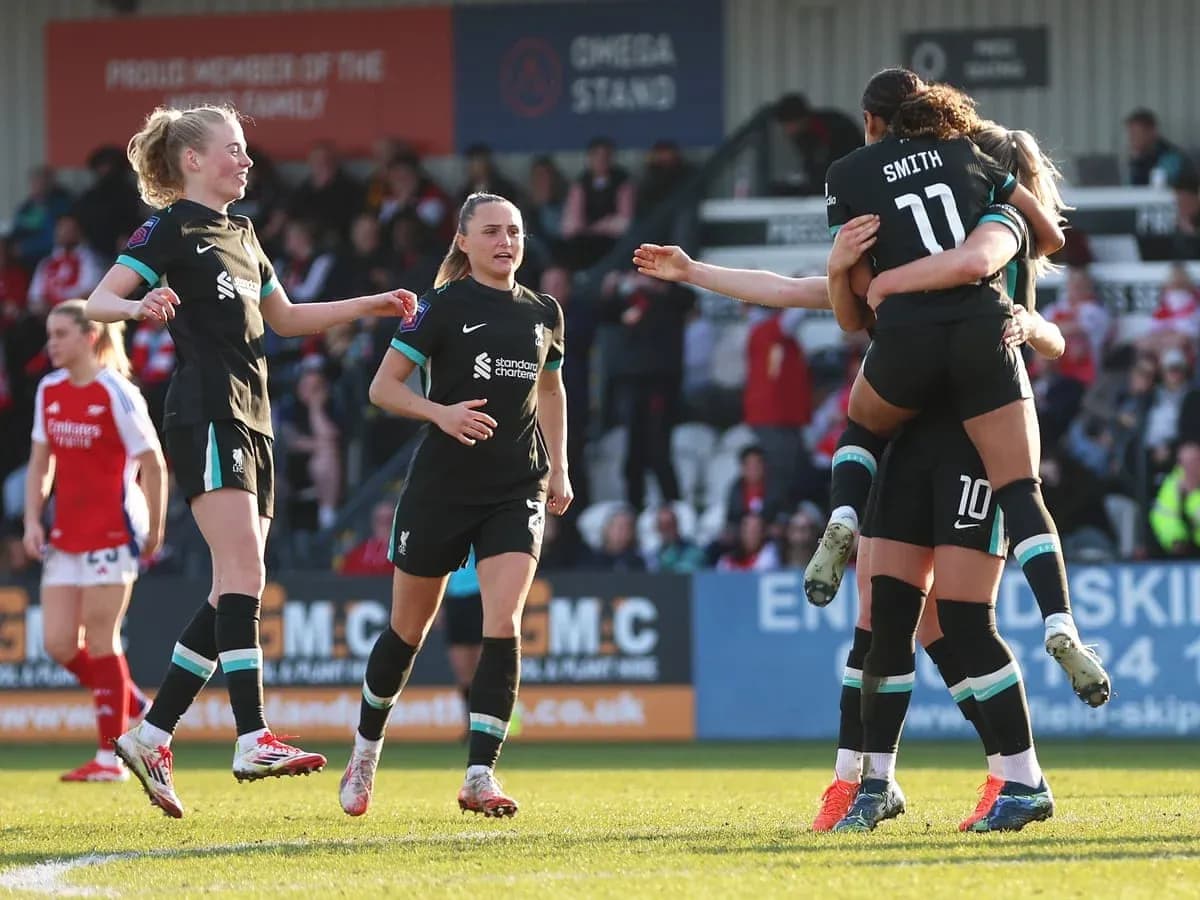
Liverpool W vs Arsenal W: FA WSL Clash Preview
Anfield stages a fascinating FA WSL clash on 16 May 2026 as Liverpool W host title-chasing Arsenal W. The stakes are clear at both ends of the table: Liverpool arrive in 11th place with 17 points and a negative goal difference of -11, still looking over their shoulder, while Arsenal sit 2nd on 48 points with a +37 goal difference and Champions League football already marked in the standings description.
This is not a cup tie, so there is no direct 1/4 final on the line, but the implications are significant. For Liverpool, any result against an elite opponent would be a statement and a buffer in the relegation fight. For Arsenal, three points are non‑negotiable if they are to maintain pressure at the top and justify their “Champions League” tag in the table.
Form and momentum
In the league, Liverpool’s overall record underlines the scale of the challenge: 4 wins, 5 draws and 12 defeats from 21 matches, with 20 goals scored and 31 conceded. Their recent form line of “LLWDW” hints at volatility but also a late‑season flicker: two wins in their last five, including a positive “WDW” stretch in the final three games of that sequence.
At Anfield and their other home venues, Liverpool have been more competitive: 3 wins, 3 draws and 4 defeats from 10 home fixtures, with 12 goals for and 12 against. They average 1.2 goals scored and 1.2 conceded per home match, and have kept 3 clean sheets in front of their own fans. However, the season‑long form string (“LLLLLLDDLLDDWLWLWDWLL”) shows long losing runs and only short pockets of stability.
Arsenal, by contrast, have been relentlessly consistent across all phases. In the league they have 14 wins, 6 draws and just 1 defeat from 21 games, scoring 50 and conceding 13. Their recent form (“WWDWW”) captures a side finishing strongly, with four wins and a draw in their last five.
Away from home, Jonas Eidevall’s side have been formidable: 6 wins, 3 draws and 1 defeat in 10 away league matches, with 22 goals scored and only 7 conceded. They average 2.2 goals scored and 0.7 conceded per away game, and have kept 5 away clean sheets. The season‑long form string (“WWDDLWWDDWWDWWWWWWDW”) includes a six‑match winning streak and only one defeat in the entire campaign.
Tactical tendencies
Liverpool’s season data suggests a team often forced to adapt and absorb. They have used a 4‑1‑4‑1 formation most frequently (8 times), with 4‑2‑3‑1 (4 times) and even a more conservative 5‑4‑1 (2 times) also in the mix. That flexibility hints at a reactive game plan, especially against stronger opponents.
Their goals profile is modest: 20 goals in 21 league games, with a total average of 1.0 per match. At home, they still only hit 1.2 goals per game. They have failed to score in 9 league fixtures overall, including 3 at home, and rely heavily on work rate and compactness. Their “biggest wins” (4-1 at home, 2-3 away) show that when they do click, they can be incisive in transition, but those performances have been rare.
Defensively, Liverpool concede 1.5 goals per match across all phases, rising to 1.7 away but a more controlled 1.2 at home. Four clean sheets overall indicate they can keep things tight on their day, but a biggest home defeat of 1-4 and away of 3-0 underline how quickly games can get away from them if they are forced to open up.
Arsenal’s tactical identity is built on control and attacking depth. Their most common shape is a 4‑2‑3‑1 (9 uses), with occasional switches to 4‑4‑2, 4‑3‑3 and 4‑1‑4‑1. That base allows them to dominate the ball, press high and flood the final third with creative and goalscoring options.
They have scored 49 league goals across all phases (27 at home, 22 away), averaging 2.5 per match. Away from home they still manage 2.2 goals per game, a figure that speaks to both their chance creation and efficiency. Defensively, they concede just 0.7 goals per match overall, with 10 clean sheets split evenly between home and away. They have failed to score in only 3 league games all season.
The “biggest wins” column is telling: 7-0 at home and 1-5 away, with their heaviest away defeat only 3-2. That pattern suggests that even when beaten, Arsenal remain a consistent attacking threat.
Key players and attacking weapons
Arsenal’s firepower is spread across several high‑impact players.
Alessia Russo has been one of the league’s standout forwards. With 6 goals and 2 assists in 20 appearances (19 starts), a 7.45 average rating and 22 shots on target from 32 attempts, she is the focal point of Arsenal’s attack. Her 16 key passes and 17 successful dribbles from 32 attempts underline a striker comfortable dropping into pockets, linking play and driving at defences. She has not scored or missed a penalty this season, so any spot‑kick responsibility likely lies elsewhere, but her open‑play output is elite.
Stina Blackstenius offers a different profile: 5 goals and 2 assists in 19 appearances, but with only 7 starts and 467 minutes. Her return of 5 goals from 14 shots on target makes her a highly efficient rotational option, ideal as an impact substitute or a second striker in a 4‑4‑2 variation.
Behind them, Olivia Smith has emerged as a key creative midfielder. She has 4 goals and 2 assists from 18 appearances (14 starts), with 19 key passes and 11 successful dribbles from 21 attempts. Her 7.31 rating reflects her dual role: linking midfield to attack and contributing defensively with 19 tackles and 4 interceptions.
Chloe Kelly adds yet another dimension from wide areas or as a second forward. With 4 goals and 1 assist in 15 appearances (only 4 starts), and 11 shots with 6 on target, she provides penetration and directness, albeit with a more limited minutes sample (299 minutes). Her 4 yellow cards suggest an aggressive edge out of possession.
For Liverpool, the attacking burden falls mainly on Beata Olsson and Mia Enderby. Olsson has 4 goals and 2 assists from 15 appearances (12 starts), with 6 shots on target from 11 attempts. Her passing accuracy (55%) suggests a more vertical, risk‑taking role, likely as a runner beyond the last line or a counter‑attacking outlet.
Enderby, operating from midfield, has 3 goals and 2 assists in 21 appearances (16 starts). She has contributed 188 passes at 77% accuracy, 11 successful dribbles from 21 attempts and 11 tackles, indicating a box‑to‑box profile who can carry the ball and press. Both players will need standout performances to trouble Arsenal’s well‑drilled back line.
From the spot, Liverpool have converted 2 penalties from 2 attempts this season, while Arsenal have scored their sole penalty. No individual player in the top‑scorer data has a penalty goal or miss recorded, so any penalty narrative must remain team‑level and limited.
Head‑to‑head: recent competitive history
The last five competitive meetings between these sides (excluding friendlies) show Arsenal with a clear edge, though Liverpool have landed a notable recent blow.
- On 6 December 2025 in the FA WSL at the Emirates Stadium, Arsenal W beat Liverpool W 2-1.
- On 22 March 2025 in the FA WSL at the Emirates Stadium, Arsenal W beat Liverpool W 4-0.
- On 9 March 2025 in the FA Women’s Cup quarter-finals at Mangata Pay UK Stadium, Liverpool W beat Arsenal W 0-1.
- On 15 December 2024 in the FA WSL at St Helens Stadium, Arsenal W beat Liverpool W 0-1.
- On 28 January 2024 in the FA WSL at Prenton Park, Arsenal W beat Liverpool W 0-2.
Across these five matches, Arsenal have 4 wins, Liverpool have 1, and there have been 0 draws. The only away win in that run belongs to Liverpool, the 0-1 cup success in March 2025.
Discipline and game management
Liverpool’s card distribution shows a tendency for problems late in games. A large proportion of their yellow cards arrive between 61–75 minutes and 91–105 minutes, and both of their red cards this season have come between 16–30 minutes and 61–75 minutes. That could be crucial if they are forced into extended periods of defending against Arsenal’s sustained pressure.
Arsenal, by contrast, have no red cards recorded and a relatively even spread of yellows, with a slight spike between 76–90 minutes. Their ability to maintain numerical parity while still playing aggressively in the press is a key structural advantage.
The verdict
On paper and in the data, this is a meeting between one of the league’s most potent, balanced sides and a team fighting to stay afloat. Arsenal’s superiority in goals scored, goals conceded, clean sheets, away form and recent head‑to‑head record points strongly in their favour.
Liverpool’s best route into the game lies in a disciplined, compact shape — likely a 4‑1‑4‑1 or even 5‑4‑1 — aimed at protecting central spaces, limiting Russo’s touches in the box and trying to spring Olsson and Enderby on the break. Their even home goals‑for and goals‑against numbers suggest they can keep things competitive at Anfield if they avoid early mistakes and disciplinary issues.
Arsenal, however, have shown all season that they can break down low blocks, rotate high‑quality attacking options from the bench and manage games with maturity. With multiple players capable of deciding the match and a defensive unit that concedes less than a goal per game away, they will expect to control territory and chances.
Liverpool have already proved once in March 2025 that they can upset Arsenal in a knockout environment, but across 90 minutes at Anfield in the league, the data strongly leans towards an Arsenal win, most likely in a match where the visitors create significantly more chances and Liverpool rely on resilience and set pieces to stay in touch.