.svg&w=384&q=75 "naujapitch logo")
Lionel Messi Shatters World Cup Records Again
Lionel Messi did it again.
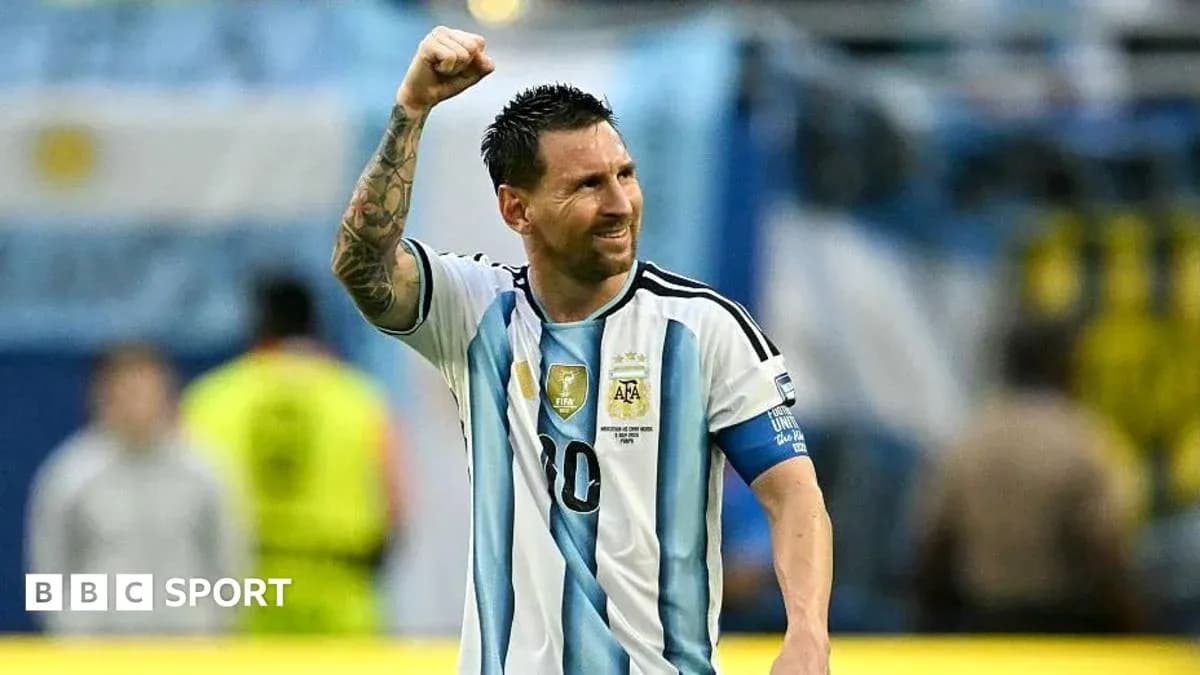
Three against Algeria, two against Austria, one against Jordan, and now another in Miami as Argentina squeezed past Cape Verde 3-2 in a wild World Cup last‑32 tie. One more goal, one more record, one more night that felt like it belonged to him.
This was his 20th goal at World Cup finals, stretching the landmark he had already ripped from the history books during the group stage in the United States. It was his seventh of this tournament alone. Numbers that, in anyone else’s career, would define a lifetime. For Messi, they feel like the latest chapter in a story that refuses to end.
A city painted in sky blue and white
The match felt like an Argentine home game hours before kick-off. Streets around the stadium turned into a river of sky blue and white. Drums, songs, flares, families wrapped in flags. Fans posed beneath giant Argentina banners, some bearing his face, others simply the number 10 that needs no name.
Inside, the stands were a sea of blue and white shirts, Messi’s 10 printed on backs in every direction. Flags hung from railings, one striking banner pairing him with Diego Maradona as almost saintly figures – an illustrated altar to the two men many here believe sit above the rest of football history.
The devotion is unfiltered. “He’s our hero. He’s like our God,” said one supporter before kick-off. Another smiled and went for a different metaphor: “He has aged like fine wine. The older he gets, the better he gets.”
Ask them about the Golden Boot and the answer is simple: if Argentina reach the final, they expect him to be there at the top of the scoring chart. Yet there is also a sense of gratitude, of something already fulfilled. “We’ve already had so much from him,” one fan said. “If he wins it, fantastic, but everything he’s already done for Argentina is enough. He is incredible.”
A quiet game, a brutal finish
By his own outrageous standards, this was not Messi at his most dominant. Cape Verde refused to play the part of grateful guests. Ranked outside the world’s top 60, they went after the team sitting second in the rankings with a composure and belief that rattled Argentina for long spells.
They closed space, broke forward with purpose, and at times dragged the game away from Messi’s orbit.
Then came the moment.
It always seems to come.
Lisandro Martínez stepped out and threaded a pass through a gap that barely existed. Messi had already seen it. He timed his run to perfection, ghosting beyond the back line, taking the ball in stride with his first touch before lifting it, almost lazily, over the Cape Verde goalkeeper.
A flick. A pause. The net bulged. Another World Cup goal.
On BBC Radio 5 Live, James McFadden could barely hide his admiration. The former Scotland forward called the finish “just incredible,” then broke it down like a coach replaying a masterclass: the run beyond the defensive line, the weight of the pass, the “exquisite” first touch.
On ITV, Ally McCoist simply called it what it looked like: “genius at work.” Then he summed up the broader picture: “It’s just one record after another. It’s amazing.”
He’s right. The records keep falling.
Records that keep moving the bar
Messi is now the first player, male or female, to reach 20 World Cup goals. No one else has done that. No one else has scored in eight consecutive World Cup appearances either. He has also become the first player to score seven or more goals at two separate World Cups, having hit the same mark in 2022.
His seven goals at this tournament would have been enough to win the Golden Boot at five of the last six World Cups. Since 1978, there have been 13 editions of this competition. Messi’s current tally would have topped the scoring charts in all but two of them.
The scale of it is almost numbing. But his game is not about relentless sprinting or sheer physical dominance. It never really was. What separates him now, at 39, is his reading of the game – an understanding of space and timing that borders on clairvoyant.
While others chase the ball, Messi watches. He scans the pitch before the pass arrives, stores pictures in his head, then waits. He walks, he drifts, he appears detached. He is not. He is saving energy for the one moment that matters.
And yet, in this tournament, there has been a noticeable twist.
“Throughout the years, Messi has walked at times in games to assess what is happening,” McFadden noted. “But here he is getting back to try and win the ball and is leading the press. It’s not a full, high-energy press, but he is leading it.”
Even in the twilight of his career, he is adjusting, reshaping his role, adding small new details to a game that already feels complete.
Miami, capital of Messi’s world
If there is a place outside Argentina where Messi mania feels most intense, it is Miami.
His arrival at Inter Miami in 2023 turned the city into an unofficial outpost of Rosario and Buenos Aires. His face is on murals splashed across concrete walls. His name is in shop windows, on flags, on billboards, on the backs of children playing barefoot football on the sand, all of them wearing that Argentina number 10.
Inside stadiums, his name is chanted long before kick-off. It doesn’t matter who else is on the pitch. The soundtrack belongs to him.
The obsession spills over into daily life. Argentine restaurants around the city proudly serve milanesa – breaded beef or chicken, one of his favourite dishes – and some have gone further, naming items on the menu after him. You can eat in a Messi-themed corner of town without ever stepping near a stadium.
Around him, the media circus has grown into its own ecosystem. In the press zone after matches, the tone shifts the moment he appears. Conversations stop. Journalists surge forward, microphones shoot into the air, cameras tilt and rise to catch a glimpse over a forest of heads.
He speaks briefly, if at all. Then he is gone down the corridor, and the noise slowly drops back to normal.
His every step is tracked. Entire digital platforms exist just to follow him – training clips, tunnel walks, family celebrations, pre-match routines. Every movement is another frame in a story that millions refuse to miss.
This World Cup, then, is not only about Argentina’s hunt for another trophy. It has become a rolling exhibition of one man’s final act at the summit, a last chance for many to see him bend the game to his will on the biggest stage.
How long he can keep doing it, nobody knows. For now, the numbers grow, the records fall, and the world keeps watching a 39-year-old who still needs only one touch, one run, one moment to change everything.