.svg&w=384&q=75 "naujapitch logo")
Ibrahim Mbaye: Youngest African to Score at FIFA World Cup
There is a version of 16 June 2026 that disappears into the scoreline.
France 3, Senegal 0 at MetLife Stadium, the clock edging towards 90, the game apparently gone. Then a teenager steps off the bench into a match that looks like a formality and treats it like an exam he fully expects to pass.
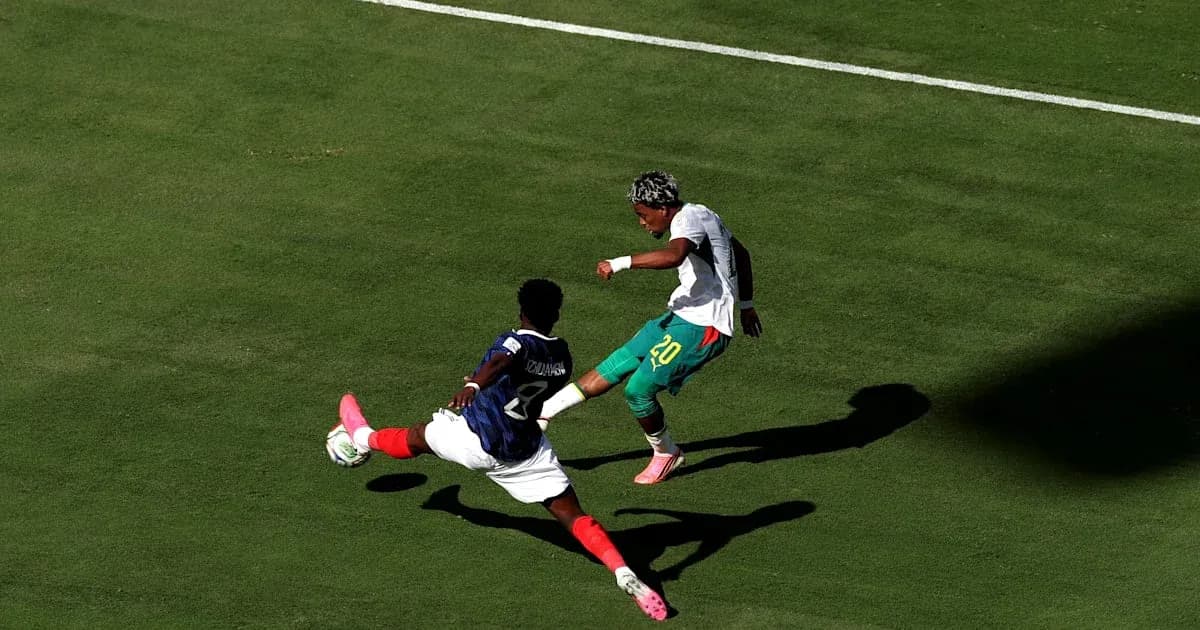
Ibrahim Mbaye collects the ball wide on the right. One feint, one roll of the foot, and Théo Hernandez is leaning the wrong way. Mbaye doesn’t hesitate. He whips his shot past Mike Maignan and into the far corner.
Minute 95. France 3, Senegal 1. The result stays the same. The record books do not.
At 18 years and 143 days, the Paris Saint-Germain forward becomes the youngest African ever to score at a FIFA World Cup, taking a record from his compatriot Moussa Wagué, who set it in 2018. Look at the global company he keeps now: Pelé, Manuel Rosas, Gavi, Lamine Yamal. That is the level of the conversation.
C’est du sérieux. And Mbaye has been serious long before MetLife learned his name.
Books, then Ballon d’Or dreams
Rewind ten months. PSG are flying to Marseille for a Ligue 1 fixture. Mbaye, 17 at the time, is not on the plane.
He is in an exam hall, sitting his baccalauréat — the rite of passage every French teenager must clear before the state considers them properly educated. While his team-mates stretch and tape ankles, he is solving equations and writing essays.
PSG arrange a separate journey. He finishes his exam, travels later, and joins the squad in time for an 8pm kick-off. No drama, no social media circus. For most players, it would be the defining story of a career. For Mbaye, it was just another day.
This is how the PSG Academy works now. The same conveyor belt that has pushed Warren Zaïre-Emery and Senny Mayulu into the first team treats the classroom like an extra training pitch. Director Yohan Cabaye points to a 95 per cent baccalauréat pass rate among academy players and insists that academic rigour and football intelligence are welded together.
In Mbaye, that philosophy finds its sharpest proof. The nutmeg and finish against France was not a flash of street football, but a problem calmly solved in real time — the kind of clarity you expect from someone who approaches a 95th‑minute World Cup chance and a national exam with the same pulse rate.
The boy from Trappes who chose Senegal
Mbaye’s story starts in Trappes, a Paris suburb with a reputation for producing talent and turbulence in equal measure. Nicolas Anelka came from there. So did a generation of kids who grew up on concrete cages and big dreams.
His father is Senegalese, his mother Moroccan. His footballing education, though, is entirely French. He comes through the national youth teams, good enough that inside Clairefontaine there is little serious doubt: this is one for Les Bleus.
Then November 2025 arrives, and he chooses Senegal.
No tug-of-war, no public pressure campaign. The call is his. He explains it simply to Senegalese broadcaster RTS after lifting the Africa Cup of Nations trophy in January, a teenager among seasoned pros twice his age: it was a decision from the heart, one he will never regret. Months later, he doubles down, calling it the best decision of his life and praising the “huge hearts” of the Senegalese.
That is why the goal against France cuts so deep. A boy raised in the Paris suburbs, polished in the country’s most prestigious academy, scoring his first World Cup goal against the nation that shaped him — but doing it in the green of Senegal.
Quelle histoire. Scriptwriters would have binned it as too perfect.
A career on fast‑forward
Strip away the romance and the numbers still look absurd.
Mbaye makes his Ligue 1 debut at 16 years, 6 months and 23 days, becoming PSG’s youngest-ever league starter, taking a record from Zaïre-Emery. He signs his first professional contract in February 2025, scores his first senior goal weeks later, and by August is the youngest Frenchman to appear in a UEFA Super Cup, overtaking a mark Ryan Giggs set back in 1987.
In May 2026, he steps up again, this time in Lens. Deep into stoppage time, he scores the goal that seals PSG’s 14th Ligue 1 title. Another pressure moment, another clean finish.
For Senegal, the acceleration is just as fierce. A debut against Brazil in November 2025. A first international goal three days later on his second cap. He becomes the youngest player ever to appear at the Africa Cup of Nations in December, then breaks his own record weeks later as Senegal’s youngest AFCON goalscorer in January — on the way to lifting the trophy before CAF later rules to award the victory to Morocco after the match.
Four goals in twelve caps before his 19th birthday do not need hype. They demand context. When people mention Kylian Mbappé in the same breath, it does not feel outlandish.
Coaches highlight one trait above all: decision-making. When to carry, when to pass, when to accelerate, when to slow the game to his tempo. He does not clutter the pitch with touches. He chooses his moments, then cuts.
One touch, one action, one outcome.
As Senegalese journalist Wahany Johnson Sambou puts it, speaking to Olympics.com in January, Mbaye is “world class” and, crucially, he “did not choose France – he chose Gaindeyi”. The message is clear: this is their jewel, and his ceiling is frighteningly high.
Dakar to LA: the Olympic thread
Senegal’s story with Olympic football is still in its prologue. The men’s team has appeared at the Games only once, in London 2012, a tournament that helped launch Sadio Mané, Idrissa Gueye and Cheikhou Kouyaté onto the global stage.
They have not been back since.
That could be about to change. Dakar will host the Youth Olympic Games this October, placing the country at the centre of the sporting world. Inside Senegalese football, there is a growing sense that this is the moment to anchor a new generation to the Olympic rings.
Mbaye, born in January 2008, will be 20 when LA 2028 kicks off — the perfect age for an Under‑23 tournament that has previously showcased Lionel Messi, Neymar and Mohamed Salah. Olympics.com already lists him among Africa’s brightest prospects for those Games. Watch him for five minutes and the reasoning writes itself.
It is not only the medals already on his CV that make the idea compelling. It is the temperament behind them: the same calm that carried him through a baccalauréat exam on a matchday afternoon, the same clarity that allowed him to walk into a World Cup opener against the reigning world champions and score in the 95th minute as if he were back in a training drill at Camp des Loges.
For now, Mbaye keeps moving the way he always has — quietly, efficiently, ahead of schedule. He arrives early to moments everyone else thinks are still years away.
The question is no longer whether he belongs on this stage. It is how far, and how fast, he intends to climb from here.