.svg&w=384&q=75 "naujapitch logo")
Haaland vs Kane: World Cup Quarterfinal Showdown in Miami
Miami will sweat. England and Norway will suffer.
On Saturday evening in Florida, two very different World Cup stories collide: the seasoned tournament campaigners chasing another semifinal, and the resurgent outsiders who have just dumped Brazil out of the competition and are suddenly staring at history.
Norway, back at a World Cup for the first time since 1998, have already won more knockout games in this tournament than in their entire previous history. England, chasing a fourth semifinal, are trying to avoid yet another quarterfinal exit. One will melt away in the heat. One will walk into the last four.
And at the heart of it all: the game’s most ruthless finishers, sharing the same pitch at last.
Haaland vs Kane: Golden Boot, golden moment
This is what the tournament has been waiting for. Erling Haaland and Harry Kane, both right in the thick of the Golden Boot race, finally facing off in a match that matters.
Stale Solbakken dodged the duel in the group stage. With qualification already secured, he left Haaland on the bench against Kylian Mbappe and France, even though the striker had scored twice in each of Norway’s opening wins over Iraq and Senegal. The purists groaned. The coach moved on.
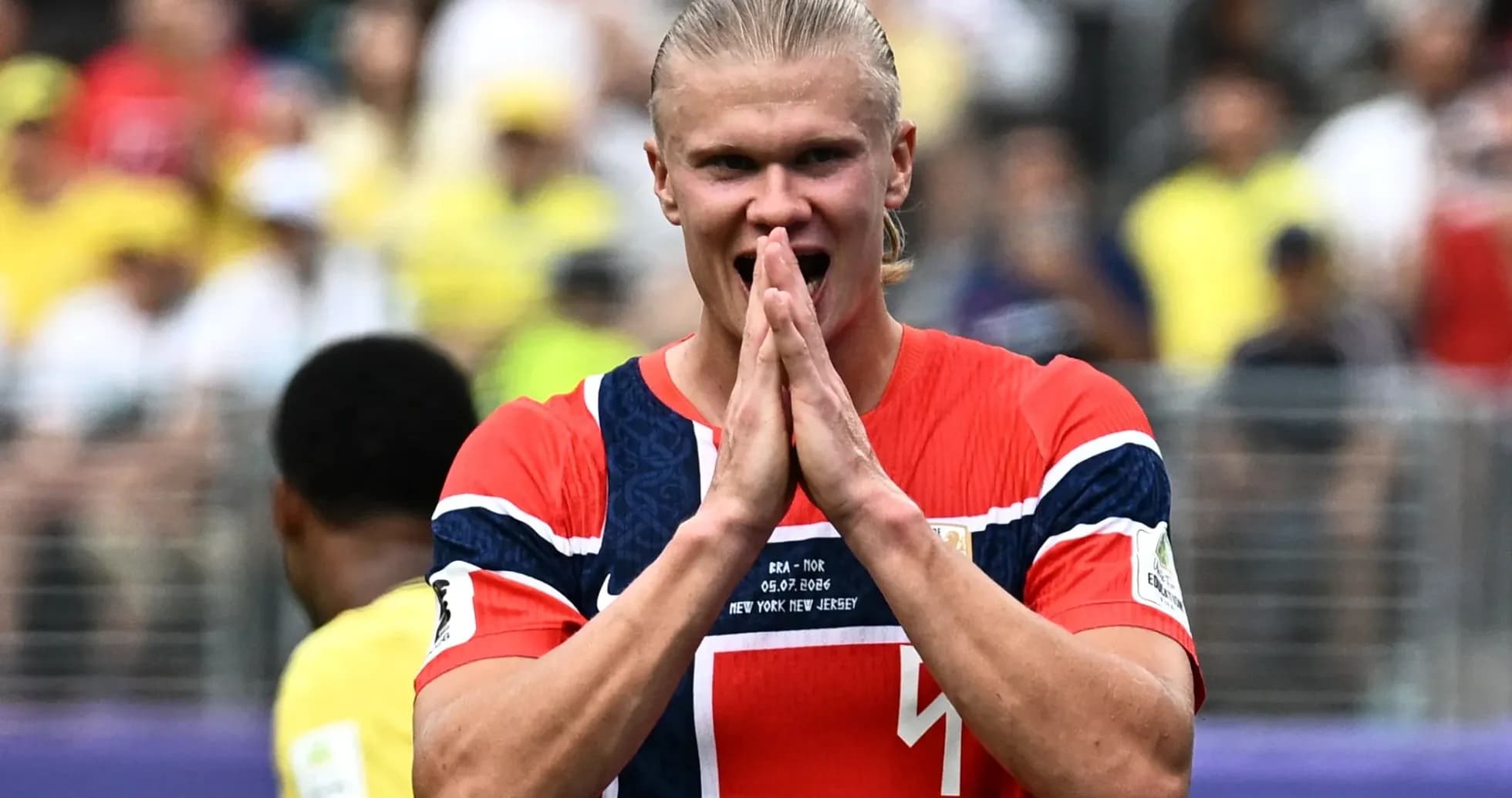
Haaland did not sulk. He scored the winner in the first knockout game against Ivory Coast. Then he dismantled Brazil, grabbing both goals in a 2-1 win that sent the five-time champions home and Norway into the quarterfinals. He now has seven goals in four appearances at this World Cup, 14 consecutive Norway games with at least one strike, 27 goals in that run, and an absurd international record of 62 goals in 54 caps.
He arrives in Miami one behind Mbappe and Lionel Messi in the Golden Boot race. One ahead of Kane.
Kane’s path has been steadier, more familiar. Two goals in the opening win over Croatia, another in the victory against Panama to clinch top spot in the group, both strikes in the late turnaround against DR Congo in the Round of 32, and then the penalty that ultimately decided the wild 3-2 win over Mexico. Different opponents, same story: Kane keeps England alive.
There is symmetry between these two. Three Premier League Golden Boots each. Both have thrived in Germany. Yet they have barely shared the stage. Just two meetings in 2022/23, Tottenham Hotspur against Manchester City. One win and one goal apiece.
Miami feels like a decider of sorts. Not for their careers, but for this moment in time. If one of them drags his country into the semifinals with another decisive performance in this furnace of a quarterfinal, the claim to be the most devastating striker on the planet right now grows louder.
The Haaland puzzle: is Burn the unlikely answer?
Thomas Tuchel’s biggest tactical question is obvious: how do you stop Haaland when he’s in this kind of mood?
One left-field answer has a very straightforward name: Dan Burn.
The 6’7” Newcastle centre-back was a surprise face in Tuchel’s World Cup squad. He only made his England debut shortly before turning 33 in March 2025 and has started just four times, all against Andorra and Albania in qualifying. On paper, not the profile of a man you throw at the world’s most feared striker.
Then came Mexico. With England down to 10 men and clinging to a 3-2 lead, Burn came on for the final 15 minutes and turned the closing stages into an aerial blockade. He headed away cross after cross, flung himself into challenges, and helped drag England over the line through 12 minutes of added time.
He is slower than Haaland, nine years older, and will never match the Norwegian’s mobility. But he is two inches taller and has history with him. Since Haaland arrived at Manchester City in 2022, the pair have shared more than 10 hours on the pitch in eight meetings across the Premier League, FA Cup and League Cup. Haaland has scored just once in that time, in their very first encounter in August 2022.
For a striker who averages a goal every 73 minutes in international football, that is not a trivial detail.
Burn is not alone in that file of awkward opponents. Ezri Konsa has also frustrated Haaland: just one goal conceded in 406 minutes across five matches, again scored in their first meeting in September 2022 when Konsa was at Aston Villa. Given Haaland has plundered 112 goals in 132 Premier League appearances over four seasons, winning the Golden Boot in three of them, those numbers will encourage Tuchel.
The contrast is stark with others. Marc Guehi conceded seven goals to Haaland in five matches before joining him at Manchester City. John Stones has never faced him at club level, only trained with him. The England manager knows exactly which defenders have the muscle memory of stopping Haaland, and which only know the theory.
The question is whether he trusts Burn, in this heat, in this stage, to do it again.
Odegaard vs Rice: control or chaos?
If Haaland is the finisher, Martin Odegaard is the metronome. England ignore him at their peril.
Against Brazil, the Norway captain produced one of the midfield performances of the tournament. He carried the ball forward 61 times, completed 101 of his 109 passes, and dictated a game in which the Selecao saw just 33.6 percent of the ball – their lowest share ever in a World Cup match.
Norway strangled Brazil’s rhythm. Odegaard was the hand on the throat.
England, remarkably, had even less of the ball against Mexico. Their possession figure was 0.4 percent lower than Brazil’s against Norway, the lowest share the Three Lions have recorded since such data was tracked. For long spells they were pinned in their own box, down to 10 men, simply trying to survive.
If they play that way again, Odegaard will suffocate them.
Declan Rice knows him better than anyone in the England squad. The pair have shared the Arsenal midfield 117 times in the past three seasons, driving the club to a long-awaited Premier League title and a Champions League final. Rice has seen every angle of Odegaard’s game, every disguise, every favourite passing lane.
But Rice is not at full capacity. Neural pain in his lower back and hamstring has nagged him for months. Odegaard will know that too. The numbers hint at a physical imbalance: Rice logged 3,094 Premier League minutes this season, his England partner Elliot Anderson even more, while Odegaard played only 1,369. The Norwegian arrives fresher, lighter, sharper.
If Rice cannot disrupt that familiar teammate, England may spend another night chasing shadows in the Florida heat.
Miami heat: who melts first?
This quarterfinal will not just be decided by tactics and talent. It will be decided by lungs.
Kickoff is set for 5pm local time in Miami, with temperatures forecast around 33°C (91°F) and humidity at roughly 58 percent. Thunderstorms lurk in the forecast. The city has already staged the two hottest group games of the tournament: Uruguay’s 2-2 draw with Cape Verde and 1-1 draw with Saudi Arabia.
Neither England nor Norway come from climates that prepare you for this. But their routes to Miami have been very different.
Norway have already been through the wringer. They opened in Boston against Iraq, then moved to New York/New Jersey to beat Senegal. They went back to Boston for the defeat to France, when Solbakken rotated heavily, changing 10 players. Their only game in enclosed conditions came in Dallas against Ivory Coast. Then it was back to the humidity of New York/New Jersey to shock Brazil.
England’s path has been kinder. They started under the roof in Dallas against Croatia, then played in rain-cooled conditions in Boston (goalless against Ghana) and New York/New Jersey (2-0 against Panama). The Round of 32 win over DR Congo came in the air-conditioned comfort of Atlanta. Even Mexico City, where they edged that wild 3-2 win, was relatively cool despite the thunderstorm and one-hour delay.
Norway have lived in the heat. England have dipped in and out of it. That may matter when legs go heavy and concentration frays.
Whoever manages their energy, their hydration, their substitutions better could find themselves walking out again on Wednesday night for a semifinal.
Norway’s left vs England’s right: a fault line in the making
If there is a fault line in this match, it might run straight down England’s right flank.
Reece James, the only recognised right-back in Tuchel’s squad, has missed the last three games after a hamstring injury against Ghana. With Tino Livramento already ruled out on the eve of the tournament by a calf problem, England have been improvising.
Djed Spence, Konsa, Stones and even Jarell Quansah have all taken turns on that side. At one point against DR Congo, Rice dropped in there too. Quansah’s red card against Mexico now removes another option. James is pushing to be fit for the quarterfinal, a timely boost if he makes it. If he does not, Konsa is the favourite to continue after an impressive, backs-to-the-wall showing in the last match.
Whoever starts will be tested immediately.
On Norway’s left, Antonio Nusa offers raw pace and mischief. The winger loves to drive inside onto his right foot, the same weapon he used to curl a superb strike into the top corner against Ivory Coast in the Round of 32. He has flickered in and out of matches, but his threat is obvious.
Then there is Andreas Schjelderup, the man who changed the game against Brazil. Introduced at half-time in place of Nusa, the Benfica winger delivered his best performance of the tournament. His cross found Haaland for the opening goal. Later, he set up the forward again, this time for a ruthless low finish from the edge of the box that killed the contest.
Nusa brings chaos, Schjelderup brings craft. Both will fancy the space behind an England right-back who is either short of match fitness or playing out of his usual position.
Miami will be brutal. The stakes are unforgiving. Haaland, Kane, Odegaard, Rice – all of them arrive at a crossroads in this World Cup.
By Saturday night, one fairytale will be over. The other will be two games from the trophy.