.svg&w=384&q=75 "naujapitch logo")
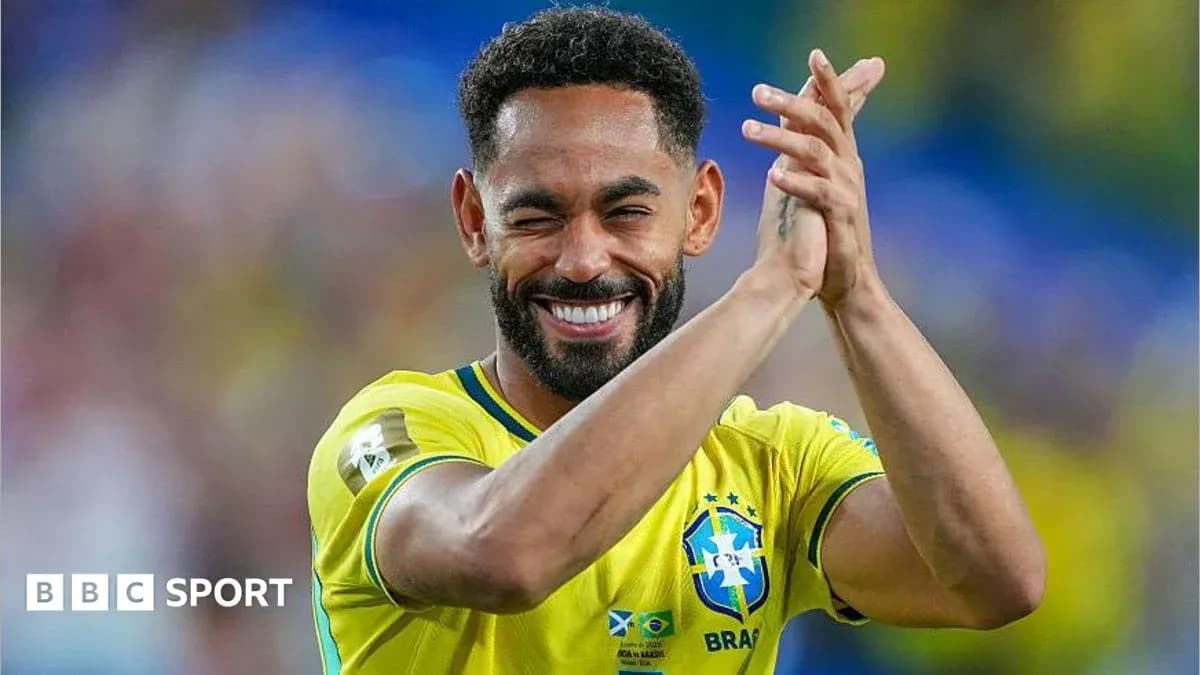
Brazil's Evolving World Cup Attack: The Rise of Matheus Cunha
Brazil’s World Cup machine is beginning to hum – and so is Carlo Ancelotti’s reshaped, reimagined attack.
The group stage has turned into a laboratory that now looks more like a finished product. With each game, Brazil have tightened their structure, sharpened their press and, crucially, found the man to knit it all together: Matheus Cunha.
The rise of a “nine-and-a-half”
Brazilian number nines usually arrive with a myth attached. Ronaldo. Adriano. Romario. The role is almost sacred: live in the box, finish everything, carry the weight of a nation on your shoulders.
Cunha is something else entirely.
He’s not the classic spearhead the Brazilian public expects. He is what you might call a “nine-and-a-half” – part centre-forward, part creator. He can occupy the last line like a traditional striker, but he also drops into pockets, links play and opens doors for others. He already has three goals at this World Cup, so he cannot be dismissed as a pure playmaker either.
What he offers is a profile Brazil have rarely seen in that position. He moves constantly, drifts into midfield, and forces defenders into uncomfortable decisions. Follow him, and you leave Vinicius Jr and Rayan with room to attack the spaces you’ve just vacated. Hold your position, and Cunha receives between the lines, free to turn, slide passes or shoot.
There’s a touch of Roberto Firmino about him. The same habit of stepping away from the centre-backs, the same intelligence in dragging markers into no-man’s land. For defenders, it’s a guessing game they keep losing.
Crucially, Cunha looks completely at ease with this hybrid role. He leads the press, sometimes dropping so deep he resembles a number six screening in front of the midfield. That defensive work sets the tone and gives Brazil’s attack a balance that had been missing.
Ancelotti’s accidental solution
For once, Brazil walked into a World Cup without a nailed-on number nine. It felt strange. Un-Brazilian.
Right up to the Scotland game, nobody could say with certainty who would start through the middle. Ancelotti himself seemed to be searching. Cunha, Igor Thiago, Endrick, Joao Pedro, Richarlison – all had a turn as the focal point.
Then football did what it often does to managers: it forced a decision.
Raphinha began the tournament as a key piece, floating between positions. Against Morocco he operated as a 10 behind Igor Thiago, but his versatility meant he could pop up on either wing as well. When a hamstring injury against Morocco forced him off, Rayan came on and something clicked.
Rayan is a very different type of wide forward. He tends to hold his position on the right, stretching the pitch and staying high. With Vinicius Jr wide left and Rayan wide right, Cunha suddenly had the central channels almost to himself. Space opened up exactly where he likes to operate.
The knock-on effect has been huge. The wingers pin full-backs and centre-backs, Cunha roams in the gaps, and Brazil’s attack has started to look coherent and dangerous from multiple angles.
That doesn’t close the door on Igor Thiago. He offers a more traditional, physical reference point – useful if Brazil are chasing a game or facing opponents who want a battle in the box. He can plant himself on the centre-halves and occupy them in a way Cunha doesn’t. But right now, the rhythm of the team beats to Cunha’s movement.
Back home, the shift has been noticed. The more he plays, the more Brazilians are starting to believe he is the answer in that role. Opponents will study him, try to close his spaces, but his intelligence without the ball makes him a difficult puzzle to solve.
Ancelotti’s Brazil: control without the ball
So much of this evolution leads back to Ancelotti.
His reputation has long rested on man-management, on his ability to handle big egos and keep dressing rooms calm. What’s standing out with this Brazil side is his tactical edge.
He has built a team that is comfortable not having the ball. This is not a Brazil obsessed with 70% possession or endless sterile dominance. Instead, they are happy to hand the initiative to the opposition and turn that into a problem for them.
You could see the plan clearly against Scotland. Brazil allowed Scotland to have the ball, but not the zones they wanted. They guided passes, shaped the press, and sent Scottish players exactly where the trap was set. The first goal came from that aggression. The second, ruled out harshly, followed the same pattern. Those moments weren’t accidents. Brazil had already scored similar goals in warm-up matches against Panama and Egypt.
They didn’t own the ball. They owned the game.
When the press triggered, it did so at full speed and in numbers. The timing, the angles, the intensity – all spoke of a coach who understands that control can come from structure, not just from possession.
This flexibility is at the heart of Ancelotti’s identity. He refuses to be boxed in as a possession ideologue or a counter-attacking purist. The plan bends to the opponent and to the moment. With players as adaptable as this Brazil squad, it makes sense to build a team that can change its skin mid-tournament.
A different kind of Brazil
This is not a throwback to the Brazil of old, and that’s deliberate.
The full-backs tell the story. For decades, Brazil’s identity ran down the flanks: Roberto Carlos and Cafu thundering forward, Maicon and Marcelo transforming games, Dani Alves living as a playmaker from the right. The list is a highlight reel of attacking defenders.
This time, the approach is more restrained. Douglas Santos, Roger Ibanez or Danilo are far more conservative with their forward runs. They rarely bomb on recklessly. They hold their shape, protect the back line and allow the front three to stay higher.
The effect is clear. Vinicius Jr doesn’t need to waste energy tracking back constantly. He can remain closer to goal, fresher and more explosive when Brazil break. The back four looks stable, the distances between lines more compact, the chaos reduced.
Midfield has also been recalibrated. In the opener against Morocco, Casemiro found himself brutally exposed. Left alone at the base of a 4-2-3-1, he was asked to cover too much ground, too often. The criticism came quickly, but the problem was structural, not individual. At 34, expecting him to chase every press and tackle across the width of the pitch is unrealistic – and it has never truly been his game anyway.
Ancelotti adjusted. Brazil shifted into a 4-3-3. Now, when Bruno Guimaraes surges forward, Casemiro has Lucas Paqueta alongside him to share the defensive workload. The midfield triangle feels balanced, the spaces between them controlled. Against Haiti and Scotland, the difference was obvious. Brazil looked compact, less vulnerable in transition, more in command of central areas.
That structure will be vital against Japan, a side far more fluid and dangerous in attack than Haiti or Scotland. Japan’s movement between the lines can pull teams apart. Brazil’s new shape is designed to stop exactly that.
Momentum, and a looming test
The numbers back up the sense of progress: seven goals scored, only one conceded so far. The performances have grown in authority, the combinations in attack more natural, the pressing more coordinated.
Most importantly, the mood has shifted.
Before the first game, anxiety gripped the country. The uncertainty over the number nine, the tactical tweaks, the sense of a “new” Brazil – it all fed into a nervous opening. After three matches, that tension has flipped into excitement. The public is smiling again, feeling the old connection with the team, but through a new lens.
Now comes Japan in the last 32. A sharper opponent, a different kind of test, a game that will reveal how sturdy this new structure really is.
Brazil arrive with a defined idea, a settled core and a centre-forward who doesn’t fit the old mould but might just be perfect for this one.
The World Cup is taking shape. So is Brazil. The question now is whether this modern, more pragmatic version can carry them all the way.