.svg&w=384&q=75 "naujapitch logo")
Brazil vs Morocco Match Report: 1-1 Draw in Group C
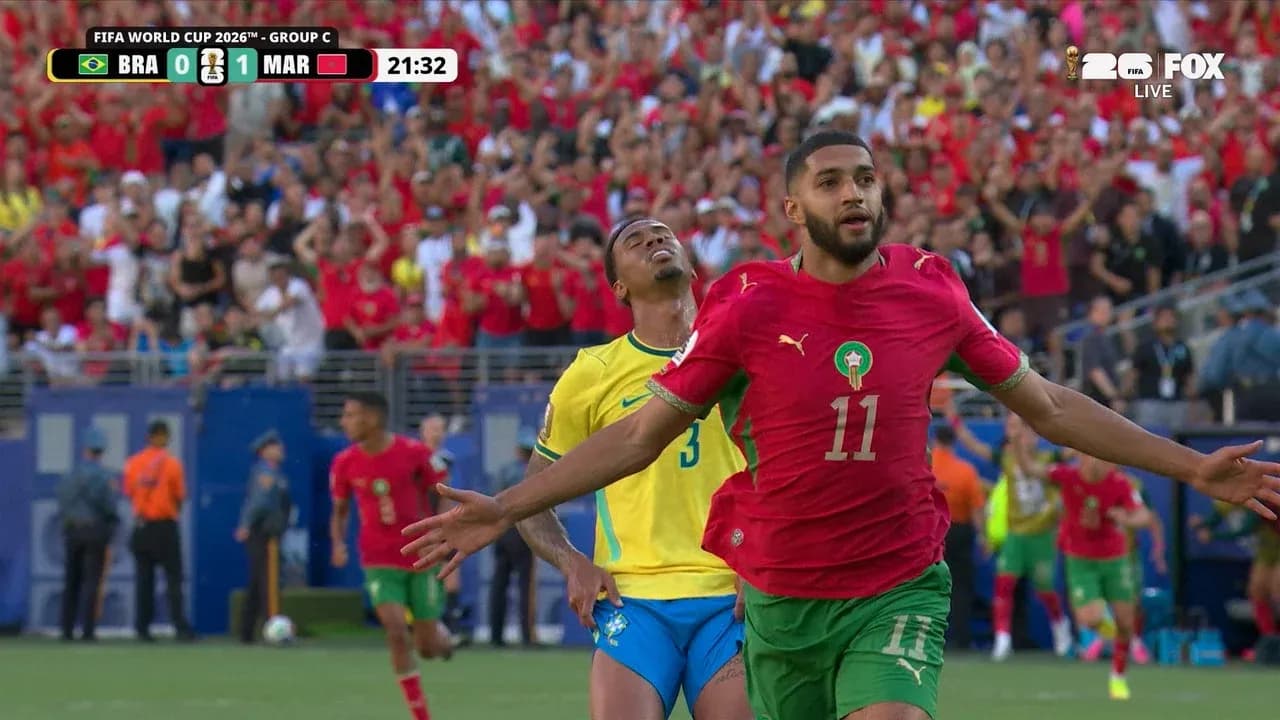
Brazil 1-1 Morocco at MetLife Stadium opens Group C with both sides moving to 2 points from two draws and keeping themselves in the qualifying places, but without taking full control of the section.
Match Report
The game’s first major incident arrived on 21', when Morocco struck the opener. A sharp transition down the right ended with a cut-back into the area and a composed finish: 21' Morocco goal — I. Saibari (assisted by B. Diaz) for 0-1. Brazil’s response was measured rather than frantic, and they were level just over ten minutes later. After a spell of sustained possession, a vertical pass into the left channel freed their star winger, who cut inside and finished low: 32' Brazil goal — Vinicius Junior (assisted by Bruno Guimaraes) for 1-1.
Brazil’s attempts to wrest control before the break came with a physical edge. On 37', Casemiro (Brazil) — yellow card (Tripping) after halting a Moroccan break in midfield. Six minutes later, another defender went into the book as Brazil struggled with Morocco’s counters: 43' Ibanez (Brazil) — yellow card (Tripping) for a late challenge near the touchline.
Those cautions shaped Carlo Ancelotti’s half-time decisions. At 46', Danilo replaced Ibanez (Brazil), a like-for-like change to protect the booked centre-back and add more composure in the build-up. Simultaneously, Fabinho replaced Casemiro (Brazil) on 46', refreshing the holding role and reducing the risk of a second yellow in a game increasingly played in transition.
Brazil’s search for greater attacking thrust continued into the second half. On 61', M. Cunha replaced Lucas Paqueta (Brazil), with Cunha operating closer to the central striker to add penalty-box presence. A minute later, another attacking tweak followed: 62' Luiz Henrique replaced I. Thiago (Brazil), injecting fresh legs and width on the right to stretch Morocco’s compact block.
Morocco responded with their own double change on 65', aimed at preserving energy and maintaining their threat on the break. First, C. Talbi replaced B. Diaz (Morocco), removing the creative assist provider of the opener but adding a more direct runner to press Brazil’s back line. At the same time, S. El Mourabet replaced A. Ounahi (Morocco), giving fresh legs in midfield to continue contesting second balls and screening the defence.
As Brazil pushed, Morocco adjusted their back line on 80' to resist the mounting pressure. A. Salah-Eddine replaced N. Mazraoui (Morocco), renewing the full-back position on the left, while A. Amaimouni replaced B. El Khannouss (Morocco) to keep energy high in the advanced midfield role. Brazil also made a late midfield switch at this point: 80' Danilo Santos replaced Bruno Guimaraes (Brazil), a move that added a more box-to-box profile in central areas as Brazil tried to sustain tempo and counter-press against Moroccan counters.
The final substitution came on 89', with Morocco removing their goalscorer to add fresh pace for the closing moments: 89' S. Rahimi replaced I. Saibari (Morocco). Despite these adjustments on both sides, neither team could find a decisive late goal, and the match closed at 1-1.
Fixture Statistics & Tactical Audit
- xG: Brazil 1.24 vs 1.28 Morocco
- Possession: Brazil 54% vs 46% Morocco
- Shots on Target: Brazil 4 vs 2 Morocco
- Goalkeeper Saves: Brazil 1 vs 3 Morocco
- Blocked Shots: Brazil 4 vs 6 Morocco
The 1-1 scoreline was broadly aligned with the underlying numbers, with xG almost level at 1.24 to 1.28. Brazil were slightly more dominant in territorial terms (54% possession and 501 passes at 88% accuracy) but did not translate that control into a clear volume of high-quality chances, managing only 4 shots on target from 12 attempts. Morocco matched Brazil for total shots (12) despite less of the ball, reflecting a game plan built on compact defending and sharp transitions; their 6 blocked shots underline how aggressively they protected the box. Bono’s 3 saves against Brazil’s 4 shots on target highlight how often Morocco relied on their goalkeeper in key moments, while Alisson faced only 2 shots on goal, saving 1, as Morocco’s attacks were more sporadic but still dangerous when they broke through.
Standings Update & Seasonal Impact
Both teams started the day on 1 point with a goal difference of 0 (1 scored, 1 conceded) after their opening group fixtures. This draw moves Brazil to 2 points, with 2 goals for and 2 against, keeping their goal difference at 0. Morocco also rise to 2 points, likewise with 2 goals scored and 2 conceded, and a goal difference of 0. With both sides already in positions described as “Advancing to the Round of 32,” this result maintains their strong qualification platform but leaves the group finely balanced, with head-to-head and goal difference likely to be decisive in the final round of matches.
Lineups & Personnel
Brazil Starting XI
- GK: Alisson
- DF: Douglas Santos, Gabriel Magalhães, Marquinhos, Roger Ibañez
- MF: Bruno Guimarães, Casemiro, Vinícius Júnior, Raphinha, Lucas Paquetá
- FW: Igor Thiago
Morocco Starting XI
- GK: Bono
- DF: Noussair Mazraoui, Chadi Riad, Issa Diop, Achraf Hakimi
- MF: Ayyoub Bouaddi, Neil El Aynaoui, Bilal El Khannouss, Azzedine Ounahi, Brahim Díaz
- FW: Ismael Saibari
Post-Match Verdict
This was a controlled but not truly clinical Brazil performance (only 4 shots on target from 54% possession and 12 total attempts), against a Moroccan side that executed a compact, resilient game plan (6 blocked shots and 1.28 xG from just 46% of the ball). Brazil’s structure in a 4-2-3-1 gave them passing security and territorial control, yet their final-third play lacked variety, relying heavily on Vinicius Junior’s individual quality for the equaliser. Morocco were defensively robust (Bono making 3 saves and the back line blocking 6 efforts) and selectively dangerous on the counter, as shown by Saibari’s opener and their near parity in xG. In tactical terms, Brazil will feel they controlled the flow but did not do enough to tilt the shot quality decisively in their favour, while Morocco leave with a deserved point, having balanced risk and compactness effectively over the 90 minutes.