.svg&w=384&q=75 "naujapitch logo")
Arsenal's Callum Wilson and the Drama of VAR Decisions
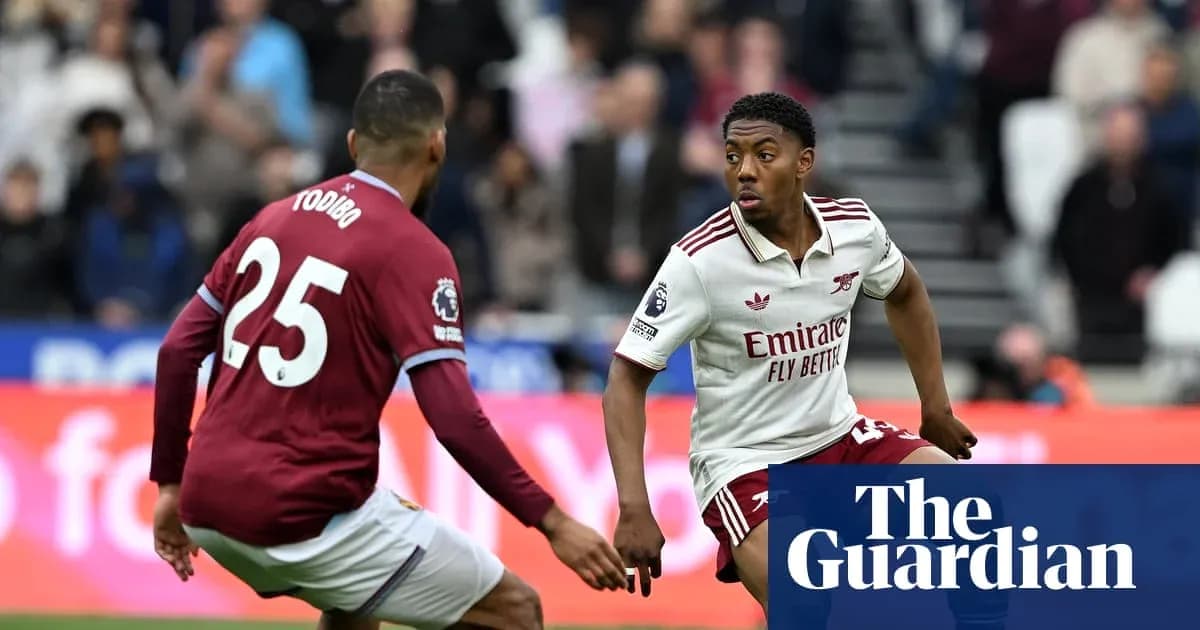
The noise inside the London Stadium had already turned feral when Chris Kavanagh put his hand to his ear. Ninety-fifth minute. Callum Wilson wheeling away. Arsenal’s title charge apparently pierced at the death.
Then the referee’s voice cut through the chaos.
Pablo had fouled David Raya. Goal disallowed. “Final decision, direct free-kick.”
For most of the football world, it was another VAR flashpoint. For Ian Wright, it was scripture.
Asked on Sky Sports whether those were the sweetest words he had ever heard, the Arsenal legend went straight for the grandest comparison he could find. “The sweetest words since Martin Luther King’s ‘I have a dream’,” he said, half-laughing, half-ecstatic, fully Wright.
Inside the away dressing room, Myles Lewis-Skelly felt it as something close to divine intervention.
“It was just God on our side,” he said. “We are so grateful.”
Arsenal walked out of east London with a 1-0 win that felt heavier than the scoreline. Heavier than the three points. With two games left – Burnley at home, Crystal Palace away – they stand five points clear of Manchester City, who still have a game in hand and a run-in of Palace at home, Bournemouth away, Aston Villa at home.
The margins at the top are brutal. The margins at the bottom are, too. West Ham sank deeper into trouble. Arsenal clung to their dream.
Relief, and something more
Lewis-Skelly tried to start with understatement.
“It is just a huge sense of relief,” he said.
But the words kept coming. “Joy, excitement, fulfilment – everything you can describe. We are buzzing, but we know that the job is not done. We have got two more finals left.”
That VAR delay – Kavanagh watching, rewatching, the stadium holding its breath – felt like an eternity to everyone. To a 19-year-old who has lived his own season of limbo, it struck a deeper chord.
An extraordinarily worrying situation, followed by everything coming good at the last. Faith, belief, resilience. It is not a bad summary of Lewis-Skelly’s year.
From prodigy to proving ground
Only a few months ago, Lewis-Skelly looked like a teenager in a hurry. Fifteen Premier League starts in his breakout spell. His first Arsenal goal in a 5-1 demolition of Manchester City, capped with that cheeky nod to Erling Haaland’s “Zen” celebration. No fear, no deference.
He stepped into senior football as if he had written the script himself. He scored 20 minutes into his England debut against Albania. He went to the Bernabéu in the Champions League quarter-final, ran the game, and left Real Madrid’s grandees in the posh seats asking the same question: “Who is this kid?”
Then the script flipped.
This season, the minutes dried up. His England place disappeared. The buzz around his name turned into something more hostile. The dreaded two words – “pure” and “profit” – began to swirl, the shorthand for a homegrown player who might be sacrificed on a balance sheet.
Mikel Arteta did not pretend otherwise. He admitted he had been hard on the youngster. Lewis-Skelly, suddenly, was no longer the story of the moment but a test case in how a prodigy copes when the spotlight moves on.
“It was tough for me initially,” Lewis-Skelly said. “But I pride myself on having mental strength. Sport is not one pathway because there are ups and downs. It’s how you bounce back from that, how you are in those moments when you face adversity. That is what defines you.”
He shut out the noise the only way he could.
“I spoke with my family and friends. I just told them: ‘I don’t want to hear all the noise that is coming from social media. Let me stay in this moment, let me continue to face this adversity and let me come out the other side of it.’”
The message to himself was simple: always be ready. “It is always being prepared, always feeling like I prepare as a starter because you never know when your time will come. Luckily enough, it came against Fulham. I took my opportunity and helped the team out as much as I can.”
The gut call that changed everything
For weeks, his opportunities had been scarce. When Arteta handed him a start against Bournemouth on 11 April – only his second league start of the campaign – it ended in a damaging defeat. Questions about his readiness hardened into doubts.
Then came Fulham, nine days ago, and a manager’s hunch.
Arteta went with a “gut feeling” and dropped Lewis-Skelly into midfield from the start. Not at left-back, where he had first broken into the side, but back in the role he had played throughout his academy years.
The effect was immediate. He drove through lines, snapped into duels, played with a clarity and courage that had gone missing from his season. Arsenal won 3-0. Something stirred.
“It feels so natural for me to be there,” he said of the midfield role. “I have been training there a lot so [against Fulham] I felt comfortable. The boss told me: ‘You are going to play midfield, so go for it.’ That is what I did. I had to be bold and play with courage because that is what this league demands.”
Arteta believed what he had seen. Lewis-Skelly kept his place for the Champions League semi-final second leg against Atlético Madrid, a tight, nervy 1-0 win that carried Arsenal into a showdown with Paris Saint-Germain. He kept it again at West Ham.
In a heartbeat, he had climbed above Martín Zubimendi in the midfield pecking order. The competition is unforgiving: Martin Ødegaard, the captain and creative heartbeat, came on after 67 minutes at West Ham and immediately lifted a flagging performance, with Lewis-Skelly shunted back to left-back to accommodate him.
No complaints. Just another role, another job, another test passed.
Title race now, talk later
The speculation over his future will return. It always does when a young player’s value soars and the accountants circle. For now, it can wait.
Lewis-Skelly has been close enough to the edge this season to know what matters and what does not.
“I am focused on the games we have got coming up,” he said. “And bringing this club back to glory.”
Two games left. A five-point lead. Manchester City looming in the rear-view mirror with that game in hand. A Champions League final on the horizon against PSG.
A teenager who spent months on the margins now stands in the thick of it, carrying the ball, the pressure and a portion of Arsenal’s hopes.
If this is what he produces under adversity, what happens if he finishes the season with a medal in his hands?