.svg&w=384&q=75 "naujapitch logo")
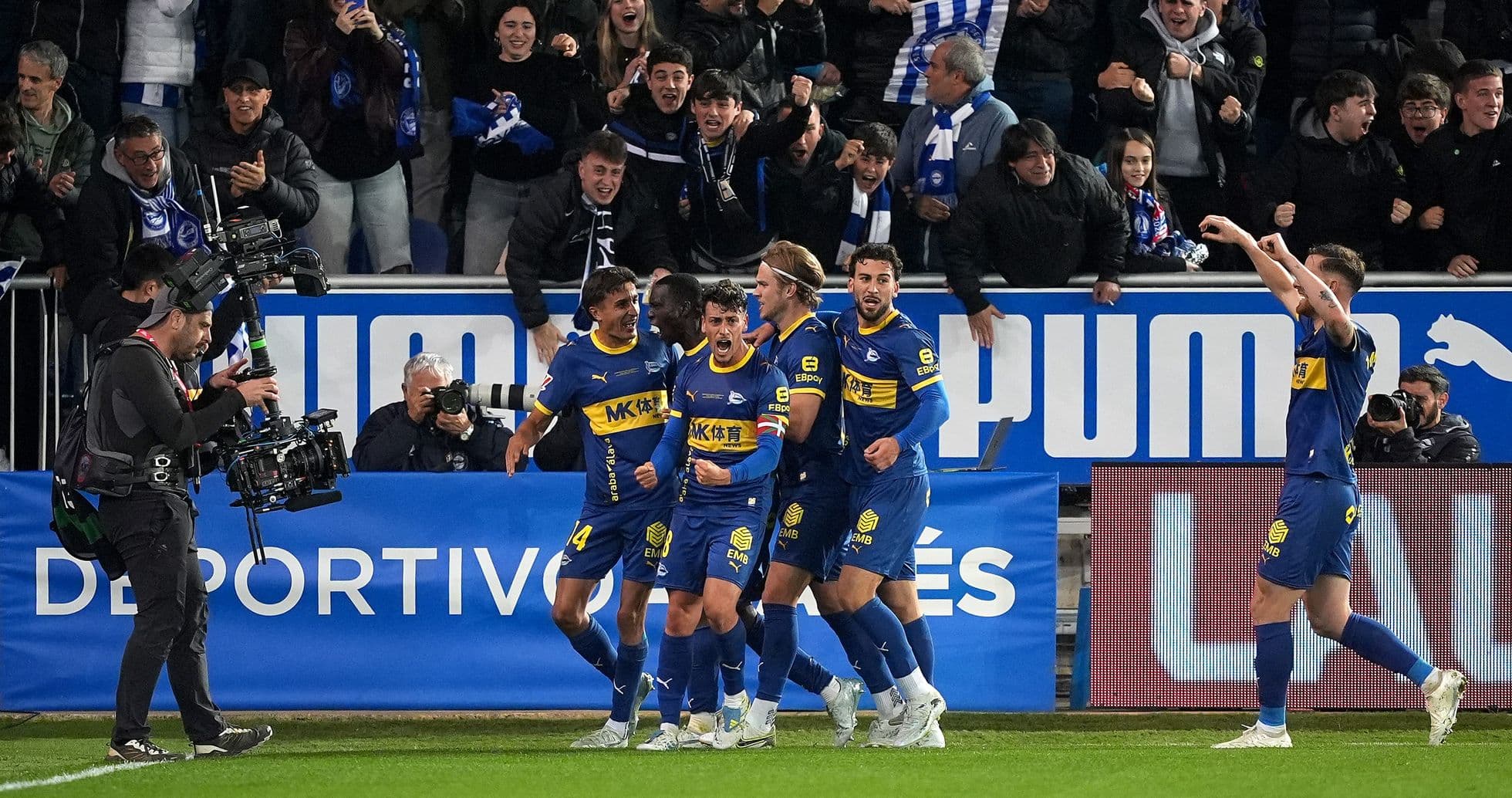
Alaves Upset Barcelona 1-0 in La Liga Match
Alaves’ 1-0 win over Barcelona at Estadio Mendizorrotza was a classic low-block upset built on defensive density, vertical efficiency and ruthless exploitation of a single transition. Despite having only 23% possession and completing 190 passes to Barcelona’s 676, Quique Sanchez Flores’ side controlled the zones that mattered and turned a 0.66 xG profile into the decisive first-half breakthrough that the visitors, held to 0.59 xG and zero shots on target, never solved.
Executive Summary
La Liga’s Regular Season - 36 fixture pitted a 5-3-2 Alaves against Hansi Flick’s 4-2-3-1 Barcelona. The match finished 1-0 to Alaves, who led 1-0 at half-time and protected that edge through a disciplined, compact block and aggressive but controlled defending. Barcelona monopolised the ball (77% possession), circulated it with 89% passing accuracy and pushed numbers into the final third, yet their sterile domination crashed against an Alaves structure that consistently protected the box, denied central combinations and forced low-quality efforts from distance or crowded half-spaces.
Scoring Sequence & Disciplinary Log
The game’s only goal arrived on the stroke of half-time. At 45', I. Diabate (Alaves) finished a “Normal Goal”, assisted by A. Blanco, capitalising on one of the few moments when Alaves could break Barcelona’s rest defence. That action defined the match: a direct, vertical incision from a deep defensive posture, punishing Barcelona’s high line and their difficulty in controlling second balls around the pivot zone.
Discipline followed the events array strictly and remained manageable but telling. The cards were:
- 46' Marcus Rashford (Barcelona) — Foul
- 81' Abderrahman Rebbach (Alaves) — Persistent fouling
- 89' João Cancelo (Barcelona) — Foul
Totals: Alaves 1 yellow, Barcelona 2 yellows, overall 3 cards. The timing matters tactically: Rashford’s early-second-half booking constrained his ability to counter-press aggressively on the left side; Rebbach’s card reflected the cumulative strain of repeated duels as Alaves’ left wing-back; Cancelo’s late caution illustrated Barcelona’s growing frustration as they chased an equaliser without breaking the block.
Tactical Breakdown & Personnel
Alaves set up in a 5-3-2 with A. Sivera in goal behind a back five of A. Rebbach, V. Parada, V. Koski, N. Tenaglia and A. Perez, with J. Guridi, A. Blanco and D. Suarez as a narrow midfield three and T. Martinez partnering I. Diabate up front. The structure was clear: protect the central lane with three midfielders screening, keep the back five horizontally tight, and allow wing-backs to step out only when cover was guaranteed.
The defensive plan revolved around three principles:
- Box protection and shot suppression
- Barcelona finished with 8 total shots, only 4 inside the box and crucially 0 on goal.
- Alaves’ 3 blocked shots show how the back five collapsed aggressively onto shooting lanes, often with the nearest centre-back stepping out while the other two squeezed compactly.
- Sivera officially recorded 0 goalkeeper saves, underlining how effectively the defensive unit prevented clear attempts rather than relying on last-line heroics. His 0.12 goals prevented reflects a couple of marginal situations but not major interventions.
- Vertical release and selective pressing
- With only 190 total passes and 59% accuracy (112 accurate), Alaves did not aim to build from the back. Instead, they used long diagonals and direct passes from the back line and midfield toward Diabate and T. Martinez.
- The 7 shots inside the box from just 9 total attempts show that when Alaves attacked, they did so with purpose: running in behind, crossing early or attacking second balls after clearances.
- The goal sequence at 45' encapsulated this: a quick progression, with A. Blanco finding Diabate in a central channel before Barcelona’s rest defence could reset.
- Rotational fouling and midfield screening
- Alaves committed 14 fouls to Barcelona’s 8, a deliberate trade-off to break rhythm.
- Rebbach’s yellow for “Persistent fouling” at 81' reflects his role in repeatedly stepping out to disrupt Barcelona’s right-sided combinations, especially as João Cancelo entered and pushed high from full-back.
- The three-man midfield shifted laterally in unison, with Blanco and Guridi often forming a double screen in front of the central centre-back, while D. Suarez tilted to whichever side Barcelona overloaded.
Barcelona’s 4-2-3-1 with W. Szczesny in goal, a back four of A. Balde, A. Cortes, P. Cubarsi and J. Kounde, a double pivot of M. Casado and M. Bernal, and an attacking line of R. Bardghji, D. Olmo, M. Rashford behind R. Lewandowski, was built for ball dominance and positional play. They achieved the structural possession targets:
- 676 total passes, 605 accurate (89%)
- 77% ball possession
- 4 corner kicks, 8 total shots
However, the positional structure did not translate into penetration:
- The double pivot circulated in front of Alaves’ block rather than breaking lines.
- Wide players, especially Rashford, were often forced to receive to feet with their back to goal, leading to duels and, in Rashford’s case, the 46' yellow for “Foul” as he tried to recover after turnovers.
- Lewandowski was isolated, with few cut-backs or low crosses arriving between the posts; Alaves’ three centre-backs simply defended the box rather than being dragged into wide areas.
Szczesny’s 3 goalkeeper saves and 0.12 goals prevented underline that Alaves’ threat, while limited in volume, produced a small number of genuine chances beyond the goal itself. Barcelona’s high line occasionally left space for Martinez and Diabate, forcing Szczesny to remain alert in transitional phases.
Substitutions followed a clear tactical logic. Flick’s triple change at 62' — Ferran Torres (IN) came on for R. Bardghji (OUT), Pedri (IN) came on for M. Casado (OUT), X. Espart (IN) came on for P. Cubarsi (OUT) — aimed to add creativity between lines and more direct threat in the half-spaces. Later, at 79', João Cancelo (IN) came on for A. Balde (OUT), pushing a more aggressive, inverted full-back into the final third. Finally, at 87', T. Marques (IN) came on for M. Bernal (OUT), adding another attacking profile in midfield. Yet the structural problem remained: Alaves’ central congestion and box defence were never disorganised enough to yield clear shots.
Alaves’ changes were about energy and preserving compactness: at 64', A. Manas (IN) came on for I. Diabate (OUT) and P. Ibanez (IN) came on for D. Suarez (OUT), refreshing legs in both the front line and midfield. At 80', C. Protesoni (IN) came on for V. Parada (OUT), maintaining the integrity of the back five as fatigue set in.
The Statistical Verdict
The underlying numbers confirm that this was not a smash-and-grab but a structurally coherent defensive performance. Alaves’ 0.66 xG from 9 shots, with 3 on target and 7 inside the box, reflects a low-volume but relatively high-quality shot profile whenever they did attack. Barcelona’s 0.59 xG from 8 shots, none on target, underscores how thoroughly they were kept at arm’s length.
Defensively, Alaves’ overall form on the night was characterised by discipline and collective effort, while their defensive index — inferred from 0 shots on target conceded, 3 blocks and 0.12 goals prevented by Sivera — points to a unit that functioned as more than the sum of its parts. Barcelona’s superior passing metrics and possession did not translate into threat, illustrating a recurring tactical theme: dominance of the ball without corresponding penetration against a well-drilled low block.
Card totals remain exact: Alaves 1 yellow, Barcelona 2 yellows, total 3. The final 1-0 scoreline at Estadio Mendizorrotza therefore accurately reflects a match in which Alaves executed their defensive and transitional game plan with precision, while Barcelona’s positional play lacked the verticality and box occupation needed to break them down.